Pakistan telecom authority proposes framework to tighten control on social media, digital platforms

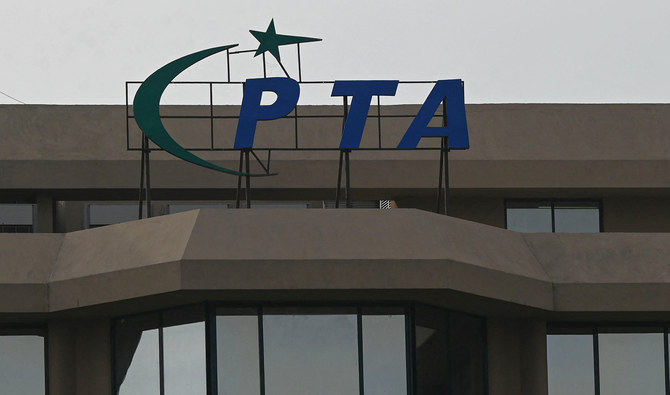
The logo of the Pakistan Telecommunication Authority is pictured on the building facade at its headquarters in Islamabad on June 24, 2023. (AFP/File)
Short Url
Updated 06 July 2024
Follow

Pakistan telecom authority proposes framework to tighten control on social media, digital platforms

  • PTA wants the OTT services to seek a 15-year authorization to maintain legal operations in the country
  • It also wants them not to store the personal data of local consumers beyond Pakistan’s territory

ISLAMABAD: The Pakistan Telecommunication Authority (PTA) has developed a regulatory framework for over-the-top (OTT) services, including social media, digital streaming platforms and popular messaging apps, with the aim to exert greater control after eliciting feedback from stakeholders and finalizing it.
The PTA has posted a 14-page document containing all the provisions along with a list of questions for feedback.
The framework specifies three different kinds of OTT services, dealing with communication (such as Skype, WhatsApp and Facebook Messengers), application (like LinkedIn and X) and media (including YouTube, Netflix and Spotify).
It mentions the OTT authorization that these services will have to obtain from the PTA to maintain legal operations in the country.
“This OTT Authorization shall be valid for a period of fifteen (15) years,” it says. “The Licensed OTT Service Provider shall be required to enter into agreement with the TSPs [telecom service providers] licensees.”
It also mentions data localization, saying these services will not be able to store the personal data of local consumers beyond the country’s geographical territories without the PTA’s approval.
Additionally, it highlights the responsibility for the blocking of unlawful online content in accordance with “Section 37 of the Prevention of Electronic Crimes Act, 2016 and/or as determined by the Authority from time to time.”
The PTA has taken actions against platforms like TikTok, YouTube and Facebook in the past, citing reasons related to immoral, indecent and blasphemous content and even blocking these services.
This has also been criticized by free speech activists in the country that described such official decisions as a form of censorship and to stifle free expression and open access to information.
The final deadline for stakeholders to share their feedback with the telecom authority in July 10.


Pakistan sells 480MHz for $507 million in 5G spectrum auction

Updated 10 March 2026
Follow

Pakistan sells 480MHz for $507 million in 5G spectrum auction

  • Mobile network operator Jazz buys 190 MHz, Ufone 180MHz and Zong 110MHz, says telecom authority chairman
  • Most mobile networks in Pakistan currently operate on fourth-generation (4G) infrastructure, while 5G rollout has faced delays

ISLAMABAD: Pakistan has sold 480 megahertz (MHz) of fifth-generation (5G) telecom spectrum for $507 million, the Pakistan Telecommunication Authority (PTA) confirmed after a live auction on Tuesday, marking a key step toward introducing faster mobile broadband.

The live auction was organized by the PTA to determine which telecom operators would acquire the frequencies needed to deploy 5G mobile networks across Pakistan.

Pakistan, a country of over 240 million people, is one of the world’s largest telecom markets by population, with over 190 million mobile phone users. However, most networks currently operate on fourth-generation (4G) infrastructure, and the rollout of 5G has faced delays in recent years due to regulatory, economic and spectrum-allocation challenges.

“In total out of 595 MHz, 480 MHz spectrum has been sold today,” PTA Chairman Hafeez-ur-Rehman said in a speech aired on state media. “This is a very big achievement and a big victory for Pakistan, in my opinion.”

Chinese mobile operator Zong ‌bought 110 MHz of the 5G spectrum, while Ufone bought ⁠180 ⁠MHz and Veon-backed firm Jazz bought 190 MHz, Rehman announced.

“And the price in total for this is $507 million,” the PTA chairman said. 

According to officials, 5G services are expected to be rolled out first in Islamabad, Lahore, Karachi, Peshawar and Quetta cities, before expanding nationwide as network infrastructure develops.

Information Technology Minister Shaza Fatima Khawaja has previously said the government is also encouraging wider adoption of 5G-compatible devices, noting that about 95 percent of mobile phones used in

Pakistan are locally manufactured, while premium models such as iPhones and Google Pixel devices are imported.

Officials say Pakistan currently uses around 274 megahertz of spectrum, much of it allocated decades ago, while the new auction will make 600 megahertz of spectrum available for next-generation services.

Under the government’s rollout plan, telecom operators are expected to add roughly 3,000 new network sites annually to support the expansion of 5G services.

PTA officials say Pakistan currently offers some of the world’s cheapest mobile data services and have pledged that consumer protection will remain a priority as the country moves toward next-generation connectivity.