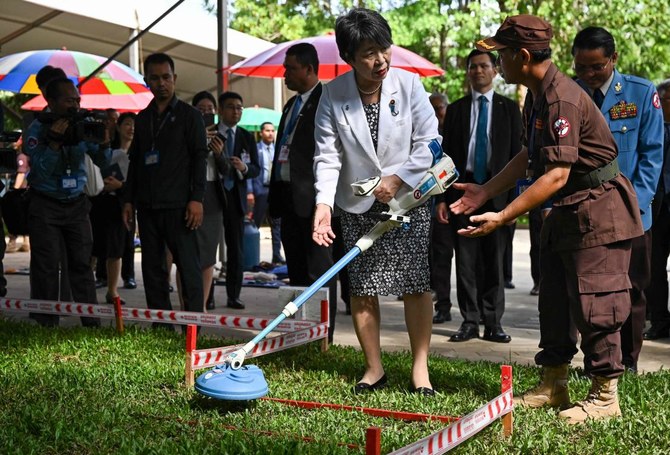
PHNOM PENH: Japan will work with Cambodia to remove land mines from Ukraine and other war-torn countries, Foreign Minister Yoko Kamikawa said during a visit to Phnom Penh on Saturday.
Millions of land mines were laid in Cambodia during the nearly three decades of conflict that ended in 1998, with tens of thousands of people killed or maimed over the years.
The Southeast Asian country is widely regarded as a world leader in land mine countermeasures and has been working with Japan to clear the weapons since 1998.
“Cambodia is an essential partner in Japan’s global land mine removal efforts,” Kamikawa said at a press conference.
“I am confident Cambodia will contribute greatly to raising awareness of the inhumanity of anti-personnel land mines as a country that suffered from them.”
The minister said Japan would provide Ukraine with a large demining machine next week, and in August would train Ukrainian agencies in Cambodia on how to use the equipment.
Heng Ratana, director general of the Cambodian Mine Action Center (CMAC), told reporters his organization and local deminers were “proud of this important initiative and strongly support the new strategy of the cooperation.”
“We are glad to take part in sharing experiences with countries that have problems with land mines and remnants of war in accordance with the policy of the (Cambodian) government,” he added.
Deaths caused by land mines occur frequently among civilians and soldiers in Ukraine, which has been littered with mines and explosive remnants since it was invaded by Russia in 2022.
According to Human Rights Watch, land mines have been documented in 11 of Ukraine’s 27 regions.
Russian forces are known to have used at least 13 types of anti-personnel mines since February 2022, the organization said.
Cambodia, meanwhile, is still littered with discarded ammunition and arms from decades of war starting in the 1960s.
Deaths from mines and unexploded ordnance are common, with around 20,000 fatalities since 1979, and twice that number injured.
In August last year, thousands of pieces of unexploded ordnance left over from the war were unearthed inside a school in the country’s northeast.
In 2018, an Australian and a Cambodian were killed when war-era ordnance exploded during a demining training exercise in southern Cambodia.
The government has vowed to clear all mines and unexploded ordnance by 2025.


![]()

Japan, Cambodia to help remove land mines from Ukraine
Short Url
https://arab.news/5m55m
Japan, Cambodia to help remove land mines from Ukraine
- The minister said Japan would provide Ukraine with a large demining machine next week
- Deaths caused by land mines occur frequently among civilians and soldiers in Ukraine


Latest updates


Recommended


© 2026 SAUDI RESEARCH & PUBLISHING COMPANY, All Rights Reserved And subject to Terms of Use Agreement.