

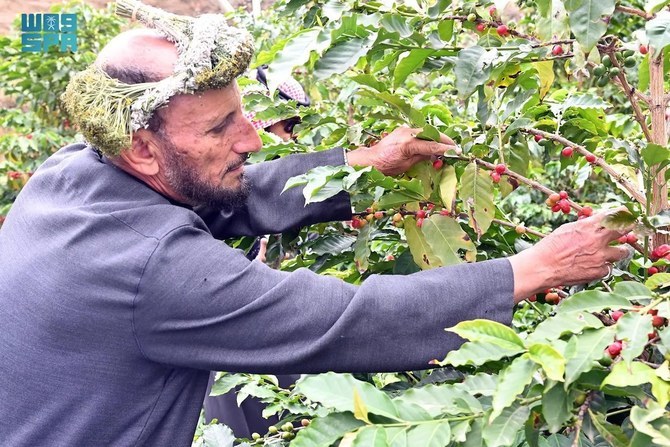

RIYADH: Coffee production in southwest Saudi Arabia had a boost on Thursday when the National Center for the Prevention and Control of Plant Pests and Animal Diseases, “Weqa,” and relevant authorities participated in a workshop to increase the number of trees in the Jazan region.
Dr. Muhammad bin Abdullah Al-Khuraiji, head of the plant health sector at Weqa, explained that the center is working on preventive and remedial measures to ensure the health and sustainability of plants and animals and to enhance the participation of the private sector.
He pointed out the importance of government and private agencies uniting to integrate the efforts of concerned parties and develop sustainable coffee cultivation in the region.
The workshop reviewed the projects and initiatives of the Saudi Ministry of Environment, Water and Agriculture in strengthening the coffee sector in Jazan and introduced the role of the Weqa Center in achieving this, in addition to reviewing what was done in the previous meeting to unify efforts to produce coffee.
The review highlighted the efforts of the countryside in the sector, as well as the role of the Mountain Regions Development and Reconstruction Authority in supporting and developing the agriculture sector in general and coffee production in particular, and learning about the contributions of organic agriculture management.
In February this year, the Jazan Development Strategic Office organized the first International Saudi Coffee Exhibition in Jazan to provide farming expertise and introduce best practices, support initiatives to encourage coffee cultivation in the region, and contribute to transforming Jazan into a global trade center.
At the opening ceremony, Saudi Deputy Minister of Environment, Water and Agriculture Mansour Al-Mushaiti said that the Kingdom’s coffee industry has undergone a qualitative shift over the past decade, growing from local to a global scale.
Jazan, one of the Kingdom’s most important agricultural regions, is known as the Kingdom’s fruit basket, but also for its coffee, a product of the region and a vital part of its heritage.
The governorates of Al-Dayer, Fifa, Al-Raith, Al-Ardah and Al-Aidabi are home to many coffee farms.
According to the Ministry of Environment, Water and Agriculture, there are more than 2,000 coffee farms in the region, yielding more than 1,000 tons of coffee every year.


