Three killed, five injured in roadside blast in northwest Pakistan

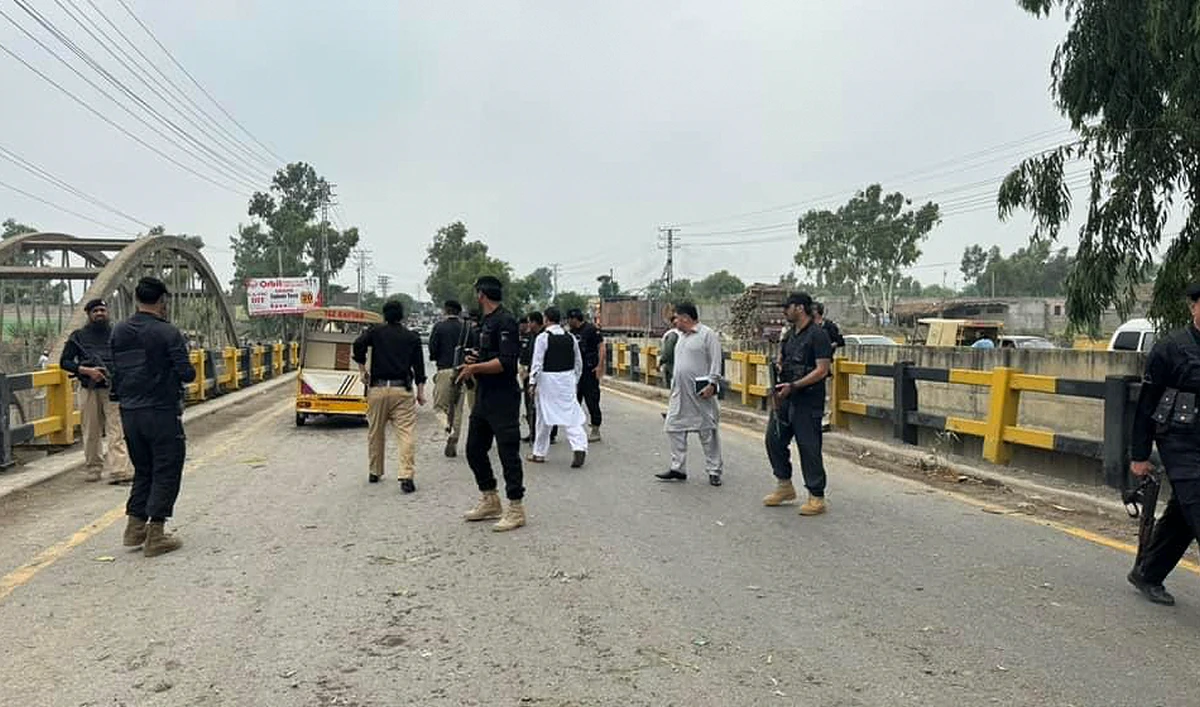
Security personnel examine the site of a blast in Mardan district of the Khyber Pakhtunkhwa province on July 5, 2024. (Photo courtesy: X/@zarrar_11PK)
Short Url
Updated 05 July 2024
Follow

Three killed, five injured in roadside blast in northwest Pakistan

  • The improvised explosive device targeted an auto-rickshaw in the Mardan district
  • No group claimed responsibility, but suspicion is likely to fall on Pakistani Taliban

PESHAWAR: Three people were killed and five others were injured in a remote-controlled roadside blast in Pakistan’s northwestern Khyber Pakhtunkhwa (KP) province on Friday, police said.
The improvised explosive device (IED) targeted an auto-rickshaw in KP’s Mardan district, according to police and rescue officials.
No group immediately claimed responsibility for the attack, but suspicion is likely to fall on the Tehreek-e-Taliban Pakistan (TTP), which has claimed dozens of attacks in the region.
“The IED targeted a Tez Raftar rickshaw near Jalala Bridge in Takht Bhai tehsil of Mardan district,” District Police Officer Zahoor Afridi told Arab News. “Three persons died and five others were injured due to the blast.”
Bilal Faizi, a spokesperson for the Rescue 1122 service, said the injured persons were rushed to Tehsil Headquarters Hospital Takht Bhai and Mardan Medical Complex. “One person succumbed to injuries during treatment,” he added.
Pakistan has witnessed a renewed surge in militant violence in its two western provinces, KP and Balochistan, since the TTP called off its fragile truce with the government in November 2022.
Earlier this month, a policeman and a paramilitary soldier were killed after militants attacked a check-post in KP’s Khyber district. In June, seven Pakistani soldiers, including an army captain, were killed in a roadside blast in the Lakki Marwat district of the province.
Islamabad has blamed the surge in violence on militants operating out of neighboring Afghanistan. Kabul denies the allegation and says rising violence in Pakistan is a domestic issue of Islamabad.


Pakistan signals commitment to regulate digital assets in meeting with Binance leadership

Updated 6 sec ago
Follow

Pakistan signals commitment to regulate digital assets in meeting with Binance leadership

  • Binance delegation led by CEO Richard Teng meets Pakistan’s prime minister, army chief in Islamabad
  • Pakistan has attempted to tap into growing crypto market to curb illicit transactions, improve oversight

ISLAMABAD: Pakistan’s government has signaled its “strong commitment” to digital asset regulation as the country’s senior officials met the leadership of Binance, one of the world’s most prominent global cryptocurrency exchanges, the Prime Minister’s Office (PMO) said on Saturday. 

The Binance team, led by its Chief Executive Officer Richard Teng, is in Pakistan and has held meetings with Finance Minister Muhammad Aurangzeb, Pakistan Virtual Assets Regulatory Authority (PVARA) Chairman Bilal bin Saqib and senior Pakistani bank officials this week. 

Pakistan has been attempting to regulate its fast-growing crypto and digital assets market by bringing virtual asset service providers (VASPs) under a formal licensing regime. Officials say the push is aimed at curbing illicit transactions, improving oversight and encouraging innovation in blockchain-based financial services.

“Binance senior leadership visits Pakistan as government signals strong commitment to digital asset regulation,” the PMO said. 

A Binance delegation led by Teng met Chief of Army Staff and Chief of Defense Forces Field Marshal Syed Asim Munir in Islamabad. 

Saqib also attended the meeting and gave the Binance team a briefing about his organization.

Pakistan has attempted in recent months to tap into the country’s growing crypto market, a move analysts say could bring an estimated $25 billion in virtual assets into the tax net.

In September, Islamabad invited international crypto exchanges and other VASPs to apply for licenses to operate in the country, a step aimed at formalizing and regulating its fast-growing digital market.