

‘Black sheep’ embarrass French far right before vote

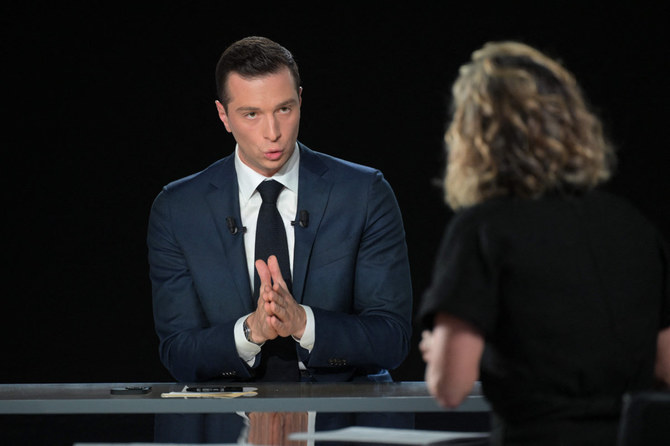
French far-right Rassemblement National (RN) political party President and lead MEP Jordan Bardella (L) answers to French journalist Caroline Roux during the TV show "L'Evenement" broadcasted on French TV channel France 2 in Paris on July 4, 2024, ahead of the second round of the legislative elections. (POOL/AFP)
Short Url
Updated 05 July 2024
Follow

‘Black sheep’ embarrass French far right before vote

PARIS: Efforts by France’s far right to cultivate an image of respectability before legislative elections have been hurt by a number of racist and other extremist incidents involving its candidates.
National Rally (RN) heavyweights Marine Le Pen and Jordan Bardella rushed to take a stance against what they both called “black sheep” in the party to limit the damage.
The RN is projected to emerge as the biggest party in the National Assembly, with Bardella tipped as France’s next prime minister if it wins an absolute majority, or gets close enough.
But some RN candidates in Sunday’s second round of voting have fueled suspicions that xenophobic, racist and anti-Semitic attitudes in the party are perhaps not just a thing of the past.
On Wednesday, Bardella was confronted on live television with a sound recording of RN deputy Daniel Grenon saying that anybody of French-North African double nationality “has no place in high office.”
Bardella quickly condemned the remark, calling it “abject,” and announced the creation of a “conflict committee” within the party to deal with such cases.
“Anybody who says things that are not in line with my convictions will be excluded,” he said.
Earlier Laurent Gnaedig, a parliamentary candidate for the RN, caused uproar by saying that remarks by discredited party founder Jean-Marie Le Pen, who called Nazi gas chambers “a detail of history,” were not actually anti-Semitic.
Gnaedig later presented his “sincere apologies” and said he had never meant to question the reality of “the horror of the Holocaust.” He would accept any decision by the party’s conflict commission, he added.
In November, Bardella himself got into hot water on the same topic when he said he did “not believe that Jean-Marie Le Pen was an anti-Semite.” He later walked back the remark, saying Le Pen “obviously withdrew into a kind of anti-Semitism.”

Another candidate, Ludivine Daoudi, dropped out of the race for France’s parliament on Tuesday after a photo of her allegedly wearing a cap from Nazi Germany’s air force, the Luftwaffe, sparked furor online.
And Brittany region candidate Francoise Billaud deleted her Facebook account after she was found to have shared a picture of the grave of French Vichy collaborationist leader Philippe Petain with the caption “Marshal of France.”
RN deputy Roger Chudeau meanwhile got into trouble with the party leadership for saying that the 2014 appointment of Moroccan-born Najat Vallaud-Belkacem as the Socialist government’s education minister had been “an error.”
Marine Le Pen has over the past years moved to make the party a mainstream force and distance it from the legacy of Jean Marie Le Pen, her father and its co-founder, in a process widely dubbed “dediabolization” (un-demonization).
“What really matters is how a political party reacts,” she has said, adding that the party commission’s would be “harsh” in dealing with such cases of extremism.
She added there was a distinction to be made between “inadmissible” statements for which sanctions were “highly likely,” and cases of mere “clumsiness.”
The latter category, she said, included an attempt by candidate Paule Veyre de Soras to defend her party against racism charges by saying that “I have a Jewish ophthalmologist and a Muslim dentist.”
Le Pen said most candidates “are decent people who are in the running because the National Assembly needs to reflect France and not reflect Sciences Po or ENA,” two elite universities.
The RN has acknowledged that President Emmanuel Macron’s decision to call a snap election left little time to select candidates in the numbers needed to fill the seats it expects to win.
The far right has also noted that other parties have similar problems, citing the case of hard-left National Assembly candidate Raphael Arnault, who was found to be on a French police anti-extremist watchlist.
Arnault was suspected of terrorist sympathies and questioned after tweeting on October 7 that “the Palestinian resistance has launched an unprecedented attack on the colonialist state of Israel.”
A recent poll by Harris Interactive projected the RN and its allies would win 190 to 220 seats in the National Assembly, the leftist coalition NFP 159 to 183 seats and Macron’s Ensemble (Together) alliance 110 to 135.


Hungry, wounded, orphaned: South Sudan’s children trapped in new conflict

Updated 6 sec ago
Follow

Hungry, wounded, orphaned: South Sudan’s children trapped in new conflict

  • The hospital in Akobo has only one surgeon, now overwhelmed
  • More than 40 young men were being treated for gunshot wounds during AFP’s visit

AKOBO, South Sudan: An 18-month-old boy lies motionless on a dirty hospital bed deep in the conflict zone of South Sudan, a bullet wound in his leg — another newly orphaned victim in the world’s newest country.
“When they arrived, they started shooting everyone in the area — elder, child, and mother,” Nyayual, his grandmother, told AFP at the hospital in the opposition-held town of Akobo, eastern Jonglei State.
The bullet that hit the little boy also killed his mother — Nyayual’s daughter. AFP is using only her first name for fear of reprisals.
She says it was government forces that attacked their village.
“We ran away... they were still shooting at us,” she said. “This failed government has no way to resolve things.”
South Sudan gained independence in 2011 but soon descended into civil war between two rival generals, Salva Kiir and Riek Machar.
A 2018 power-sharing deal brought relative peace, with Kiir as president and Machar his deputy, but the agreement has unraveled over the past year.
Fighting in Jonglei state between the army under Kiir and forces loyal to Machar has displaced some 280,000 people since December, according to the United Nations.
The hospital in Akobo — a ramshackle collection of buildings, most without doors or windows — has only one surgeon, now overwhelmed. More than 40 young men were being treated for gunshot wounds during AFP’s visit.
In one ward, an elderly woman lay, her face turned away from the family around her. She was shot by soldiers in both legs, they said. They carried her for days before finding a car that agreed to bring them to the hospital.
The military declined to comment to AFP on the claims. The Jonglei state government’s information minister, Nyamar Lony Thichot Ngundeng, said she did not have information about the incidents.
However, she added: “If you get injured during the crossfire, that is counted as a crossfire, it is not intentional.”

- ‘Disaster’ -

UNICEF says more than half the displaced are children, some fleeing for the second or third time. Around 825,000 are at risk of acute malnutrition across three of South Sudan’s states: Jonglei, Unity and Eastern Equatoria.
Akeer Amou, 33, fled Jonglei for an informal camp on the banks of the White Nile, where she gave birth to her fifth child.
Not on any maps, the place is known only as Yolakot, meaning riverside, but hundreds of women and children now live under the shade of its trees, waiting for help. AFP saw at least three other newborns among them.
Amou named her child Riak, meaning “disaster.”
She does not know why the conflict is happening, but she knows her son will bear the brunt.
“Breast milk can come if there is something to eat, but now there is nothing,” she said, gently rocking Riak under the scant protection of a cotton sheet.
The mothers spend the days foraging for fruit, nuts, and water lily seeds, while children splash in the river’s murky waters.
Most are desperately hungry. A local official told AFP there were roughly 6,700 people waiting for food, but there was no sign of any aid.

- Out of supplies -

In Jonglei’s state capital Bor, doctors try to serve the massive influx of displaced people with rapidly dwindling supplies.
David Tor, acting director of the town’s hospital, introduced AFP to a mother who had been forced to deliver in nearby swamp land. He had managed to reduce the newborn’s fever, a rare bit of good news.
The mother fled Fangak, a town to the north, where last May the only health care facility for more than 100,000 people — run by international NGO Doctors Without Borders (MSF) — was attacked by helicopter gunships and drones, which completely destroyed its pharmacy and all its medical supplies.
“Because of the increase in the number of people who need services, we have run out of almost everything,” said Tor. “At a certain point we may lose patients.”
Jonglei information minister Ngundeng told AFP the hospital would receive supplies.
“I would say it’s enough until the hospital or the ministry of health says otherwise,” she said.

- Trapped -

South Sudan is ranked the most corrupt country in the world by monitoring group Transparency International.
Billions in oil revenue have been stolen by the elite, according to the UN, and the country relies on international donors for 80-90 percent of its health care needs.
Fresh conflict is creating another generation of children with few prospects for a better life. The World Bank estimates 70 percent are not in school.
In the displacement camp in Lake State, south of Bor, where some 35,000 people have recently arrived, mothers queued to sign up their children for an emergency education and psycho-social program run by the Norwegian Refugee Council. It has already registered 2,000 children.
Some of those in the queue may never escape this life.
Nyanhiar Malneth, 28, grew up in an earlier conflict in the country. Her schooling ended when she was eight and she has spent years in displacement camps with her five children.
“I want them to go to school for knowledge,” she said.
But first there are more urgent concerns: “We need something to eat.”
