

Pakistan’s disaster management authority forecasts ‘significant’ rainfall, flash floods across country till July 9

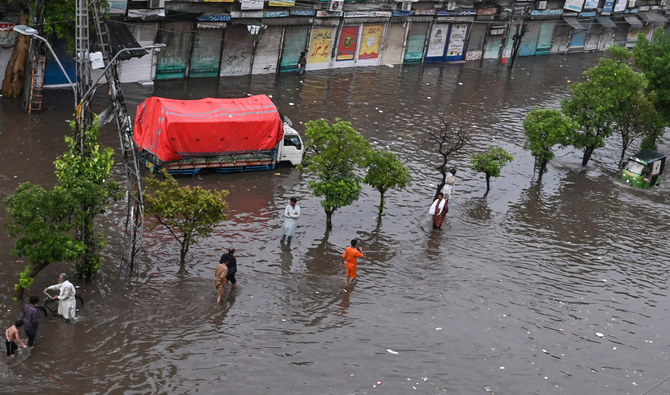
Commuters make their way through a flooded street after a heavy rainfall near row of shops in Lahore on July 1, 2024. (AFP/File)
Short Url
Updated 04 July 2024
Follow

Pakistan’s disaster management authority forecasts ‘significant’ rainfall, flash floods across country till July 9

  • Heavy rains may cause flash floods across northern Punjab, Khyber Pakhtunkhwa and Azad Kashmir, warns disaster management authority 
  • Advises authorities and masses to take necessary precautions to mitigate potential impacts of floods and landslides across Pakistan 

ISLAMABAD: Pakistan’s National Disaster Management Authority (NDMA) on Thursday forecast “significant rainfall” in many regions of the country till July 9, warning the downpours could cause flash floods. 

Last week, the NDMA warned of heavy rains in Pakistan’s Sindh and Punjab provinces, saying they could face an “emergency” situation. Pakistan is recognized as one of the most vulnerable countries to climate change effects in the world. Unusually heavy rains in June 2022 triggered flash floods in many parts of the country, killing over 1,700 people, inflicting losses of around $30 billion, and affecting at least 30 million people.

Prime Minister Shehbaz Sharif formed a high-level committee to tackle any potential emergencies brought about by the monsoon floods. 

“NDMA’s National Emergencies Operation Center (NEOC) anticipated significant rainfall across various regions of Pakistan until 9th July, 2024,” the disaster management authority said. It added that the heavy rainfall may cause urban flooding and rapid rises in water levels in nullahs and trigger flash floods across northern Punjab (Sialkot), KP and Azad Kashmir. 

“Additionally, this precipitation is expected to result in high discharge levels within the eastern rivers,” the NDMA said. “Sutlej River is expected to experience a low flood stage with approximately 50,000 cusecs of water while Kabul River is predicted to reach a medium flood level with approximately 95,000 cusecs.”

The NDMA said extreme rainfall may also trigger additional releases from Indian reservoirs such as Salal, Bhakra, and Pong Dam, which could directly impact the Chenab and Sutlej rivers in Pakistan.

The NEOC predicted moderate to heavy rainfall in GB until July 8, 2024, warning it could trigger flash floods in local nullahs putting areas such as Chigar and Khaplu. 

“Slightly heavy rainfall is expected in Gilgit-Baltistan, KPK, northern parts of Balochistan, and AJK until July 8, 2024,” the NDMA said. “The persistent heavy to moderate rains may cause localized landslides at Karakoram Highway along Hunza and some of the areas of District Nagar, Gilgit, Diamir, Kohistan, Battagram, Mansehra, and Abbottabad, potentially disrupting traffic flows and cutting off far-flung areas from main roads.”

The disaster management authority warned authorities and masses to take all necessary precautions to mitigate the impact of the floods and landslides. It said emergency response teams had been alerted and resources are being mobilized to ensure a “swift response” to any arising situations. 

“Tourists are advised to avoid traveling to these areas during the forecasted period,” the NDMA said. 


Pakistan PM calls for faster CPEC implementation, pledges security for Chinese workers

Updated 27 February 2026
Follow

Pakistan PM calls for faster CPEC implementation, pledges security for Chinese workers

  • Shehbaz Sharif pushes expanded cooperation in agriculture, IT and mining under CPEC phase two
  • Chinese envoy reaffirms Beijing’s support for Pakistan’s sovereignty and economic development

ISLAMABAD: Prime Minister Shehbaz Sharif on Friday called for speeding up projects under the China-Pakistan Economic Corridor (CPEC) and pledged stronger security guarantees for Chinese workers and investments, during a meeting with China’s ambassador in Islamabad.

Sharif made the remarks as the two countries strive to launch the second phase of CPEC, a multibillion-dollar infrastructure and energy initiative launched in 2015 as part of China’s Belt and Road Initiative (BRI).

CPEC’s first phase focused largely on power generation and transport infrastructure aimed at easing Pakistan’s chronic energy shortages and improving connectivity. The second phase seeks to expand cooperation into industrial development, with an emphasis on special economic zones and export-oriented growth.

“While highlighting the importance of accelerating ongoing CPEC projects, the Prime Minister stressed on the need to enhance cooperation in agriculture and IT and mining & minerals,” said a statement circulated by the PM Office after the meeting.

“He also underscored Pakistan’s resolve to provide a secure and conducive environment for Chinese personnel, investments, and institutions in Pakistan,” it added.

Chinese nationals and projects in Pakistan have faced security threats in the past, including attacks by militant groups targeting infrastructure sites and convoys. Islamabad has repeatedly vowed to tighten security and has deployed special protection units for Chinese workers.

China is Pakistan’s closest ally in the region and a key economic partner, with CPEC widely regarded by Islamabad as central to long-term economic growth.

During the meeting, the prime minister conveyed greetings to Chinese President Xi Jinping and Premier Li Qiang, particularly on the occasion of the Chinese New Year.

China’s Ambassador to Pakistan, Jiang Zaidong, reiterated Beijing’s support for Pakistan’s sovereignty and socioeconomic development, according to the statement. Both sides also exchanged views on regional and international issues and agreed to maintain close coordination.