

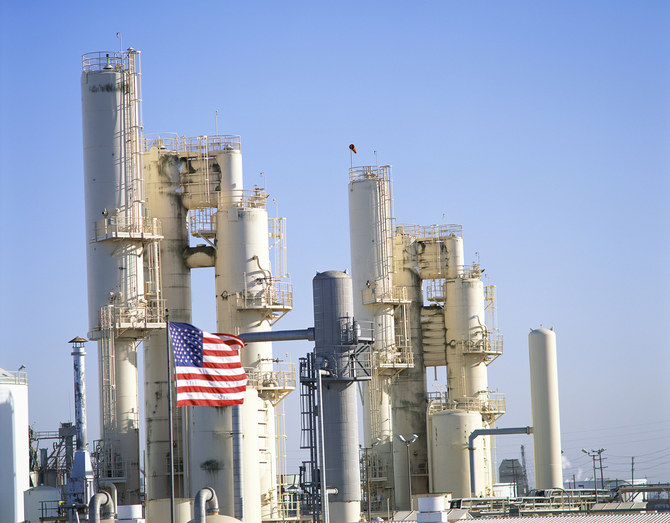
Oil Updates — crude drops on worries about demand, slowing US economy 

Brent crude futures were down 60 cents, or 0.69 percent, at $86.74 a barrel, while US West Texas Intermediate crude futures fell 63 cents, or 0.75 percent, to $83.25 by 09:51 a.m. Saudi time. Shutterstock
Short Url
Updated 01 October 2024
Follow

Oil Updates — crude drops on worries about demand, slowing US economy 

TOKYO: Oil prices fell on Thursday, with investors turning cautious on expectations of lower demand as US employment and business data came in weaker than forecast, signaling the economy of the world’s top oil consumer may be cooling, according to Reuters. 

Brent crude futures were down 60 cents, or 0.69 percent, at $86.74 a barrel, while US West Texas Intermediate crude futures fell 63 cents, or 0.75 percent, to $83.25 by 09:51 a.m. Saudi time, with activity thinned by the US Independence Day holiday. 

“Geopolitics and weather remain bullish risks, but the underlying physical market strength looks set to turn softer,” Citi analysts said in a note to clients, adding that physical markets are trading post-summer September cargoes when demand could soften partly due to hurricane risks. 

US crude shipments bound for Europe fell to a two-year low in June as European buyers bought cheaper regional and West African oil, though some rebound in July and August volumes could still happen. 

The drop in oil prices is also partly attributable to traders taking profits after recent gains, analysts said. 

Oil futures on both sides of the Atlantic are on track for a fourth straight weekly increase. 

“The intraday weakness seen in oil prices in today’s Asian session seems to be some form of profit-taking activities as WTI crude managed to hold above $81.90/barrel key minor support,” OANDA senior market analyst Kelvin Wong said. 

Further underscoring the lower demand expectations was data from the US that showed first-time applications for US unemployment benefits increased last week, while the number of people on jobless rolls rose further to a 2-1/2-year high toward the end of June. 

The ADP Employment report showed private payrolls increased by 150,000 jobs in June, below a consensus predicting an increase of 160,000, and after rising by 157,000 in May. 

Also, the ISM Non-Manufacturing index, a measure of US services sector activity, fell to a four-year low of 48.8 in June, well below the 52.5 consensus. 

However, weaker economic data may add to the US Federal Reserve’s arguments to start cutting rates, analysts said, a move that would be supportive for the oil markets as lower rates could boost demand. 

Softer US data has already prompted markets to lift the probability of a September rate cut to 74 percent, from 65 percent, while pricing in 47 basis points of easing for this year.  

A “lower interest rate environment in the US may cap the strength of the dollar at least in the short term which favors the current bullish bias of WTI crude,” OANDA’s Wong said. 

US crude and fuel stockpiles fell by more than expected last week, the Energy Information Administration said on Wednesday. 


Kuwait to boost Islamic finance with sukuk regulation

Updated 05 February 2026
Follow

Kuwait to boost Islamic finance with sukuk regulation

  • The move supports sustainable financing and is part of Kuwait’s efforts to diversify its oil-dependent economy

RIYADH: Kuwait is planning to introduce legislation to regulate the issuance of sukuk, or Islamic bonds, both domestically and internationally, as part of efforts to support more sustainable financing for the oil-rich Gulf nation, Prime Minister Sheikh Ahmad Abdullah Al-Ahmad Al-Sabah said on Wednesday.

Speaking at the World Governments Summit in Dubai, Al-Sabah highlighted that Kuwait is exploring a variety of debt instruments to diversify its economy. The country has been implementing fiscal reforms aimed at stimulating growth and controlling its budget deficit amid persistently low oil prices. Hydrocarbons continue to dominate Kuwait’s revenue stream, accounting for nearly 90 percent of government income in 2024.

The Gulf Cooperation Council’s debt capital market is projected to exceed $1.25 trillion by 2026, driven by project funding and government initiatives, representing a 13.6 percent expansion, according to Fitch Ratings.

The region is expected to remain one of the largest sources of US dollar-denominated debt and sukuk issuance among emerging markets. Fitch also noted that cross-sector economic diversification, refinancing needs, and deficit funding are key factors behind this growth.

“We are about to approve the first legislation regulating issuance of government sukuk locally and internationally, in accordance with Islamic laws,” Al-Sabah said.

“This enables us to deal with financial challenges flexibly and responsibly, and to plan for medium and long-term finances.”

Kuwait returned to global debt markets last year with strong results, raising $11.25 billion through a three-part bond sale — the country’s first US dollar issuance since 2017 — drawing substantial investor demand. In March, a new public debt law raised the borrowing ceiling to 30 billion dinars ($98 billion) from 10 billion dinars, enabling longer-term borrowing.

The Gulf’s debt capital markets, which totaled $1.1 trillion at the end of the third quarter of 2025, have evolved from primarily sovereign funding tools into increasingly sophisticated instruments serving governments, banks, and corporates alike. As diversification efforts accelerate and refinancing cycles intensify, regional issuers have become regular participants in global debt markets, reinforcing the GCC’s role in emerging-market capital flows.

In 2025, GCC countries accounted for 35 percent of all emerging-market US dollar debt issuance, excluding China, with growth in US dollar sukuk issuance notably outpacing conventional bonds. The region’s total outstanding debt capital markets grew more than 14 percent year on year, reaching $1.1 trillion.