

Head of Saudi aid agency KSrelief tours projects helping earthquake victims in Turkiye

1 / 4
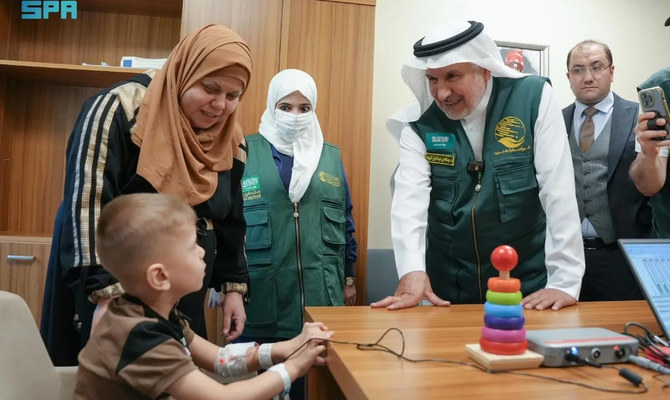
KSrelief chief Abdullah Al-Rabeeah, on Tuesday visited the cities of Reyhanli and Kirikhan in Turkiye’s Hatay Province to inspect the work of volunteers taking part in the agency’s programs to help people affected by the earthquakes that hit parts of Turkiye and Syria in February last year. (SPA)
2 / 4
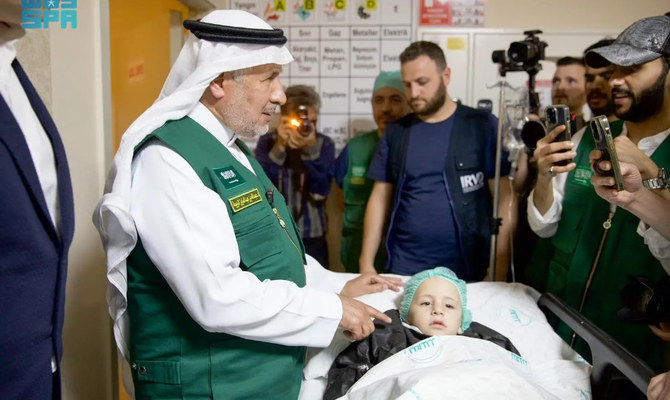
KSrelief chief Abdullah Al-Rabeeah, on Tuesday visited the cities of Reyhanli and Kirikhan in Turkiye’s Hatay Province to inspect the work of volunteers taking part in the agency’s programs to help people affected by the earthquakes that hit parts of Turkiye and Syria in February last year. (SPA)
3 / 4
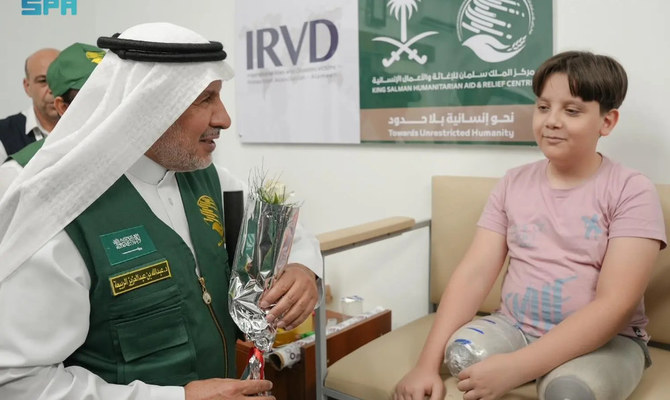
KSrelief chief Abdullah Al-Rabeeah, on Tuesday visited the cities of Reyhanli and Kirikhan in Turkiye’s Hatay Province to inspect the work of volunteers taking part in the agency’s programs to help people affected by the earthquakes that hit parts of Turkiye and Syria in February last year. (SPA)
4 / 4
KSrelief chief Abdullah Al-Rabeeah, on Tuesday visited the cities of Reyhanli and Kirikhan in Turkiye’s Hatay Province to inspect the work of volunteers taking part in the agency’s programs to help people affected by the earthquakes that hit parts of Turkiye and Syria in February last year. (SPA)
Short Url
Updated 04 July 2024
Follow

Head of Saudi aid agency KSrelief tours projects helping earthquake victims in Turkiye

  • Supervisor General Abdullah Al-Rabeeah meets volunteers providing healthcare, housing and skills training, and the beneficiaries of their work

RIYADH: The supervisor general of Saudi aid agency KSrelief, Abdullah Al-Rabeeah, on Tuesday visited the cities of Reyhanli and Kirikhan in Turkiye’s Hatay Province to inspect the work of volunteers taking part in the agency’s programs to help people affected by the earthquakes that hit parts of Turkiye and Syria in February last year.

Al-Rabeeah and his delegation reviewed the progress the Saudi voluntary Samaa Program for Auditory Rehabilitation and Cochlear Implants, at the MMT American Hospital in Reyhanli, the Saudi Press Agency reported on Wednesday. He spoke to volunteers and learned how the program is helping to alleviate suffering.

The aid agency chief praised “the distinguished performance of the Saudi crew” in implementing various volunteer programs to help those affected by the earthquakes, and said their “efforts came under the generous patronage and continuous support” of King Salman and Crown Prince Mohammed bin Salman. The Kingdom will continue to implement humanitarian projects that serve people in need worldwide, he added.

Al-Rabeeah also visited a vocational training center to review the support and assistance it provides to those affected by the earthquakes by helping them develop their skills and experience through courses in a variety of subjects, including mobile phone and tablet maintenance, sewing and embroidery, and graphic design.

During a tour of the headquarters of the Prosthetic Limbs and Rehabilitation Center in the state of Hatay, he was briefed on its work making and fitting prosthetic limbs, and the rehabilitation and basic health services it provides for earthquake victims. 

Al-Rabeeah was briefed on the work of the Saudi Volunteer Psychological Support Team and visited camps where it distributes food baskets, health supplies and gifts for children. He toured a specialist psychological clinic and learned about the integrated medical and health services system it provides.

He praised the healthcare providers for the services they are providing to support patients of all ages to help them overcome the shock and psychological effects caused by the earthquakes.

Beneficiaries of the services thanked the government and people of Saudi Arabia for the rapid responses to the earthquake by volunteer teams affiliated with KSrelief to help them through the provision of vital medical aid, food and shelter.

Al-Rabeeah met the governor of Gaziantep, Kemal Ceber, and thanked him for the facilities the governorate has provided to KSrelief to aid the implementation of its volunteer programs. Ceber praised the Kingdom for the humanitarian assistance it provides, through KSrelief, to the earthquake victims.

Al-Rabeeah also inspected a project to provide 364 houses for people in the Islahiyah area of Gaziantep. The recipients thanked the Kingdom for providing them with the shelter they so urgently needed after the earthquakes, and said the temporary housing was of high quality and modern design.

KSrelief has provided a total of 3,000 temporary housing units for earthquake victims in Syria and Turkiye, including 1,500 in the Islah and Nurdag regions of Gaziantep and the Adiyaman and Malatya governorates in Turkiye, and 1,500 in the Afrin region of Aleppo.

Each temporary housing unit has two rooms, equipped with basic furniture, and a bathroom. The agency has also built a school that can accommodate 756 children, a prayer room that can hold 700 worshipers, 20 caravans for administrative and commercial use, 15 play areas for children, and a well to provide water. KSrelief also provides solar energy equipment and infrastructure for the housing developments.

About 12,000 people have benefited so far from the housing, and work is underway to provide a further 1,000 temporary homes in three parts of Hatay Governorate, which are expected to benefit 5,000 people.


Saudi hospitality boom sparks innovation beyond the plate

Chefs at Julien prepare meals to pair with Diageo drinks. (AN photo by Basmah Albasrawi)
Updated 11 January 2026
Follow

Saudi hospitality boom sparks innovation beyond the plate

  • At the Four Seasons Riyadh, Diageo hosted a private tasting at Tonic Bar followed by a 10-course dinner at Julien
  • Dinner at Julien paired dishes with drinks made using Tanqueray 0.0, Captain Morgan 0.0, and Guinness 0.0

RIYADH: As restaurants and hotels in Saudi Arabia refine their culinary identities, beverages are increasingly being treated as crafted experiences in their own right, shaped by technique and intention.

At the Four Seasons Riyadh, Diageo hosted a private tasting at Tonic Bar followed by a 10-course dinner at Julien, offering a snapshot of how this evolution is beginning to take shape, as international players and local venues test new approaches to pairing and presentation. 

Speaking to Arab News, Nick Rees, marketing director of Diageo MENA, pointed to the rapid growth of the nonalcoholic segment globally and in the region: “There’s a far faster growing percentage of it (the industry) is non-alcohol … There (are) trends globally … A lot of it will be pointed to wellness, mindful drinking.”

Rees said that Saudi Arabia’s fast-developing culinary and hospitality scene calls for beverages that match the level of excellence seen in kitchens across the Kingdom.

“It’s kind of the lack of choices and that’s where we want to be able to provide people the option, and people here absolutely have the same kind of talent and desire as their counterparts behind the kitchen,” he said.

“That’s where our role is to give people the kind of core ingredients for them to be able to work with … we have many more brands that we would love to introduce to the Kingdom.”

The dinner at Julien paired dishes with drinks made using Tanqueray 0.0, Captain Morgan 0.0, and Guinness 0.0, offering a glimpse into the range of styles Diageo is bringing to the market.

Flavor profiles ranged from light and refreshing combinations with cucumber and capers brine to richer, malt-forward blends, each designed to complement the accompanying dishes, from ravioli to black cod. 

Rees emphasized that pairing food with thoughtfully crafted beverages is becoming an essential part of the hospitality experience. 

“In the Kingdom, we’re looking at giving people the experience that currently is not available to them because I know for sure that the kind of quality and expertise and craftsmanship that can go into creating some of these drinks is absolutely as exciting as the work that the chefs would do with their food,” he said.

Anthony Abou Haider, head of Gulf at Diageo, said the company sees long-term potential in Saudi Arabia’s hospitality sector. 

“It’s such an opportunity to be a part of this transformation journey,” he told Arab News. “We’re not looking for a short-term gain, we’re looking at a very long-term gain here because whatever we do now is building for the future.”
