

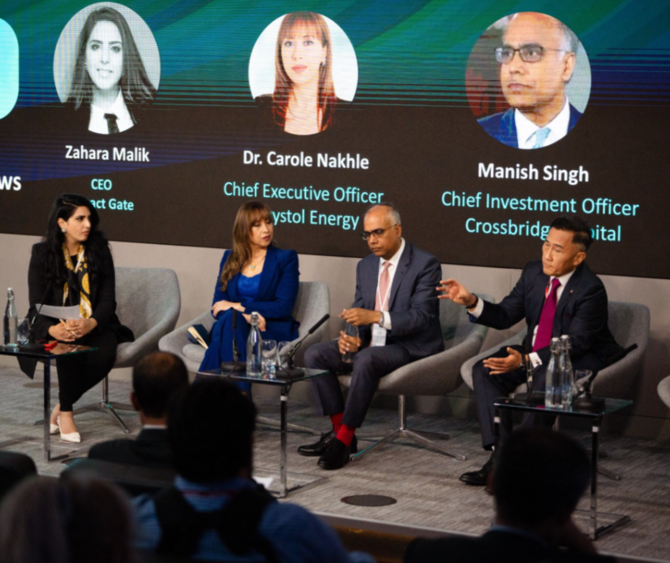

LONDON: Business leaders hailed Saudi Arabia’s investment environment and prospects for economic growth at an event at the London Stock Exchange on Wednesday.
The BMG Economic Forum, of which Arab News is a partner, is held annually to discuss business developments in the Kingdom and the wider region.
Panelists explored topics including the effect of geopolitical developments on economies, and updates on Saudi giga-projects.
The Kingdom, which is rapidly expanding its non-oil economy, also has a “powerful” energy sector that has proved resilient to major geopolitical developments, said Dr. Carole Nakhle, CEO of Crystol Energy.
“Because especially here in the Western world, I hear about oil and gas being volatile, and you can’t rely on oil and gas,” she added.
“But I tell them, ‘You’re missing the point.’ A well-functioning market has to be volatile, right? But the key is, does it clear volatility quite efficiently?
“And what we saw in the last few years were some major geopolitical developments — the war in Ukraine, the energy crisis, on top of that, all the macroeconomic challenges, the war in Gaza etc., sanctions on Russia already, sanctions on Iran, Venezuela, Libya not quite settled, Syria, Yemen, you name it. But still, prices, although they spiked, they recover to their pre-crisis levels very quickly.”
Geopolitical crises in past decades would “send prices soaring,” Nakhle said. But that trend appears outdated, with Saudi Arabia in particular able to “take proactive policies and measures” that compensate for that risk, she added.
The “commitment and clarity” of Vision 2030 means the Kingdom can take on “reduced” geopolitical risk premiums, she said.
Nakhle also pushed back against the “overwhelming thinking” predicting the end of the oil sector in Saudi Arabia as part of the larger “peak oil” debate.
“If your economy is always dependent, and you need the oil money to fund all sorts of projects, very ambitious ones, then you’re in trouble,” she said.
“That’s a general overwhelming thinking, but that’s an oversimplification of a much more complex reality, because the big mistake that we should avoid is comparing all oil producers, even within OPEC, of which Saudi Arabia is a leader. They do have a very, very divergent picture when it comes to one producer versus another.
“I’m not worried about the GCC (Gulf Cooperation Council). I’m not worried about Saudi Arabia. They have the reserves and they have the low cost of production.”
As well as the strength of its energy sector, Saudi Arabia is funding capital expenditure through deficits in an effort to diversify the economy from oil, said Manish Singh, CEO of Crossbridge Capital.
That effort is working as planned, with the Kingdom harnessing its low debt-to-gross domestic product of 28 percent, as well as the power of major players such as Saudi Aramco and the Public Investment Fund, which boast combined assets of more than $2.3 trillion.
“If you have things to do locally, and the unemployment rate is low, and you’re growing your wages and spending, that’s something that you have to welcome,” Singh said.
On a separate panel discussing Saudi Arabia’s giga-projects, Jerry Inzerillo, CEO of the Diriyah Gate Development Authority, delivered an overview via video of progress in the original home of the Kingdom’s royal family.
“In 2023, we finished 9 km of parks, we introduced our hotel practice, which will have 42 new hotels,” he said.
“We introduced our Diriyah Futures Museum, one of nine, which will open in September of this year.
“We’ll also open … in September the first of all 42 hotels. We’re ahead of schedule, on time and on budget, and we look forward to welcoming everybody.”
Inzerillo was joined by Catalina Valentino, group CEO of ELIXR; and Arta Selmani, CEO of Mimicrete.
Valentino, whose company is the world’s first global giga-project, praised Vision 2030 for giving Saudi Arabia a “shift in purpose.”
She added: “I think that there’s a new generation being born in business, whereas previously it was looking at capitalism — how do I make money and how do I profit from these companies?
“And now there’s a shift to purpose-led and purpose-driven companies. And we can see that with Vision 2030 for Saudi Arabia, there’s a shift in purpose. What that means is that now we’re looking at those joints and how we join those up.”


