

Pak-Russia not driven by geopolitics, relations with other countries, PM Sharif tells Putin

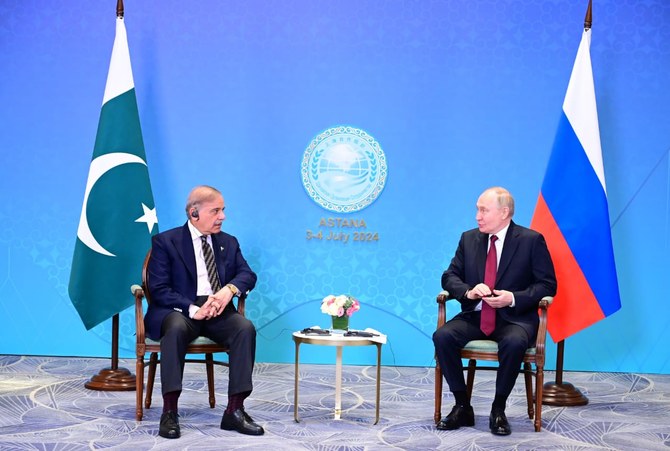
Pakistan Prime Minister Shehbaz Sharif meets Russian President Vladimir Putin at the sidelines of the Shanghai Cooperation Organization (SCO) leaders’ summit in Astana on July 3, 2024. (Government of Pakistan)
Short Url
Updated 03 July 2024
Follow

Pak-Russia not driven by geopolitics, relations with other countries, PM Sharif tells Putin

  • Sharif meets Russian President Vladimir Putin at sidelines of Shanghai Cooperation Organization summit in Astana 
  • Pakistani premier says both countries can overcome banking, financial issues to further enhance bilateral trade

ISLAMABAD: Prime Minister Shehbaz Sharif met Russian President Vladimir Putin at the sidelines of the Shanghai Cooperation Organization (SCO) leaders’ summit on Wednesday, saying that ties between both countries stand on their own strength and are not driven by “geopolitical contingencies” or Islamabad’s relations with other nations. 

Pakistan and Russia, once Cold War rivals, have warmed up to each other in recent years through regular business and trade interactions. As Islamabad seeks to enhance its role as a transit hub for landlocked economies in Central Asia, it has expressed interest in connecting with Russia through Central Asia for bilateral trade. 

Last year, Pakistan began making purchases of discounted Russian crude oil under a deal struck between Islamabad and Moscow. Pakistan also received its first shipment of liquified petroleum gas from Russia, marking Islamabad’s second major Russian energy purchase, despite Western powers’ move to impose sanctions on Moscow for invading Ukraine in 2022. 

Pakistan has carefully sought to balance its ties with Washington, a longtime bitter rival of Russia and China, as it moves to enhance trade with Moscow. 

“Your excellency, our relations stand on our own strength,” Sharif told Putin on the sidelines of the summit in Astana where leaders and diplomats from India, China, Turkiye, Iran, Kazakhstan, Kyrgyzstan, Tajikistan and Uzbekistan are also in attendance.

 “Neither our relations are driven by any geopolitical contingency nor these are impacted by our relations with other countries.”

The South Asian country notified a mechanism for barter trade with Russia, Iran and Afghanistan in February 2023, allowing state-owned enterprises and private sector entities to engage both in imports and export of goods.

Sharif recalled how Pakistan used to engage in barter trade with Russia during the 1950s and the 1960s, saying that Islamabad used to import heavy machinery from Moscow and exported leather goods and textile products to it.

“I think today is the time we can overcome financial and other banking issues by renewing our trade and expanding our trade under barter that will be very beneficial for Pakistan and overcome many problems,” he said. 

The Pakistani prime minister congratulated Putin on getting re-elected in March, hoping Russia would progress under his administration. 

He said both countries can enhance bilateral trade, which at the moment stood at $1 billion. 

Last year, Pakistan began making purchases of discounted Russian crude oil under a deal struck between Islamabad and Moscow. Pakistan also received its first shipment of liquified petroleum gas from Russia, marking Islamabad’s second major Russian energy purchase. 

“We received a shipment of oil from your great country and I am very grateful for that,” he said. “But we really need to move further in that direction.”


Pakistan deputy PM speaks with Iranian FM as Saudi Arabia intercepts missiles and drones

Updated 4 sec ago
Follow

Pakistan deputy PM speaks with Iranian FM as Saudi Arabia intercepts missiles and drones

  • Ishaq Dar expresses concern over evolving regional situation as both officials agree to remain in contact
  • Pakistan earlier reminded Tehran of its mutual defense pact with Saudi Arabia during diplomatic outreach

ISLAMABAD: Pakistan’s Deputy Prime Minister and Foreign Minister Ishaq Dar spoke with Iranian Foreign Minister Seyyed Abbas Araghchi on Friday amid escalating tensions in the Gulf, including recent missile and drone attacks targeting Saudi Arabia that were intercepted by the Kingdom’s air defenses.

The call comes as Islamabad remains in contact with both Tehran and Gulf states to prevent the widening Iran conflict from spilling further across the region, particularly after attempted strikes on Saudi territory, a sensitive development for Pakistan, which signed a mutual defense pact with the Kingdom last year.

Pakistan’s foreign ministry said Dar raised concerns about the evolving regional situation during the conversation.

“Deputy Prime Minister/Foreign Minister Senator Mohammad Ishaq Dar spoke this evening with the Foreign Minister of Iran, Seyyed Abbas Araghchi,” the ministry said in a statement.

“The DPM/FM expressed concern over the evolving regional situation. The two agreed to remain in touch on the developments,” it added.

The ministry did not share details of the conversation, though it came amid fast-moving developments in the region, with Saudi Arabia saying its air defenses intercepted multiple missiles and drones early on Friday.

Earlier this week, Prime Minister Shehbaz Sharif’s adviser on political affairs Rana Sanaullah said Pakistan was in contact with Iran to discourage attacks on Gulf countries and prevent misunderstandings.

“Such attacks should not be carried out from Iran’s side,” he told Geo TV.

Prior to that, the deputy prime minister told Pakistan’s Senate that Islamabad had engaged both Iran and Saudi Arabia at the outset of Iran’s retaliation in the region, reminding Tehran of its defense agreement with Saudi Arabia and conveying assurances from Riyadh that Saudi territory would not be used against Iran.

Pakistan says its administration is striving to end the conflict, though the United States-Israeli strikes on Iran, which triggered the war and led to its spillover, have only intensified.

Iranian President Masoud Pezeshkian said on Friday some countries had begun mediation efforts but insisted Tehran would defend its sovereignty.

Meanwhile, US President Donald Trump has called for Iran’s “unconditional surrender” on his Truth Social platform as the confrontation shows little sign of easing.