

All change in Cairo as new Egyptian Cabinet is sworn in

Egyptian President Abdel-Fattah El-Sissi poses with Egypt’s new cabinet, led by Prime Minister Mostafa Madbouly, fourth left, at Al-Ittihadiya Palace in Cairo, Egypt. (AP)
Short Url
Updated 04 July 2024
Follow

All change in Cairo as new Egyptian Cabinet is sworn in

  • The reshuffle followed a presidential directive calling for changes to government policies to keep pace with the challenges faced by the state
  • The challenges include the Gaza war, a struggling economy and daily power cuts

CAIRO: Egypt's President Abdel Fattah El-Sisi swore in a reshuffled Cabinet on Wednesday that includes new finance and foreign ministers in a government facing challenges including the Gaza war, a struggling economy and daily power cuts.

El-Sisi reappointed Prime Minister Mostafa Madbouly and said his new govern- ment should focus on lowering inflation and boosting investment.

The president tasked Madbouly and his administration with achieving a number of goals, including maintaining national security in the face of regional and international challenges; prioritization of initiatives to help the Egyptian people develop and advance, particularly in the fields of health and education; and the continuation of efforts to improve political engagement.

The reshuffle followed a directive from El-Sisi calling for changes to government policies to keep pace with the challenges faced by the state, in response to which Madbouly tendered the previous government’s resignation to the president on June 3.

Kamel El-Wazir, who has been minister of transport since March 2019, is now minister of industry and transport, and will also serve as the deputy prime minister for industrial development.

Khaled Abdel-Ghaffar is minister of health and population, and deputy prime minister for human development.
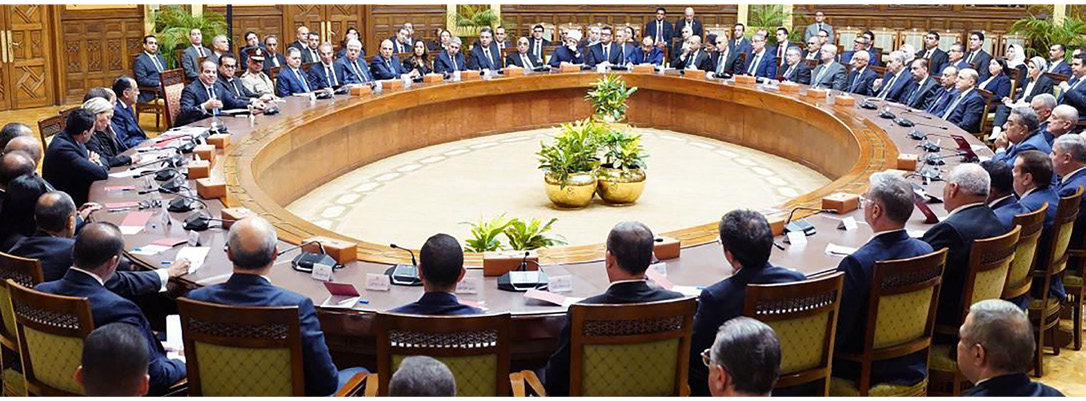


President Abdel Fattah El-Sisi meets new government members in Cairo. (AFP)

Lt. Gen. Abdel-Maguid Sakr becomes minister of defense, replacing Mohammed Zaki.

Badr Abdelatty is the new minister of foreign affairs and emigration and expatriate Affairs, replacing Sameh Shoukry, who previously held the foreign affairs role, and Soha Gendi, who handled emigration and expatriate affairs.

Amr Talaat remains as minister of communications and information technology, while Rania Al-Mashat, previously minister of international cooperation, becomes minister of planning, economic development and international cooperation.

Ayman Ashour continues in the post of minister of higher education and scientific research, which he has held since August 2022, and Hani Sewilam remains as minister of water resources and irrigation.

Mohammed Sheemy is the new minister of public business sector. He succeeds Mahmoud Esmat, who becomes minister of electricity. Ahmed Kouchouk takes over as minister of finance from Mohammed Maait.

Manal Awad Mikhail becomes minister of local development, replacing Hisham Amna, while Sherif Farouk takes over as minister of supply and internal trade from Ali Moselhi.

Usama Alazhary replaces Mokhtar Gomaa as minister of religious endowment, while Mohammed Gobran succeeds Hassan Shehata as minister of labor.

Mahmoud Tawfik continues as minister of interior and Yasmine Fouad remains minister of environment, positions they have held since 2018.

New Finance Minister Kouchouk, a former World Bank economist, said after being sworn in that Egypt was committed to fiscal discipline, bringing down debt, and structural reform to allow for private sector growth.

An influx of funding from the UAE, the IMF, and the EU has eased a chronic foreign currency shortage in Egypt, but power cuts and gas shortages have left businesses and families struggling.

Karim Badawi, an oil services manager, was appointed petroleum minister and said supplying fuel to power stations would be a priority.

Sherif Farouk, who took over at the Supply Ministry, which manages a food subsidy program that feeds more than 60 million people and is a target for reform, is former head of Egypt Post.

Analysts say radical change is needed to make Egypt’s economy more stable, including the state and military ceding space for the private sector.

“We need to have a plan from now, which is a new growth model, a new development model,” former Investment Minister Mahmoud Mohieldin said.


Syrian military tells civilians to evacuate contested area east of Aleppo amid rising tensions

Updated 15 January 2026
Follow

Syrian military tells civilians to evacuate contested area east of Aleppo amid rising tensions

  • Syria’s military has announced it will open a “humanitarian corridor” for civilians to evacuate from an area in Aleppo province
  • This follows several days of intense clashes between government forces and the Kurdish-led Syrian Democratic Forces

DAMASCUS: Syria’s military said it would open a corridor Thursday for civilians to evacuate an area of Aleppo province that has seen a military buildup following intense clashes between government and Kurdish-led forces in Aleppo city.
The army’s announcement late Wednesday — which said civilians would be able to evacuate through the “humanitarian corridor” from 9 a.m. to 5 p.m. Thursday — appeared to signal plans for an offensive in the towns of Deir Hafer and Maskana and surrounding areas, about 60 kilometers (40 miles) east of Aleppo city.
The military called on the Kurdish-led Syrian Democratic Forces and other armed groups to withdraw to the other side of the the Euphrates River, to the east of the contested zone.
Syrian government troops have already sent troop reinforcements to the area after accusing the SDF of building up its own forces there, which the SDF denied. There have been limited exchanges of fire between the two sides, and the SDF has said that Turkish drones carried out strikes there.
The government has accused the SDF of launching drone strikes in Aleppo city, including one that hit the Aleppo governorate building on Saturday shortly after two Cabinet ministers and a local official held a news conference there.
The tensions in the Deir Hafer area come after several days of intense clashes last week in Aleppo city that ended with the evacuation of Kurdish fighters and government forces taking control of three contested neighborhoods. The fighting killed at least 23 people, wounded dozens more, and displaced tens of thousands.
The fighting broke out as negotiations have stalled between Damascus and the SDF, which controls large swaths of northeast Syria, over an agreement to integrate their forces and for the central government to take control of institutions including border crossings and oil fields in the northeast.
Some of the factions that make up the new Syrian army, which was formed after the fall of former President Bashar Assad in a rebel offensive in December 2024, were previously Turkiye-backed insurgent groups that have a long history of clashing with Kurdish forces.
The SDF for years has been the main US partner in Syria in fighting against the Daesh group, but Turkiye considers the SDF a terrorist organization because of its association with the Kurdistan Workers’ Party, or PKK, which has waged a long-running insurgency in Turkiye. A peace process is now underway.
Despite the long-running US support for the SDF, the Trump administration has also developed close ties with the government of interim Syrian President Ahmad Al-Sharaa and has pushed the Kurds to implement the integration deal. Washington has so far avoided publicly taking sides in the clashes in Aleppo.
The SDF in a statement warned of “dangerous repercussions on civilians, infrastructure, and vital facilities” in case of a further escalation and said Damascus bears “full responsibility for this escalation and all ensuing humanitarian and security repercussions in the region.”
Adm. Brad Cooper, commander of US Central Command, said in a statement Tuesday that the US is “closely monitoring” the situation and called for “all parties to exercise maximum restraint, avoid actions that could further escalate tensions, and prioritize the protection of civilians and critical infrastructure.” He called on the parties to “return to the negotiating table in good faith.”
Al-Sharaa blasts the SDF
In a televised interview aired Wednesday, Al-Sharaa praised the “courage of the Kurds” and said he would guarantee their rights and wants them to be part of the Syrian army, but he lashed out at the SDF.
He accused the group of not abiding by an agreement reached last year under which their forces were supposed to withdraw from neighborhoods they controlled in Aleppo city and of forcibly preventing civilians from leaving when the army opened a corridor for them to evacuate amid the recent clashes.
Al-Sharaa claimed that the SDF refused attempts by France and the US to mediate a ceasefire and withdrawal of Kurdish forces during the clashes due to an order from the PKK.
The interview was initially intended to air Tuesday on Shams TV, a broadcaster based in Irbil — the seat of northern Iraq’s semi-autonomous Kurdish region — but was canceled for what the station initially said were technical reasons.
Later the station’s manager said that the interview had been spiked out of fear of further inflaming tensions because of the hard line Al-Sharaa took against the SDF.
Syria’s state TV station instead aired clips from the interview on Wednesday. There was no immediate response from the SDF to Al-Sharaa’s comments.