

Social conservatives push Trump to back federal role on abortion

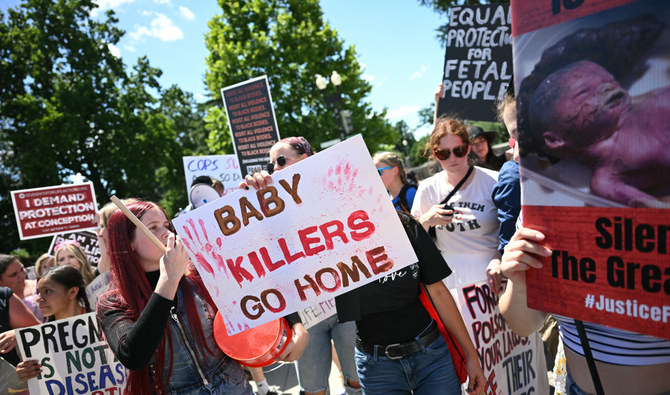
Anti-abortion activists protest as reproductive rights activists demonstrate in front of the US Supreme Court in Washington, DC, on June 24, 2024. (AFP/File)
Short Url
Updated 03 July 2024
Follow

Social conservatives push Trump to back federal role on abortion

WASHINGTON: A leading US anti-abortion group on Tuesday warned Republican presidential candidate Donald Trump not to water down language in the party platform on abortion restrictions, the most visible sign yet of a widening fissure between Trump and social conservatives on the issue.

The reproach by Susan B. Anthony Pro-Life America president Marjorie Dannenfelser comes as party members head to Milwaukee to draft the platform, which serves as a statement of policy principles, ahead of what is intended to be a national show of unity at the party’s convention this month.

For weeks, anti-abortion activists have been expressing concerns that the Trump campaign and the Republican National Committee would work to weaken language in the platform by eliminating any reference to a federal role in restricting abortion.

Trump has said the issue should be left solely to state legislatures in the wake of a US Supreme Court decision in 2022 that gutted constitutional protection for the procedure. He has argued that is a more politically tenable position, with polls showing a majority of Americans broadly backing abortion rights.

In a statement on Tuesday, Dannenfelser said the longtime, battle-tested alliance between the grassroots anti-abortion movement and the Republican, or GOP, Party was in jeopardy.

“If the Trump campaign decides to remove national protections for the unborn in the GOP platform, it would be a miscalculation that would hurt party unity and destroy pro-life enthusiasm between now and the election,” Dannenfelser said.

Members of the Republican Party’s platform committee are scheduled to meet privately in Milwaukee ahead of the July 15-18 convention, where Trump will be formally tapped as the party’s presidential nominee for the Nov. 5 election against President Joe Biden, a Democrat who is campaigning in favor of abortion rights.

In her statement, Dannenfelser suggested that anti-abortion groups were being shut out of the process of crafting the platform.

“We are now just two business days away from the platform committee meeting and no assurances have been made,” she said. “Instead, every indication is that the campaign will muscle through changes behind closed doors.”

Danielle Alvarez, a spokesperson for the Trump campaign, said no definitive decisions had been made on the platform’s contents.

“The platform committee has yet to convene to discuss what language should be in the final document,” Alvarez said. She did not respond to questions about whether the anti-abortion groups have a say in the process.

EVANGELICAL PRESSURE

Last month, a bevy of anti-abortion advocates, including prominent evangelical Christians such as Ralph Reed and Tony Perkins, sent a letter to Trump sharing concerns similar to Dannenfelser’s.

They called on the campaign to ensure that language be retained in the platform that explicitly says a fetus has a “fundamental right to life which cannot be infringed.” They have also urged passage of federal legislation to grant protection to fetuses under the 14th Amendment of the Constitution, which outlines the rights of US citizens, and want a further so-called

“human life amendment” added to the Constitution.

Perkins, the president of the Family Research Council who served as an evangelical adviser to Trump’s administration, has launched an online “platform integrity project” to apply grassroots pressure to Trump and party leaders to keep the current abortion language.

A member of the RNC platform committee, Perkins sent a letter to RNC Chair Michael Whatley on Monday complaining that advocates and the media would be shut out of the platform deliberations under a “gag rule” imposed by the party.

“The RNC Gag Rule heightens speculation that the GOP platform will be watered down to a few pages of meaningless, poll-tested talking points,” Perkins wrote.

The Trump campaign in a memo last month to the platform committee urged that it boil down the document to a statement of basic tenets absent of “Washington jargon” and the “shackles of lobbyist influence.”

While Trump relied on strong support from evangelicals during the Republican nominating contest, he has consistently maintained that an extreme stance on abortion hurts the party’s electoral chances and has frowned upon six-week bans like those passed by states such as Florida.

He has argued that his appointment of three Supreme Court justices who voted to overturn the seminal abortion case Roe v. Wade stands as proof of his anti-abortion bona fides.


Mystery of CIA’s lost nuclear device haunts Himalayan villagers 60 years on

Updated 4 sec ago
Follow

Mystery of CIA’s lost nuclear device haunts Himalayan villagers 60 years on

  • Plutonium-fueled spy system was meant to monitor China’s nuclear activity after 1964 atomic tests
  • Porter who took part in Nanda Devi mission warned family of ‘danger buried in snow’

NEW DELHI: Porters who helped American intelligence officers carry a nuclear spy system up the precarious slopes of Nanda Devi, India’s second-highest peak, returned home with stories that sent shockwaves through nearby villages, leaving many in fear that still holds six decades later.

A CIA team, working with India’s Intelligence Bureau, planned to install the device in the remote part of the Himalayas to monitor China, but a blizzard forced them to abandon the system before reaching the summit.

When they returned, the device was gone.

The spy system contained a large quantity of highly radioactive plutonium-238 — roughly a third of the amount used in the atomic bomb dropped by the US on the Japanese city of Nagasaki in the closing stages of the Second World War.

“The workers and porters who went with the CIA team in 1965 would tell the story of the nuclear device, and the villagers have been living in fear ever since,” said Narendra Rana from the Lata village near Nanda Devi’s peak.

His father, Dhan Singh Rana, was one of the porters who carried the device during the CIA’s mission in 1965.

“He told me there was a danger buried in the snow,” Rana said. “The villagers fear that as long as the device is buried in the snow, they are safe, but if it bursts, it will contaminate the air and water, and no one will be safe after that.”

During the Sino-Indian tensions in the 1960s, India cooperated with the US in surveillance after China conducted its first nuclear tests in 1964. The Nanda Devi mission was part of this cooperation and was classified for years. It only came under public scrutiny in 1978, when the story was broken by Outsider magazine.

The article caused an uproar in India, with lawmakers demanding the location of the nuclear device be revealed and calling for political accountability. The same year, then Prime Minister Morarji Desai set up a committee to assess whether nuclear material in the area near Nanda Devi could pollute the Ganges River, which originates there.

The Ganges is one of the world’s most crucial freshwater sources, with about 655 million people in India, Nepal, and Bangladesh depending on it for their essential needs.

The committee, chaired by prominent scientists, submitted its report a few months later, dismissing any cause for concerns, and establishing that even in the worst-case scenario of the device’s rupture, the river’s water would not be contaminated.

But for the villagers, the fear that the shell containing radioactive plutonium could break apart never goes away, and peace may only come once it is found.

Many believe the device, trapped within the glacier’s shifting ice, may have moved downhill over time.

Rana’s father told him that the device felt hot when it was carried, and he believed it might have melted its way into the glacier, remaining buried deep inside.

An imposing mass of rock and ice, Nanda Devi at 7,816 m is the second-highest mountain in India after Kangchenjunga. 

When a glacier near the mountain burst in 2021, claiming over 200 lives, scientists explained that the disaster was due to global warming, but in nearby villages the incident was initially blamed on a nuclear explosion.

“They feared the device had burst. Those rescuing people were afraid they might die from radiation,” Rana said. “If any noise is heard, if any smoke appears in the sky, we start fearing a leak from the nuclear device.”

The latent fear surfaces whenever natural disasters strike or media coverage puts the missing device back in the spotlight. Most recently, a New York Times article on the CIA mission’s 60th anniversary reignited the unease.

“The apprehensions are genuine. After 1965, Americans came twice to search for the device. The villagers accompanied them, but it could not be found, which remains a concern for the local community,” said Atul Soti, an environmentalist in Joshimath, Uttarakhand, about 50 km from Nanda Devi.

“People are worried. They have repeatedly sought answers from the government, but no clear response has been provided so far. Periodically, the villagers voice their concerns, and they need a definitive government statement on this issue.”

Despite repeated queries whenever media attention arises, Indian officials have not released detailed updates since the Desai-appointed committee submitted its findings.

“The government should issue a white paper to address people’s concerns. The white paper will make it clear about the status of the device, and whether leakage from the device could pollute the Ganges River,” Soti told Arab News.

“The government should be clear. If the government is not reacting, then it further reinforces the fear.”