

At least 116 people killed in stampede at Hindu religious event in India

1 / 4
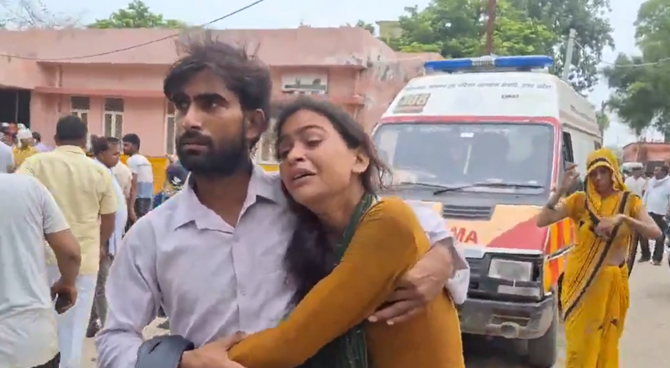
Screengrab taken from a video in northern India where nearly 150 persons were admitted to hospitals after a stampede at a religious gathering in a village in Hathras district of Uttar Pradesh state. (X/@RT_India_news)
2 / 4
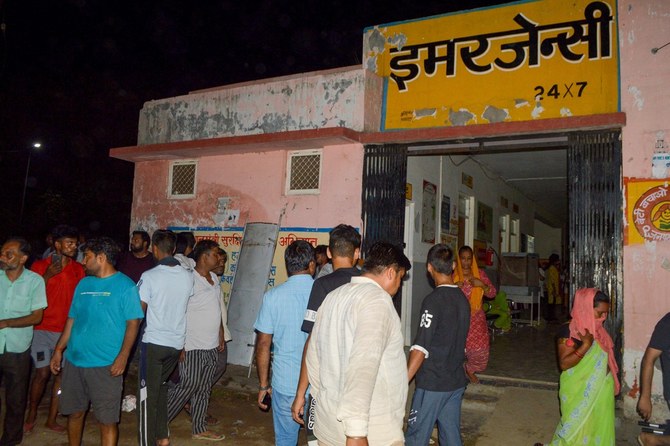
Mourners gather as the deceased who died in a melee during a sermon, are brought to a hospital in Hathras in India’s Uttar Pradesh state on Jul. 2, 2024. (AFP)
3 / 4
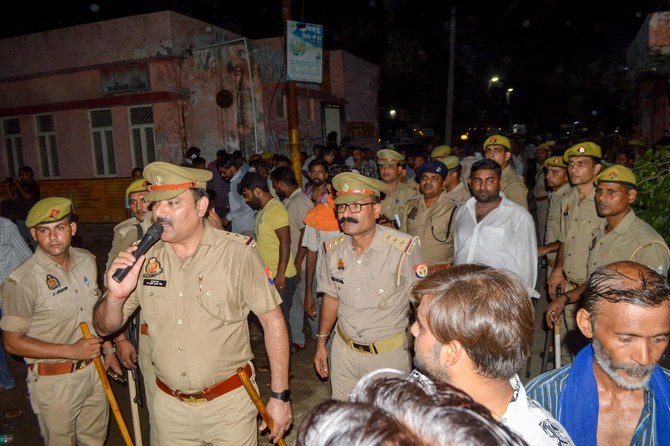
Policemen manage the mourners as the deceased who died in a melee during a sermon, are brought to a hospital in Hathras in India’s Uttar Pradesh state on Jul. 2, 2024. (AFP)
4 / 4
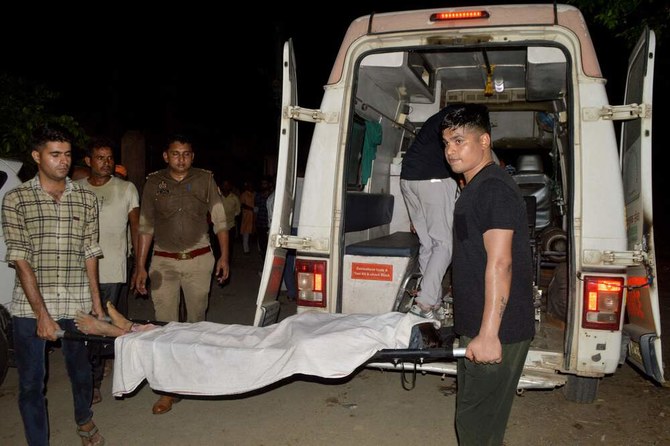
People carry the deceased who died in a melee during a sermon at Hathras in India's Uttar Pradesh state on Jul. 2, 2024. (AFP)
Short Url
Updated 02 July 2024
Follow

At least 116 people killed in stampede at Hindu religious event in India

  • “The incident happened due to overcrowding at the time when people were trying to leave the venue,” said Ashish Kumar, administrator of the Hathras district of Uttar Pradesh
  • Chaitra V., another senior state official, told broadcaster India Today that people may have lost their footing as they sought water in the heat

NEW DELHI: At least 116 people, many of them women and children, were killed in a stampede at a Hindu religious gathering in north India on Tuesday, authorities said, in one of the country’s worst such tragedies in years. The stampede happened in a village in Hathras district, about 200 km (125 miles) southeast of the national capital New Delhi, where authorities said thousands had gathered in sweltering late afternoon temperatures.
“The incident happened due to overcrowding at the time when people were trying to leave the venue,” Ashish Kumar, administrator of the Hathras district of Uttar Pradesh, India’s most populous state, told reporters.
Chaitra V., another senior state official, told broadcaster India Today that people may have lost their footing as they sought water in the heat.
“There was wet mud at one place where people may have slipped. Also because of the heat, people may have made their way to the spot where water was kept and that could have caused the incident as well,” she said.
Video clips recorded by news agency ANI, in which Reuters has a minority stake, showed bodies piled into the back of trucks and laid out in vehicles.
Purses and bags covered in dust, were heaped up at the venue, with people sitting on their haunches sifting through them to identify their belongings.
Mobile phones were similarly piled together, waiting to be claimed by their owners.
A video on social media showed a large crowd packed into a tented area, standing and listening to devotional tunes as they waved their hands in the direction of the religious leader who sat on a stage.
It also showed some women hanging on to the bamboo poles holding up the canopy to get a better view above the heads of the large crowd.
Reuters could not immediately verify the social media images.
“There must have been about 50,000 people...at the gate on the highway, some people were going left and some people were going right, the stampede was caused in that confusion,” Suresh Chandra, a witness who was at the gathering, told local media.
Seema, a woman who traveled from a town almost 60 km away to attend the event, said she was leaving the venue when the stampede occurred. She was accompanied by three relatives, two of whom were killed.

Stampedes and other accidents
involving large crowds at religious gatherings and pilgrimage sites have happened in the past and are often blamed on poor crowd management.
While 115 people were killed in central India in a stampede in 2013, nearly 250 died in 2008 and more than 340 were killed during an annual pilgrimage in the western state of Maharashtra in 2005, according to local media reports.
Uttar Pradesh Chief Minister Yogi Adityanath ordered an investigation.
Prime Minister Narendra Modi said the federal government was assisting the state and announced a compensation of 200,000 rupees ($2,400) to the families of the dead and 50,000 rupees to those injured.


US ‘totally stupid’ to attack Iran during talks: UN ambassador

Updated 5 sec ago
Follow

US ‘totally stupid’ to attack Iran during talks: UN ambassador

  • “War was not our option. War was imposed on Iran,” Bahreini told UN correspondents
  • “Nobody should expect Iran to show restraint in front of aggression”

GENEVA: The United States made a “totally stupid decision” to attack Iran while in negotiations, and betrayed Gulf nations by trashing their diplomatic efforts, Tehran’s UN ambassador said Tuesday.
Ali Bahreini, Iran’s ambassador in Geneva, insisted Tehran had no problem with its neighbors, but could not let US bases in the Gulf be used as launchpads for attacks on Iran.
“War was not our option. War was imposed on Iran,” Bahreini told UN correspondents.
“Nobody should expect Iran to show restraint in front of aggression.
“We will continue our defense until the point that this aggression is stopped,” he said.
On February 26, Washington and Tehran held indirect negotiations in Geneva on Iran’s nuclear program — with the Omani mediators reporting “significant progress.”
Bahreini was present for part of those talks and said “everybody was optimistic” and the US team “agreed to continue negotiations” in Vienna this week.
But Bahreini said Israeli Prime Minister Benjamin Netanyahu had convinced US President Donald Trump to destroy diplomacy and attack Iran, with strikes starting on Saturday.
“It was a totally stupid decision. They will know in the future how stupid this decision has been. Both of them will understand, because Iran will firmly determine the situation and the destiny of this war,” he said.
“All our neighbors are now disappointed with the betrayal of the United States because everybody was working for diplomacy, particularly Oman.
“The US betrayed everybody.”

- ‘Not a regional war’ -

Tehran has launched strikes against countries in the region that host US bases.
“I cannot accept labelling what we are doing as reprisal. What we are doing is a kind of self-defense,” said Bahreini.
The ambassador said Iran’s problem was not with its neighbors, describing the Gulf countries as friends.
“We are in daily dialogue with our neighbors to convey to them the message that this war is not a war against our neighbors.
“This is not a regional war.
“But we cannot ignore the fact that the US bases in their lands are operational against us.
“In no way we can allow those bases to be used to make military operations against Iran.”
He said Iran’s operations were “exclusively” against US military targets, and said “there has been very serious order given to our military forces not to make any harm to civilians.”
Trump claimed Tuesday that the Iranian leadership “want to talk” but Bahreini insisted no approach had been made to Washington, saying “there hasn’t been any contact from our side” since the war erupted.