

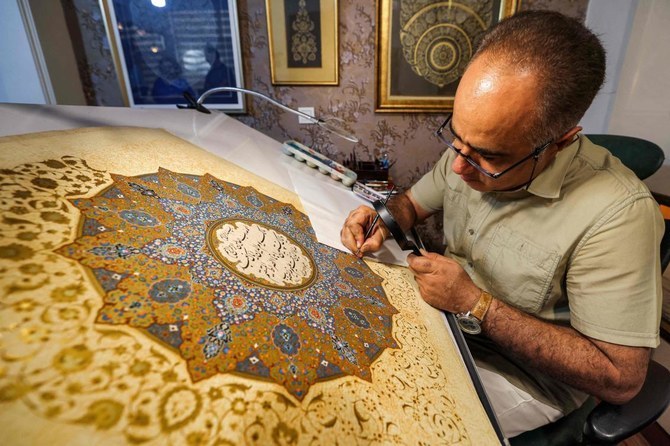

Tehran: Iranian artist Mohammad Hossein Aghamiri sometimes labors for six months on a single design, very carefully — he knows a single crooked line could ruin his entire artwork.
In the age of AI-assisted graphic design on computer screens, the centuries-old tradition of Persian illumination offers an antidote to rushing the creative process.
Aghamiri’s fine brush moves natural pigments onto the paper with deliberate precision as he creates intricate floral patterns, religious motifs and elegantly flowing calligraphy.
The exquisite artwork has for centuries embellished literary manuscripts, religious texts and royal edicts as well as many business contracts and marriage certificates.
Aghamiri, 51, is one of Iran’s dozen or so remaining masters of the ancient illumination art of Tazhib, which was inscribed last year on UNESCO’s list of intangible heritage.
“It is a very unique job that requires a lot of patience and precision,” Aghamiri, a veteran of the craft with over 30 years’ experience, told AFP in his downtown Tehran studio.
“It’s not accessible to everyone.”
Tazhib’s non-figurative and geometric flourishes have traditionally adorned the margins of holy books and epic poems.
The artform dates back to the Sassanid era in pre-Islamic Iran but flourished after the seventh century advent of Islam, which banned human depictions.

Mohammad Hossein Aghamiri, an artist who specializes in Persian miniatures, poses for a picture with his artwork in his workshop in Tehran on June 5, 2024. (AFP)
Aghamiri says it often takes him months to finish one design and that a single misplaced stroke that disrupts its symmetrical harmony can force him to start over.
When AFP visited, he was working on a so-called shamsa design, a symbolic representation of the sun, about 50 centimeters across with intertwined abstract, geometric and floral patterns.
He said he started the piece over four months ago and aimed to finish it within six weeks, using natural pigments such as lapis lazuli, saffron, gouache and pure gold, from China.
“Gold has a very strong visual appeal,” said Aghamiri. “It’s expensive and it enhances the perceived value of the work.”
Aghamiri hails from a family of artists and artisans with a rich history in Iranian craft traditions including calligraphy, miniature painting and carpet design.
His work has been showcased in museums in Iran and in nearby Arab countries of the Gulf region where interest in Oriental and Islamic art continues to grow.
“Eighty percent of my works are sold in the region, especially in the Emirates and Qatar” as well as in Turkiye, he said.
In recent years, Aghamiri garnered interest abroad and even began teaching the ancient art online to students from across the world, notably the United States.
Soon, he also hopes to hold workshops in Britain for his craft, which he says is fundamentally different from European illumination art, which flourished in the Middle Ages.
European designs, he said, are more figurative and can depict human faces, animals and landscapes, and often illustrate biblical scenes.
UNESCO labelled the Persian art of illumination as part of the Intangible Cultural Heritage of Humanity in December 2023, at the request of Iran as well as Turkiye, Azerbaijan and Uzbekistan.
“Twenty years ago, I didn’t have much hope” for the future of Persian illumination, said Aghamiri. “But things have changed, and I see that this art is becoming more and more popular.”


