

Viral campaign urges Wimbledon to sever ties with Barclays

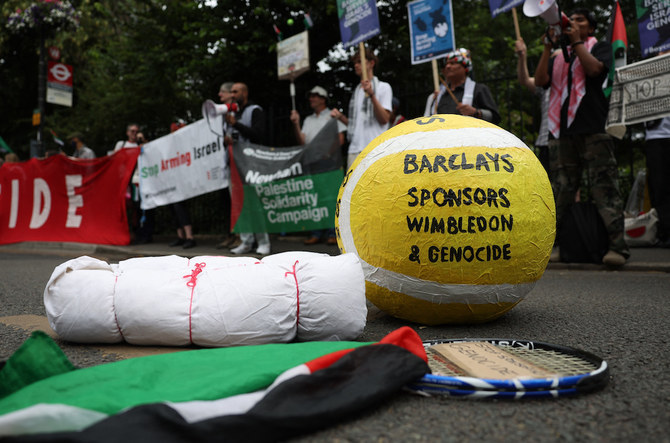
General view of a sign reading, Barclays sponsors Wimbledon and genocide, and a Palestinian flag are seen during a protest amid the ongoing conflict between Israel and Hamas. (Reuters)
Short Url
Updated 01 July 2024
Follow

Viral campaign urges Wimbledon to sever ties with Barclays

  • Graphic spoof adverts appear across London condemning tennis tournament’s links to bank
  • Protesters gather outside of venue to tell spectators about Barclays’ involvement in the fossil fuel industry, Israeli military

LONDON: An insurgent advert campaign has been launched across London criticizing the Wimbledon tennis tournament’s commercial relationship with Barclays Bank.

Adverts on billboards, bus shelters and the London Underground have been replaced with messages by a group called Brandalism highlighting Barclays’ ties to the fossil fuel industry and arms companies supplying the Israeli military.

One image, featuring a tennis player bleeding on a court, is accompanied by the words: “From Gaza to global warming, we’re making a killing.”

Another of a banker and tennis player shaking hands bears the sentence: “Partners in climate crime and genocide.”

The world-renowned annual tennis event, run by the All England Tennis Club and famed for its grass courts, all-white uniforms and spectators eating strawberries with cream, begins on Monday, with organizers under pressure to sever ties with Barclays, who campaigners accuse of using the tournament to “cover up” its activities.

On Monday, protesters gathered outside the venue, with one telling people queuing for tickets through a megaphone: “We’re here because we want you to know that Barclays, a major sponsor of Wimbledon, must be ostracized.”

One of the protestors, Rafela Fitzhugh, 55, told The Guardian: “Barclays are a massive funder of companies investing in the bombing of Gaza and we are putting pressure on them to stop.

“They’re pumping money into the slaughter of women and children,” she added.

“They only got out of apartheid South Africa when there was enough pressure was put on them and that’s what we’re doing now.”

Another protester held a sign that said: “Wimbledon strawberries tainted with Palestinian blood, courtesy of Barclays.”

Kit Speedwell, a spokesperson from Brandalism, told The Guardian: “Wimbledon’s cherished strawberries and cream image has been thoroughly sullied by its decision to partner with Barclays, the most toxic bank in Europe, while the bank continues to pour millions into the arms trade and fossil fuel companies driving climate chaos.

“Wimbledon must stop providing cover for Barclays’ grotesque lack of morals and immediately end the sponsorship deal.”

Artist Matt Bonner, who worked on the Brandalism campaign, said: “Barclays continues to bankroll fossil fuel companies like Shell and BP, which is why we’re showing Wimbledon that this partnership is an endorsement of the bank’s complicity in climate breakdown. There’s no tennis on a dead planet.”

Another creative, Lindsay Grime, said: “Wimbledon needs to wake up to the fact that Barclays is a totally toxic partner, sullying their tournament by association.”

Grime’s contribution to the campaign is a spoof advert showing money stained with blood falling out of a tennis player’s pocket.

As well as being Europe’s largest financial backer of the fossil fuel industry, Barclays is estimated to hold shares worth about £2 billion ($2.53 billion) in companies supplying the Israeli military.

On Friday, a Barclays spokesperson told The Guardian: “We are proud of our partnership with Wimbledon. Like many other banks, we provide financial services to companies supplying defence products to the UK, NATO and its allies.

“We are also financing an energy sector in transition, including providing $1 trillion of sustainable and transition finance by 2030 to build a cleaner and more secure energy system.”

A spokesperson for the All England Club said: “Our ambition to have a positive impact on the environment is a core part of putting on a successful championships. We know this is one of the defining challenges of our time and we are fully committed to playing our part. Barclays is an important partner of ours and we are working closely with them in a number of areas.”


Pakistan is latest Asian country to step up checks for deadly Nipah virus

Updated 2 sec ago
Follow

Pakistan is latest Asian country to step up checks for deadly Nipah virus

  • Vietnam, Thailand, Singapore, Hong Kong, Malaysia and Indonesia have also tightened screening
  • Nipah has high mortality rate but not easily transmitted; there is also no vaccine for it
LAHORE/HANOI: Authorities in Pakistan have ordered enhanced screening of people entering the country for signs of infections of the deadly Nipah virus after India confirmed two cases, adding to the number of Asian countries stepping up controls.
Thailand, Singapore, Hong Kong, Malaysia, Indonesia and Vietnam have also tightened screening at airports.
The Nipah virus can cause fever and brain inflammation and has a high mortality rate. There is also no vaccine. But transmission from person to person is not easy and typically requires prolonged contact with an infected individual.
“It has become imperative to strengthen preventative and surveillance measures at Pakistan’s borders,” the Border Health Services department said in a statement.
“All travelers shall undergo ⁠thermal screening and clinical assessment at the Point of Entry,” which includes seaports, land borders and airports, the department added.
The agency said travelers would need to provide transit history for the preceding 21-day period to check whether they had been through “Nipah-affected or high-risk regions.”
There are no direct flights between Pakistan and India and travel between the two countries is extremely limited, particularly since their worst fighting in decades in May last year.
In Hanoi, the Vietnamese capital’s health department on Wednesday ⁠also ordered the screening of incoming passengers at Noi Bai airport, particularly those arriving from India and the eastern state of West Bengal, where the two health workers were confirmed to have the virus in late December.
Passengers will be checked with body temperature scanners to detect suspected cases. “This allows for timely isolation, epidemiological investigation,” the department said in a statement.
That follows measures by authorities in Ho Chi Minh City, Vietnam’s largest city, who said they had tightened health controls at international border crossings.
India’s health ministry said this week that authorities have identified and traced 196 contacts linked to the two cases with none showing symptoms and all testing negative for the virus.
Nipah is a rare viral infection that spreads largely from infected ⁠animals, mainly fruit bats, to humans. It can be asymptomatic but it is often very dangerous, with a case fatality rate of 40 percent to 75 percent, depending on the local health care system’s capacity for detection and management, according to the World Health Organization.
The virus was first identified just over 25 years ago during an outbreak among pig farmers in Malaysia and Singapore, although scientists believe it has circulated in flying foxes, or fruit bats, for thousands of years.
The WHO classifies Nipah as a priority pathogen. India regularly reports sporadic infections, particularly in the southern state of Kerala, regarded as one of the world’s highest-risk regions for Nipah.
As of December 2025, there have been 750 confirmed Nipah infections globally, with 415 deaths, according to the Coalition for Epidemic Preparedness Innovations, which is funding a vaccine trial to help stop Nipah.