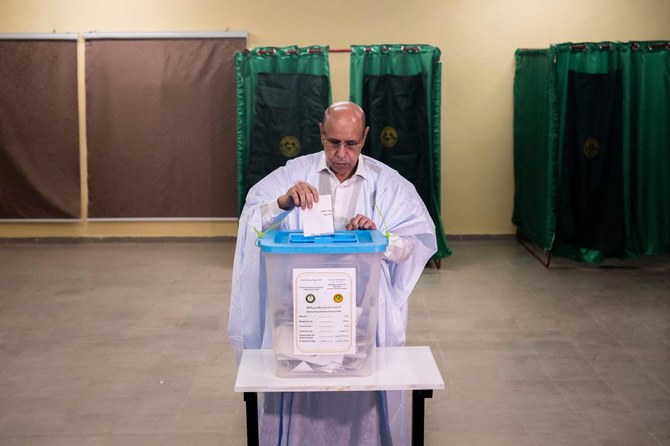
NOUAKCHOTT: Mauritania’s incumbent President Mohamed Ould Cheikh El Ghazouani has comfortably won re-election with 56.12 percent of the vote, the Independent National Electoral Commission (CENI) said Monday.
Victory gives the former army chief a second term as head of the vast desert country, seen as a rock of relative stability in Africa’s volatile Sahel region and set to become a gas producer.
Ghazouani would have faced a second round had he not won more than half the votes in Saturday’s election. As it was, he placed well ahead of his main rival, anti-slavery activist Biram Dah Abeid, who won 22.10 percent, according to results announced by CENI chief Dah Ould Abdel Jelil.
Abeid said Sunday he would not recognize the results of CENI, which he accused of being manipulated by the government.
Ghazouani’s other main rival, Hamadi Ould Sid’ El Moctar, who heads the Tewassoul party, came third with 12.78 percent, according to CENI.
“We did everything we could to prepare the conditions for a good election and we were relatively successful,” said the head of the electoral commission.
A 2019 election brought Ghazouani to power, marking the first transition between two elected presidents since independence from France in 1960 and a series of coups from 1978 to 2008.
While the Sahel has in recent years seen a string of military coups and escalating extremism, particularly in Mali, Mauritania has not experienced an attack since 2011.
Ghazouani, 67, is widely regarded as the mastermind behind the West African state’s relative security.
Saturday’s presidential election had an overall turnout of 55.39 percent, lower than in 2019.
The results had trickled in since Saturday evening and were published continuously on an official online platform, giving an indication of the final outcome.
“We will only recognize our own results, and therefore we will take to the streets” to refuse the electoral commission count, opponent Abeid said.
Some of his supporters demonstrated in the capital Nouakchott late Sunday, burning tires and disrupting traffic.
At the end of the afternoon, Abeid’s campaign headquarters were surrounded by security forces, according to an AFP journalist. His campaign manager was arrested, a spokesman said.
The police presence in the capital increased significantly later in the evening.
El Moctar said Saturday that he would “remain attentive” to any breach of voting regulations, while calling on his supporters to steer clear of anything that could create public disorder.
Ghazouani has made helping the young a key priority in a country of 4.9 million people, where almost three quarters are aged under 35.
After a first term hit by the fallout from the Covid-19 pandemic and the war in Ukraine, the incumbent says he hopes to make more reforms thanks to a favorable economic outlook.
Growth should average 4.9 percent (3.1 percent per capita) for the period 2024-2026, according to the World Bank, spurred by the launch of gas production in the second half of this year.
Inflation has fallen from a peak of 9.5 percent in 2022 to 5 percent in 2023, and should continue to slow to 2.5 percent in 2024.


![]()

Mauritania’s Ghazouani wins re-election with 56.12% of vote
Short Url
https://arab.news/52r79
Mauritania’s Ghazouani wins re-election with 56.12% of vote
- Victory gives the former army chief a second term as head of the vast desert country
- Ghazouani, 67, is widely regarded as the mastermind behind the West African state’s relative security


Latest updates


Recommended


© 2026 SAUDI RESEARCH & PUBLISHING COMPANY, All Rights Reserved And subject to Terms of Use Agreement.