Mauritanians go to the polls as Ghazouani seeks re-election

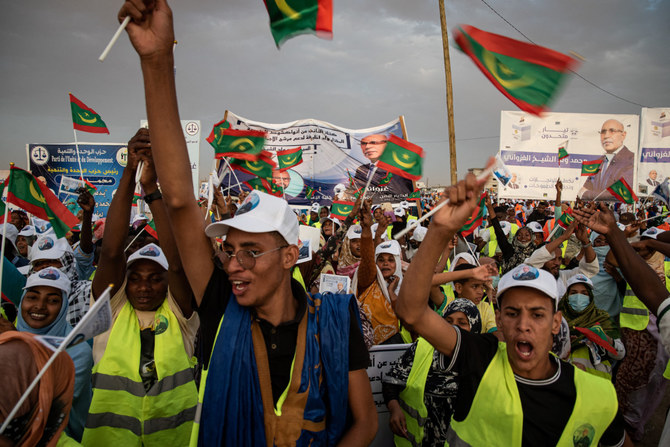
Supporters of Mauritanian President Mohamed Ould Ghazouani attend the final campaign rally in Nouakchott on June 27, 2024. (AFP)
Short Url
Updated 29 June 2024
Follow

Mauritanians go to the polls as Ghazouani seeks re-election

  • Incumbent President Mohamed Ould Ghazouani is widely expected to win Saturday’s vote due to the ruling party’s dominance
  • He has presided over a period of relative stability since 2019, while Mauritania’s Sahel neighbors struggle with Islamist insurgencies

NOUAKCHOTT: Mauritanians head to the polls on Saturday in a presidential election that sees incumbent Mohamed Ould Ghazouani taking on six challengers in the West African desert nation that will soon become a gas producer.
Ghazouani, 67, a former top soldier, has promised to accelerate investments to spur a commodities boom in the country of 5 million people, many of whom live in poverty despite its fossil fuel and minerals wealth.
Elected for a first term in 2019, Ghazouani is widely expected to win Saturday’s vote due to the ruling party’s dominance.
His six opponents include anti-slavery activist Biram Dah Abeid, who came second in 2019 with over 18 percent of the vote, lawyer Id Mohameden M’Bareck, economist Mohamed Lemine El Mourtaji El Wafi, and Hamadi Sidi El Mokhtar of the Islamist Tewassoul party.
Some 2 million people are registered to vote. Key issues for them include fighting corruption and job creation for young people.
If re-elected, Ghazouani has promised a gas-fired power plant from the Greater Tortue Ahmeyin (GTA) offshore gas project, which is on track to start production by the end of the year. He also pledged to invest in renewable energy and expand gold, uranium, and iron ore mining.
Ghazouani has presided over a period of relative stability since 2019, as Mauritania’s Sahel neighbors, including Mali, struggle with Islamist insurgencies that have led to military coups.
Mauritania has not recorded a militant attack on its soil in recent years and Ghazouani, who currently chairs the African Union, has promised to manage Islamist threats.
Prominent activist Abeid is challenging Ghazouani on his human rights record and the marginalization of Mauritania’s Black African population, while El Mokhtar has a following among conservative and religious voters.
Even so, Ghazouani “is likely to win a second term, probably in the first round,” said Carine Gazier, sub-Saharan Africa specialist at the Concerto consultancy.
If no candidate receives more than 50 percent of the vote, the election would go to a second round.
One opposition supporter in the capital Nouakchott who spoke on condition of anonymity thought Ghazouani might struggle to win outright “if the votes are conducted transparently.”
In the last election, some opposition candidates questioned the credibility of the vote, sparking some small-scale protests.
Polls are scheduled to open at 7 a.m. GMT and close at 7 p.m. GMT.


First climate migrants arrive in Australia from sinking Tuvalu in South Pacific

Updated 3 sec ago
Follow

First climate migrants arrive in Australia from sinking Tuvalu in South Pacific

SYDNEY: The first climate migrants to leave the remote Pacific island nation of Tuvalu have arrived in Australia, hoping to preserve links to their sinking island home, foreign affairs officials said on Thursday.
More than one-third of Tuvalu’s 11,000 population applied for a climate visa to migrate to Australia, under a deal struck between the two countries two years ago.
The intake is capped at 280 visas annually to prevent a brain drain in the small island nation.
Among the islanders selected in the initial intake of climate migrants is Tuvalu’s first female forklift driver, a dentist, and a pastor focused on preserving their spiritual life thousands of kilometers (miles) from home, Australian government officials said.
Tuvalu, one of the countries at greatest risk from climate change because of rising sea levels, is a group of low-lying atolls scattered across the Pacific between Australia and Hawaii.
Manipua Puafolau, from Tuvalu’s main island of Funafuti, arrived in Australia a fortnight ago. A trainee pastor with the most prominent church in Tuvalu, he plans to live in the small town of Naracoorte in the state of South Australia, where several hundred Pacific Islanders work in seasonal agriculture and meat processing jobs.
“For the people moving to Australia, it is not only for their physical and economic well-being, but also calls for spiritual guidance,” he said in a video released by Australia’s foreign affairs department.
Tuvalu Prime Minister Feleti Teo visited the Tuvaluan community in Melton, Melbourne, last month to emphasize the importance of maintaining strong ties and cultural bonds across borders as citizens migrate, Tuvalu officials said.
On Tuvalu’s main atoll of Funafuti, the land is barely wider than the road in many stretches. Families live under thatched roofs, and children play football on the airport runway due to space constraints.
By 2050, NASA scientists project daily tides will submerge half of Funafuti atoll, home to 60 percent of Tuvalu’s residents, where villagers cling to a strip of land as narrow as 20 meters (65 feet). The forecast assumes a one-meter rise in sea levels, while the worst case, double that, would put 90 percent of the country’s main atoll under water.

CLIMATE VISAS OFFER ‘MOBILITY WITH DIGNITY’
Australia’s Foreign Minister Penny Wong said the climate migrants would contribute to Australian society.
The visa offered “mobility with dignity, by providing Tuvaluans the opportunity to live, study and work in Australia as climate impacts worsen,” Wong said in a statement to Reuters.
Support services are being established by Australia to help Tuvaluan families set up in the east coast city of Melbourne, Adelaide in South Australia and in the northern state of Queensland.
Kitai Haulapi, the first female forklift driver in Tuvalu, recently married and will relocate to Melbourne, population five million. In a video released by Australia’s foreign affairs department she says that she hopes to find a job in Australia and continue to contribute to Tuvalu by sending money back to her family.
Dentist Masina Matolu, who has three school-aged children and a seafarer husband, will move with her family to the northern Australian city of Darwin. She plans to work with indigenous communities.
“I can always bring whatever I learn new from Australia back to my home culture, just to help,” she said in a video statement.