Union of salaried Pakistanis petitions Supreme Court against new taxes

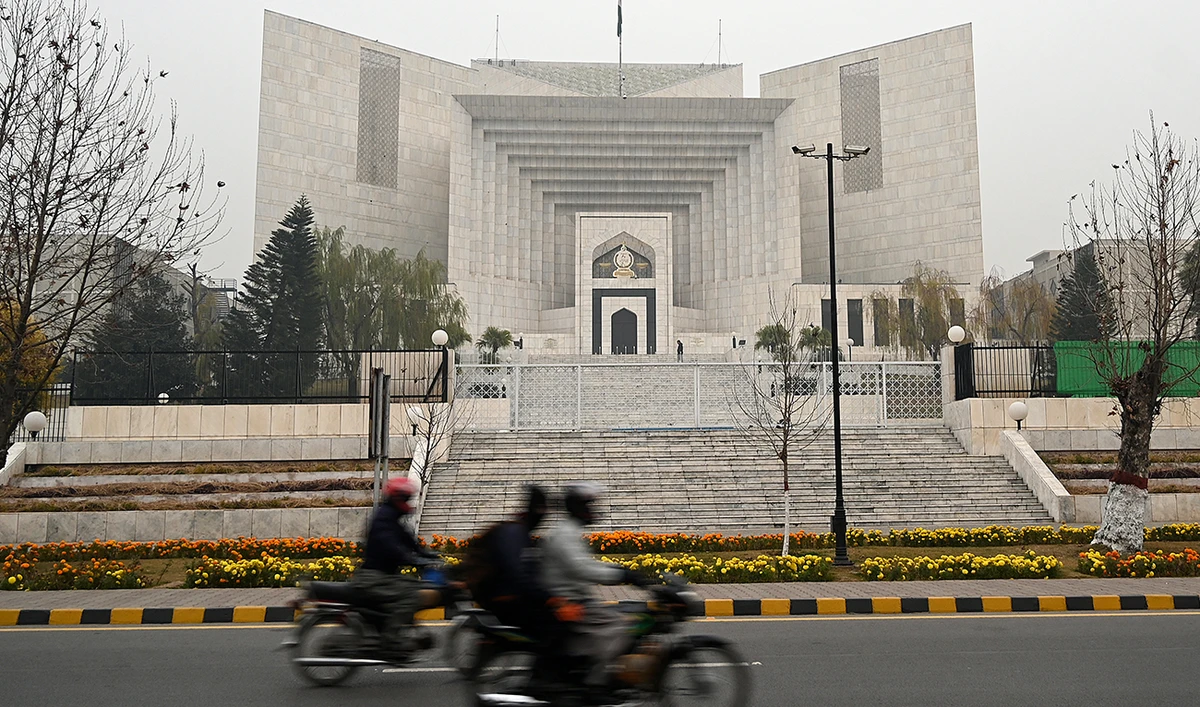
Commuters ride past the Pakistan's Supreme Court building in Islamabad on January 12, 2024. A second judge's resignation from Pakistan's Supreme Court was accepted on January 12, amid concerns of a growing rift in the judiciary ahead of general elections next month. (AFP/File)
Short Url
Updated 01 July 2024
Follow

Union of salaried Pakistanis petitions Supreme Court against new taxes

  • Budget 2024-25 has increased tax liability by Rs22,500 for all persons earning over Rs50,000 a month
  • Last year too the government had imposed more income tax on salaried people it deemed “high earners”

ISLAMABAD: The Salaried Class Alliance of Pakistan has petitioned the Supreme Court against what it calls “unfair” taxes imposed on workers under the budget 2024-2025 that came into effect today, Monday, according to a copy of the document seen by Arab News.

The government presented the national budget on June 12 with a challenging tax revenue target of 13 trillion rupees ($46.66 billion) for the year starting July 1, up about 40 percent from the current year, to strengthen the case for a new rescue deal with the International Monetary Fund (IMF). Parliament on Friday passed the finance bill, which has increased the tax liability by Rs22,500 for all persons earning more than Rs50,000 a month. Last year also the government had imposed a higher income tax on salaried persons it deemed “high earners.”

“The salaried class, already strained by high inflation and inadequate services, faces escalated tax rates without corresponding benefits or relief measures,” the union’s petition to the top court read. “The government’s approach neglects opportunities to broaden the tax base by targeting non-filers and the informal sector, crucial for equitable taxation.”

The petition said increased taxation would contribute to the brain drain of skilled professionals and capital flight, which were detrimental to Pakistan’s economic growth and stability, while also highlighting the practice of unjust taxation given the discrepancies in tax treatment for private sector salaried individuals and other sectors like government workers.

The petition called on the court to encourage measures to enforce taxation on non-active taxpayers and informal sectors.

“Request the Supreme Court’s intervention through Suo moto notice to review the constitutional validity and fairness of the tax measures proposed in the Finance Budget 2024-2025,” the petition said, outlining proposed actions for the court. 

“We appeal to the Honorable Court, under Article 184(3) of the Constitution of Pakistan, to uphold justice and protect the rights of the salaried class and all taxpayers in Pakistan. The current taxation policies threaten economic stability and fairness. We seek your urgent attention and intervention to ensure that taxation policies align with principles of equity, economic growth, and national development.”

The rise in the Pakistan government’s tax target is made up of a 48 percent increase in direct taxes and a 35 percent hike in indirect taxes over revised estimates of the current year. Non-tax revenue, including petroleum levies, is seen increasing by 64 percent. The tax would increase to 18 percent on textile and leather products as well as mobile phones besides a hike in the tax on capital gains from real estate. Workers will also get hit with more direct tax on income.

Opposition parties, mainly parliamentarians backed by the jailed former Prime Minister Imran Khan, and major trade bodies have rejected the budget, saying it will be highly inflationary and lead to industry shutdowns. On Monday, a main religious political party, the Jamaat-e-Islami, announced it would hold a sit-in in Islamabad against taxes and inflation from July 12. 

Pakistan’s central bank has also warned of possible inflationary effects from the budget, saying limited progress in structural reforms to broaden the tax base meant increased revenue must come from hiking taxes. 

The upcoming year’s growth target has been set at 3.6 percent, with inflation projected at 12 percent.


Pakistan PM orders accelerated privatization of power sector to tackle losses

Updated 15 December 2025
Follow

Pakistan PM orders accelerated privatization of power sector to tackle losses

  • Tenders to be issued for privatization of three major electricity distribution firms, PMO says
  • Sharif says Pakistan to develop battery energy storage through public-private partnerships

ISLAMABAD: Pakistan’s prime minister on Monday directed the government to speed up privatization of state-owned power companies and improve electricity infrastructure nationwide, as authorities try to address deep-rooted losses and inefficiencies in the energy sector that have weighed on the economy and public finances.

Pakistan’s electricity system has long struggled with financial distress caused by a combination of factors including theft of power, inefficient collection of bills, high costs of generating electricity and a large burden of unpaid obligations known as “circular debt.” In the first quarter of the current financial year, government-owned distribution companies recorded losses of about Rs171 billion ($611 million) due to poor bill recovery and operational inefficiencies, official documents show. Circular debt in the broader power sector stood at around Rs1.66 trillion ($5.9 billion) in mid-2025, a sharp decline from past peaks but still a major fiscal drain. 

Efforts to contain these losses have been a focus of Pakistan’s economic reform program with the International Monetary Fund, which has urged structural changes in the energy sector as part of financing conditions. Previous government initiatives have included signing a $4.5 billion financing facility with local banks to ease power sector debt and reducing retail electricity tariffs to support economic recovery. 

“Electricity sector privatization and market-based competition is the sustainable solution to the country’s energy problems,” Prime Minister Shehbaz Sharif said at a meeting reviewing the roadmap for power sector reforms, according to a statement from the prime minister’s office.

The meeting reviewed progress on privatization and infrastructure projects. Officials said tenders for modernizing one of Pakistan’s oldest operational hubs, Rohri Railway Station, will be issued soon and that the Ghazi Barotha to Faisalabad transmission line, designed to improve long-distance transmission of electricity, is in the initial approval stages. While not all power-sector decisions were detailed publicly, the government emphasized expanding private sector participation and completing priority projects to strengthen the electricity grid.

In another key development, the prime minister endorsed plans to begin work on a battery energy storage system with participation from private investors to help manage fluctuations in supply and demand, particularly as renewable energy sources such as solar and wind take a growing role in generation. Officials said the concept clearance for the storage system has been approved and feasibility studies are underway.

Government briefing documents also outlined steps toward shifting some electricity plants from imported coal to locally mined Thar coal, where a railway line expansion is underway to support transport of fuel, potentially lowering costs and import dependence in the long term.

State authorities also pledged to address safety by converting unmanned railway crossings to staffed ones and to strengthen food safety inspections at stations, underscoring broader infrastructure and service improvements connected to energy and transport priorities.