

Making Olympic timekeepers’ bells: a labor of love

The bells are rung for a range of disciplines including athletics, track cycling, mountain biking and boxing. (AFP)
Short Url
Updated 01 July 2024
Follow

Making Olympic timekeepers’ bells: a labor of love

LA CHAUX DE FONDS: The air is stifling hot, with a heavy, metallic smell that sticks in the throat and stings the eyes.
In his foundry with smoke-blackened walls, Alois Huguenin uses an enormous ladle to pour molten bronze at 1,250 degrees Celsius (2,282 degrees Fahrenheit) into a metal frame.
For three generations, the century-old traditional foundry in La Chaux-de-Fonds in northwestern Switzerland — the cradle of the country’s famous watchmaking industry — has been crafting the bells used at the Olympic Games.
The bells are rung for a range of disciplines including athletics, track cycling, mountain biking and boxing.
Almost half a century after his grandfather made the first bell for the Moscow Olympics in 1980, Huguenin was preparing the bells for the upcoming Paris Games.
“If all goes well, one Olympic bell is three hours of work,” the 30-year-old, equipped with an apron, gloves and a protective screen, told AFP recently.
Huguenin said he had already delivered 38 bells for Paris, at the request of the Games’ official timekeeper Omega, which has its chronometric testing laboratory around 30 kilometers away in Biel.
“The bell is used to indicate to the athletes, as well as to the spectators, when the last lap has started,” said Alain Zobrist, who heads OmegaTime and is in charge of chronometry within the wider Swatch Group.
It tells the athletes “they must give it their all to reach the finish line as quickly as possible,” he told AFP.
Recalling that Omega has been timekeeping at the Olympics since 1932, he acknowledged that the bells constitute “a very traditional element.”
“Today, chronometry is done electronically. The bells are a nod to our past,” he said.

Ten minutes after pouring the molten bronze — with the texture and bright orange-yellow color of volcanic lava — Huguenin can unmold the thick liquid, with a temperature of just 200C.
With heavy blows of his hammer, he breaks the hard, black-sand mold in the frame, as smoke billows out.
The bell that emerges is covered with a crust, revealing the work that remains to be done: deburring, sanding, filing and polishing.
Huguenin made his first Olympic bell for the 2020 Tokyo Games.
While not as obsessed by bells as some collectors can be, Huguenin says he is proud his creations are seen by billions.
“I put the same energy, the same passion into all the bells I make,” he said, explaining that he also makes bells for livestock, and increasingly for individual events like weddings.
“But to know that we are participating in our own small way in the big Olympic celebration is a source of pride.”
Huguenin said Olympic bells had been part of his life as far back as he could remember.
“Each edition, we watch TV to try to see if we can spot them,” he said, recalling how he kept an eye out for his father’s bells when he was younger.
And “for a few years now, I have been looking out for the bell that I made.”

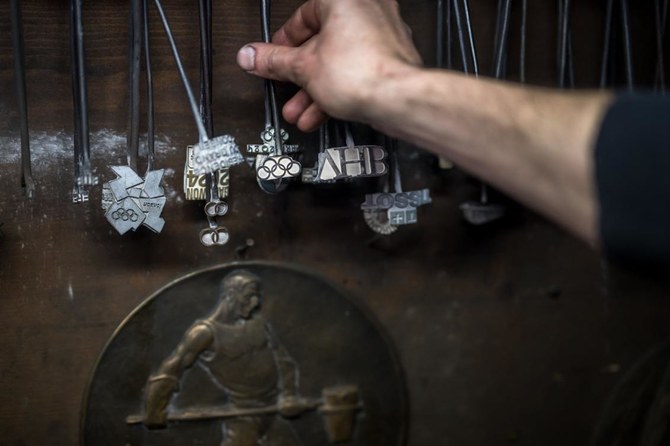
The bells used for each Olympics remain the same, with only the edition logo changing.
They are always emblazoned with the colorful Olympic rings, stand about 20 centimeters (7.9 inches) high and measure 14 centimeters (5.5 inches) across.
But each bell is nonetheless unique, Huguenin insisted, due to the use of traditional techniques, and recycling.
The clayey Paris sand used for his mold is not synthetic and is reused several times, he said, noting that some grains have been in service for 100 years.
As for the copper-tin alloy used for the bronze, it is made of individually-sourced recycled materials.
On the shelves near his wooden workbench, Huguenin keeps a souvenir collection of bells with defects that were made for previous Games in Atlanta, Rio and Athens.
But a few weeks before the opening of the Paris Olympics, he already has one eye on the future.
Bells need to be made for the 2028 Los Angeles Games, of course, he said, but “first there are the Winter Olympics in Milan Cortina” in 2026.
“I’m going to get started on it this autumn,” he said.
“I’m always one step ahead.”


In southeast Pakistan, Ramadan brings Hindus and Muslims closer

Updated 39 min 44 sec ago
Follow

In southeast Pakistan, Ramadan brings Hindus and Muslims closer

MITHI: Partab Shivani, a Hindu in Muslim-majority Pakistan, has fasted on and off during Ramadan for years, but this time is different as he practices abstinence for the entire holy month.
Every year, he and his friends in the southeastern city of Mithi arrange iftar, when Muslims break their daily fast, to foster peace and solidarity between the two religions.
“I believe we need to promote interfaith harmony. First, we are humans — religions came later,” Shivani, a 48-year-old social activist, told AFP, adding that he also reads the teachings of the Buddha.
“His message is about peace and ending war. Peace can spread through solidarity and by standing with one another. Distance only widens the gap between people,” he added.
Ninety-six percent of Pakistan’s 240 million people are Muslim. Just two percent are Hindu, most of them living in rural areas of Sindh province where Mithi is located.
In Mithi itself, most of the 60,000 inhabitants are Hindu.
Many of the city’s Hindus also observe Ramadan and iftar has become a social gathering where people from both faiths happily participate.
“This has been a wonderful tradition of ours for a very long time,” said Mir Muhammad Buledi, a 51-year-old Muslim friend who attended Shivani’s iftar gathering.
“It is a beautiful example of harmony between the two communities.”
Like brothers
Discrimination against minorities runs deep in Pakistan.
Following the end of British rule in South Asia in 1947, the subcontinent was partitioned into mainly Hindu India and Muslim-majority Pakistan.
That triggered widespread religious bloodshed in which hundreds of thousands were killed and millions displaced.
According to the Human Rights Commission of Pakistan, freedom of religion or belief is under constant threat, with religiously motivated violence and discrimination increasing yearly.
State authorities, often using religious unrest for political gain, have failed to address the crisis, the independent non-profit says.
But such tensions are absent in Mithi.
“I am a Hindu but I keep all the fasts during this month,” said Sushil Malani, a local politician. “I feel happy standing with my Muslim brothers.
“We celebrate Eid together as well. This tradition in the region is very old.”
Restaurants and tea stalls are closed across Pakistan during Ramadan.
Ramesh Kumar, a 52-year-old Hindu man who sells sweets and savoury items outside a Muslim shrine, keeps his push cart covered and closed until iftar.
“There is no discrimination among us if someone is Muslim or Hindu. I have been seeing this since my childhood that we all live together like brothers,” he said.
Muslim shrine, Hindu caretaker
Locals say Mithi’s peaceful religious coexistence can be traced to its remote location, emerging from the sand dunes of the Tharparkar desert, which borders the modern Indian state of Rajasthan.
Cows — considered sacred in Hinduism — roam freely in Mithi city, as they do in neighboring India.
At two Sufi Muslim shrines in the middle of the city, Hindu families arrange meals, bringing fruit, meals and juices for their Muslim neighbors to break their fasts.
“We respect Muslims,” said Mohan Lal Malhi, a Hindu caretaker of one of the shrines.
Mohan said his parents and elders taught him to respect people regardless of religion or color, and the traditions pass from one generation to the next.
Local residents said both communities consider their social relationships more important than their religious identity.
“You will see a (Sikh) gurdwara, a mosque, and a shrine standing side by side here,” Mohan said. “The atmosphere of this area teaches humanity.”