Explainer: How the French snap election runoff works and what comes next

1 / 3
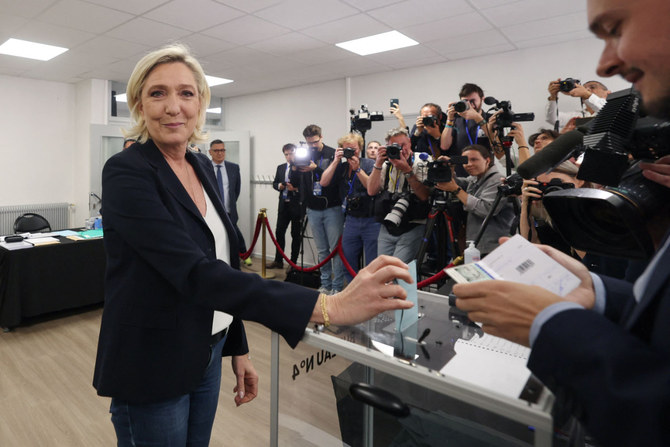
Marie-Caroline Le Pen, leader of the far right National Rally, casts her ballot in Henin-Beaumont, northern France, on June 30, 2024. (AFP
2 / 3
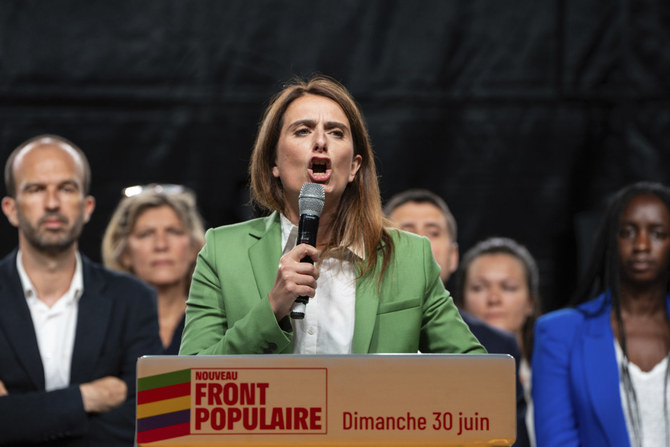
​ Green Party leader Marine Tondelier speaks at Republique plaza in Paris during a protest against the far-right National Rally, which came out strongly ahead in first-round legislative elections. (AP)
3 / 3
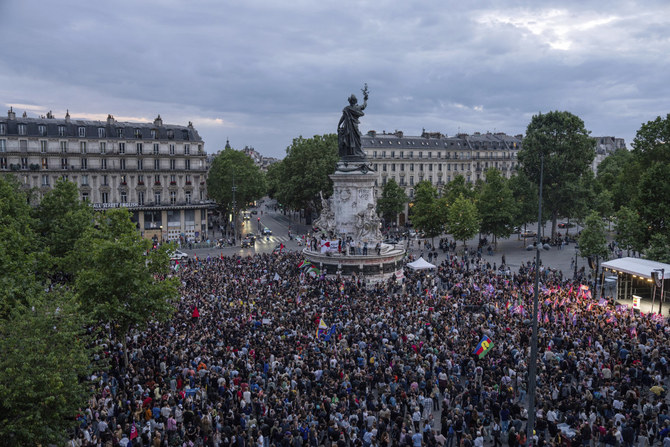
People gather at Republique square in Paris to protest the far-right National Rally on June 30, 2024 in Paris. (AP)
Short Url
Updated 01 July 2024
Follow

Explainer: How the French snap election runoff works and what comes next

  • If the National Rally or another political force than his centrist alliance gets a majority, Macron will be forced to appoint a prime minister belonging to that new majority
  • In such a situation — called “cohabitation” in France — the government would implement policies that diverge from the president’s plan

PARIS: French voters face a decisive choice on July 7 in the runoff of snap parliamentary elections that could see the country’s first far-right government since the World War II Nazi occupation — or no majority emerging at all.
Projections by polling agencies suggest the far-right National Rally stands a good chance of winning a majority in the lower house of parliament for the first time, but the outcome remains uncertain amid the complex voting system.

In Sunday’s first round, the National Rally arrived ahead with an estimated one-third of the votes. The New Popular Front coalition that includes center-left, greens and hard-left forces came out in second position, ahead of President Emmanuel Macron’s centrist alliance.
Here’s a closer look:
How does it work?
The French system is complex and not proportionate to nationwide support for a party. Legislators are elected by district.
Over 60 candidates who won at least 50 percent of Sunday’s vote have been elected outright.

In addition, the top two contenders, alongside anyone else who won support from more than 12.5 percent of registered voters, are qualified for the second round.

In many districts, three people made it to the second round, though some tactics to block far-right candidates have already been announced: The left-wing coalition said it would withdraw its candidates in districts when they arrived in third position in order to support other politicians opposed to the far right. Macron’s centrist alliance also said some of its candidates would step down before the runoff to block the National Rally.
This makes the result of the second round uncertain, despite polls showing that the National Rally party has a good chance to win an absolute majority, that is at least 289 out of the 577 seats.

The National Assembly, the lower house, is the more powerful of France’s two houses of parliament. It has the final say in the law-making process over the Senate, dominated by conservatives.
Macron has a presidential mandate until 2027, and said he would not step down before the end of his term.
What’s cohabitation?
If the National Rally or another political force than his centrist alliance gets a majority, Macron will be forced to appoint a prime minister belonging to that new majority.
In such a situation — called “cohabitation” in France — the government would implement policies that diverge from the president’s plan.

France’s modern Republic has experienced three cohabitations, the last one under conservative President Jacques Chirac, with Socialist Prime Minister Lionel Jospin, from 1997 to 2002.
The prime minister is accountable to the parliament, leads the government and introduces bills.
“In case of cohabitation, policies implemented are essentially those of the prime minister,” political historian Jean Garrigues said.
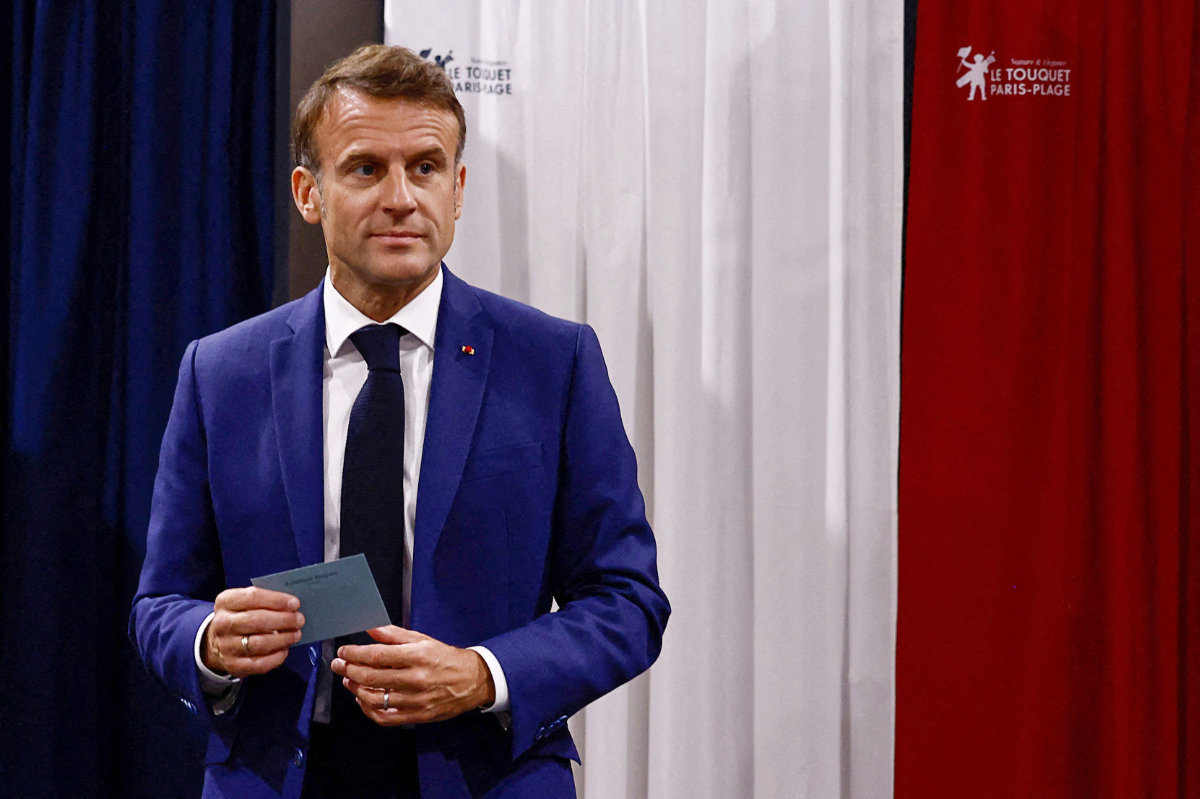


France’s President Emmanuel Macron leaves the polling booth prior to cast his vote at a polling station in Le Touquet, northern France on June 30, 2024. (POOL/AFP)

The president is weakened at home during cohabitation, but still holds some powers over foreign policy, European affairs and defense because he is in charge of negotiating and ratifying international treaties. The president is also the commander-in-chief of the country’s armed forces, and is the one holding the nuclear codes.
“It’s possible for the president to prevent or temporarily suspend the implementation of a certain number of the prime minister’s projects, since he has the power to sign or not sign the government’s ordinances or decrees,” Garrigues added.
“Yet the prime minister has the power to submit these ordinances and decrees to a vote of the National Assembly, thus overriding the president’s reluctance,” he noted.
Who leads defense and foreign policies?
During previous cohabitations, defense and foreign policies were considered the informal “reserved field” of the president, who was usually able to find compromises with the prime minister to allow France to speak with one voice abroad.
Yet today, both the far-right and the leftist coalition’s views in these areas differ radically from Macron’s approach and would likely be a subject of tension during a potential cohabitation.
According to the Constitution, while “the president is the head of the military, it’s the prime minister who has the armed forces at his disposal,” Garrigues said.
“In the diplomatic field also, the president’s perimeter is considerably restricted,” Garrigues added.
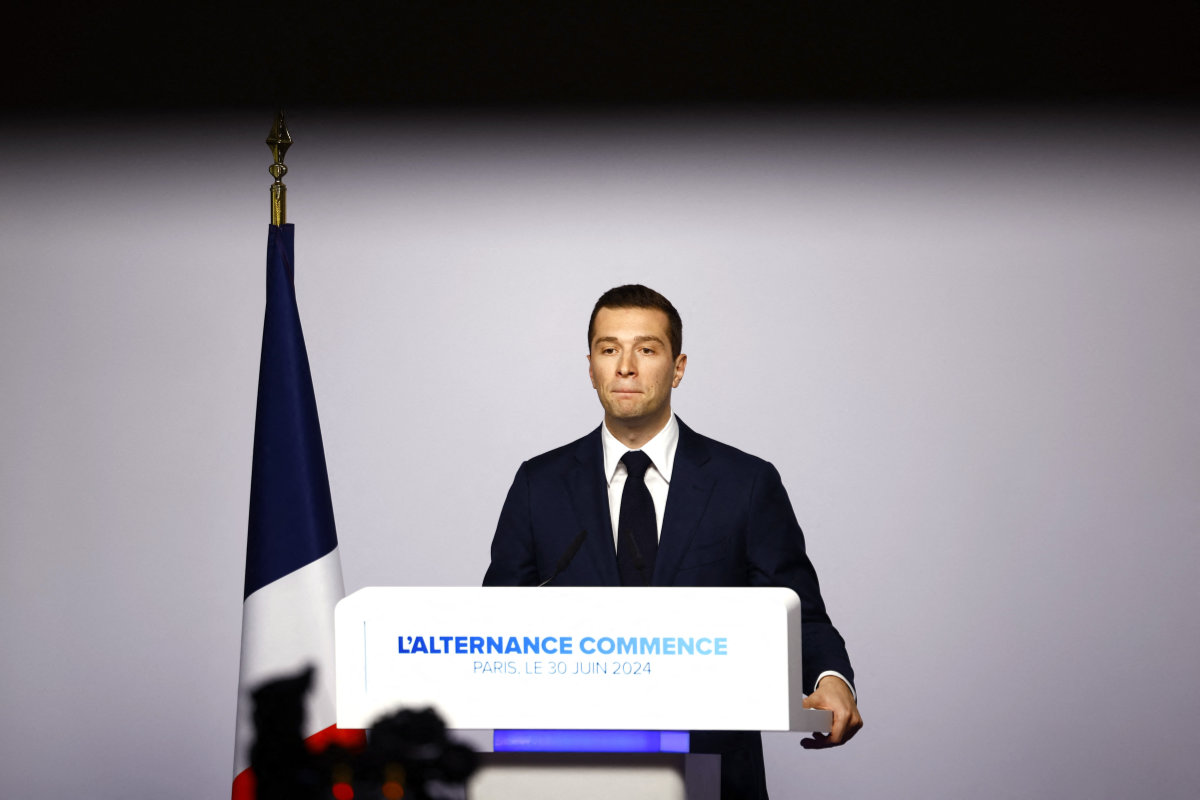


Jordan Bardella, president of the French far-right National Rally party, reacts on stage after partial results in the first round of the early French parliamentary elections in Paris on June 30, 2024. (REUTERS)

Far-right leader Jordan Bardella, who could becomes prime minister if his party wins the majority of the seats, said he intends “to be a cohabitation prime minister who is respectful of the Constitution and of the President of the Republic’s role but uncompromising about the policies we will implement.”
Bardella said that if he were to become prime minister, he would oppose sending French troops to Ukraine — a possibility Macron has not ruled out. Bardella also said he would refuse French deliveries of long-range missiles and other weaponry capable of striking targets within Russia itself.
What happens if there’s no majority?
The president can name a prime minister from the parliamentary group with the most seats at the National Assembly — this was the case of Macron’s own centrist alliance since 2022.
Yet the National Rally already said it would reject such an option, because it would mean a far-right government could soon be overthrown through a no-confidence vote if other political parties join together.
The president could try to build a broad coalition from the left to the right, an option that sounds unlikely, given the political divergences.
Prime Minister Gabriel Attal hoped Sunday to be able to have enough centrist lawmakers to build “a majority of projects and ideas” with other “Republican forces,” which may include those from the center-left and the center-right.
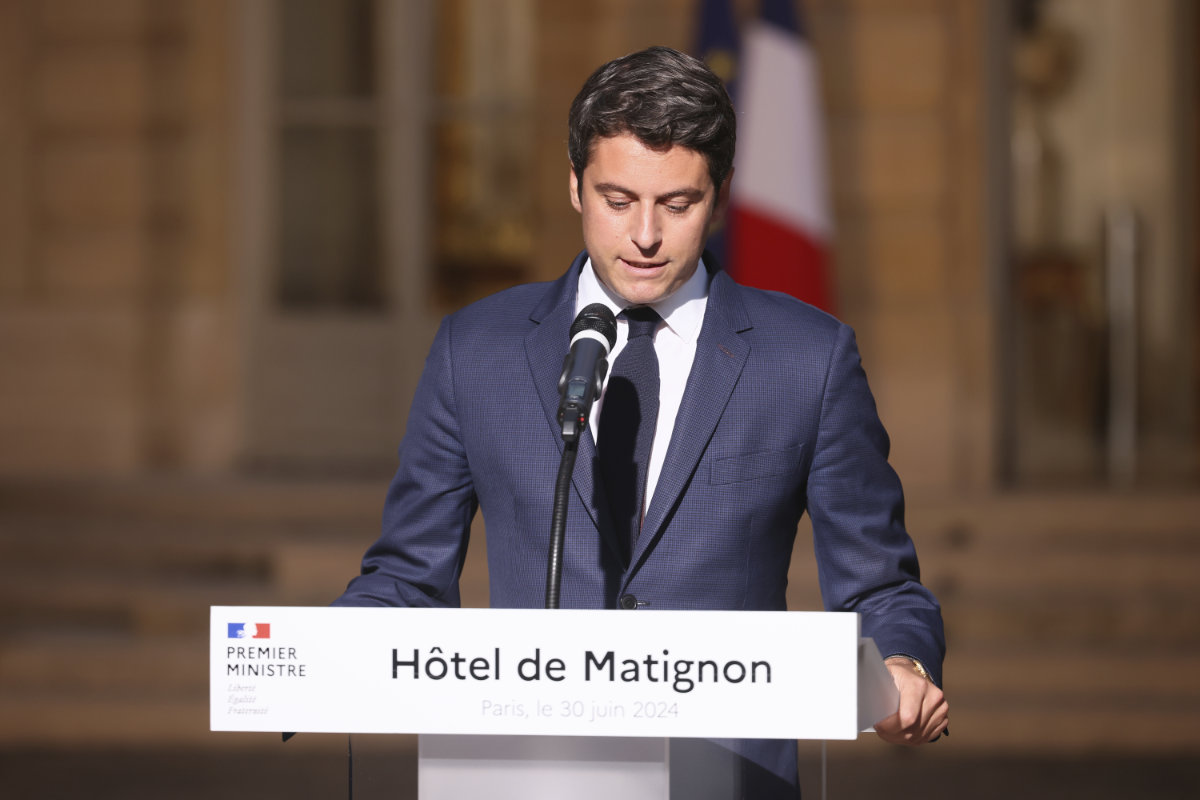


French Prime Minister Gabriel Attal delivers a speech in the courtyard of the Prime Minister’s residence in Paris on June 30, 2024. (AP)

Experts say another complex option would be to appoint “a government of experts” unaffiliated with political parties but which would still need to be accepted by a majority at the National Assembly. Such a government would likely deal mostly with day-to-day affairs rather than implementing major reforms.
If political talks take too long amid summer holidays and the July 26-Aug. 11 Olympics in Paris, Garrigues said a “transition period” is not ruled out, during which Macron’s centrist government would “still be in charge of current affairs,” pending further decisions.
“Whatever the National Assembly looks like, it seems that the Constitution of the 5th Republic is flexible enough to survive these complex circumstances,” Melody Mock-Gruet, a public law expert teaching at Sciences Po Paris, said in a written note. “Institutions are more solid than they appear, even when faced with this experimental exercise.”
“Yet there remains another unknown in the equation: the population’s ability to accept the situation,” Mock-Gruet wrote.



Zelensky reaffirms his refusal to cede land to Russia as he rallies European support

Updated 4 sec ago
Follow

Zelensky reaffirms his refusal to cede land to Russia as he rallies European support

  • “Undoubtedly, Russia insists for us to give up territories. We, clearly, don’t want to give up anything. That’s what we are fighting for,” Zelensky says

ROME: Ukrainian President Volodymyr Zelensky has reaffirmed his strong refusal to cede any territory, resisting US pressure for painful concessions to Russia as he moved ahead Tuesday to rally more European support for his country.
“Undoubtedly, Russia insists for us to give up territories. We, clearly, don’t want to give up anything. That’s what we are fighting for,” Zelensky told reporters in a WhatsApp chat late Monday.
“Do we consider ceding any territories? According to the law we don’t have such right,” he said. “According to Ukraine’s law, our constitution, international law, and to be frank, we don’t have a moral right either.”
In an interview with Politico released Tuesday, US President Donald Trump pressed Zelensky to accept the US proposal that Ukraine cede territory to Russia, arguing Moscow has the “upper hand” in its nearly 4-year-old invasion, and that Zelensky’s government must “play ball.”
Zelensky met in Rome with Italian Premier Giorgia Meloni, discussing the progress of the peace process, her office said. They emphasized the importance of US and European unity and of solutions “that will have repercussions on the continent’s security,” the statement said.
They also discussed “developing robust security guarantees to prevent future aggression and maintaining pressure on Russia to join the negotiating table in good faith,” it said.
Earlier, Zelensky met with Pope Leo XIV at Castel Gandolfo, a papal residence outside Rome. The Vatican said Leo reiterated the need for continuing dialogue and “expressed his urgent desire that the current diplomatic initiatives bring about a just and lasting peace.”
The Holy See has tried to stay neutral in the war while offering solidarity and assistance to what it calls the “martyred” people of Ukraine. Leo has met three times with Zelensky and has spoken by telephone at least once with Russian President Vladimir Putin, calling for a ceasefire and urging Moscow to make gestures promoting peace.
On Monday, Zelensky held talks in London with British Prime Minister Keir Starmer, French President Emmanuel Macron and German Chancellor Friedrich Merz to strengthen Ukraine’s hand amid mounting impatience from Trump.
Ukraine faces US pressure
US and Ukrainian negotiators completed three days of talks Saturday aimed at trying to narrow differences on the Trump administration’s peace proposal.
A major sticking point is the suggestion that Kyiv must give up control of the Donbas region of eastern Ukraine to Russia, which occupies most but not all of the territory. Ukraine and its European allies firmly resist the idea of handing over land.
“You know, a lot of people are dying,” Trump told Politico on Monday, claiming that other Ukrainian officials that he identified only as Zelensky’s “lieutenants, his top people” agree with the US administration.
Other than Zelensky’s comments Monday, Ukrainian negotiators have said little in public about the content of the US proposal or their attitude toward it.
Speaking to reporters again Tuesday on WhatsApp, Zelensky said three documents were being discussed with American and European partners — a 20-point framework document that is constantly changing, a document on security guarantees and a document about Ukraine’s recovery.
Zelensky told reporters that Ukraine’s updated version of the proposal would be given to the US on Wednesday.
Russia, Trump said, is too powerful for Ukraine to continue fighting.
“I give the people of Ukraine and the military of Ukraine tremendous credit for the, you know, bravery and for the fighting and all of that,” he said. “But you know, at some point, size will win, generally.”
Trump also repeated his call for Ukraine to hold a presidential election even though martial law doesn’t allow it and Zelensky, elected in 2019, had his five-year term extended because of the war. Trump’s position on Ukraine’s failure to hold an election mirrors frequent statements on the subject by Putin.
Responding to Trump’s remarks, Zelensky asked for help from the US and possibly Europe “to ensure security for the elections” and suggested that Ukraine could be ready to hold balloting in 60 to 90 days.
In past comments, Zelensky has declined to hold elections until a ceasefire is declared and martial law lifted, and Ukrainians have largely supported that decision.
European leaders repeat support for Kyiv
Starmer, Macron and Merz strongly backed Kyiv, with the UK leader saying Monday that the push for peace was at a “critical stage” and stressing the need for “a just and lasting ceasefire.”
Merz, meanwhile, said he was “skeptical” about some details in documents released by the US “We have to talk about it. That’s why we are here,” he said. “The coming days … could be a decisive time for all of us.”
European leaders are working to ensure that any ceasefire is backed by solid security guarantees both from Europe and the US to deter Russia from attacking again. Trump has not given explicit guarantees in public.
Zelensky and his European allies have repeatedly accused Putin of slow-walking the talks to press ahead with the invasion.
Both sides exchange aerial strikes
Ukraine’s air force said Russia fired 110 drones across the country overnight. While air defenses neutralized 84 drones, 24 more struck their targets.
Several regions of Ukraine faced emergency blackouts Tuesday due to Russian attacks on energy infrastructure, according to Ukraine’s national energy operator, Ukrenergo.
UN deputy humanitarian chief Joyce Msuya said Tuesday only 65 percent of the $278 million required to fund a winter response plan in Ukraine has been received, forcing cuts to services like cash assistance, heating support, mental health care and protection for women and girls.
This means families are facing freezing temperatures without heating, women and girls are losing access to “safe spaces” and older people in front-line areas are left without the means to evacuate, she told the UN Security Council.
The UK Defense Ministry said a member of the British military died Tuesday of his injuries from an accident while observing Ukrainian troops test a defensive system away from the front lines — the first UK servicemember to die in Ukraine in the war. It was not immediately clear what role he was serving or where the accident occurred.
The UK military has said a small of number of personnel are in Ukraine to protect British diplomats and support Ukrainian troops.
Ukraine also continued its drone attacks on Russia.
Russia said it destroyed 121 drones in various regions and in the Crimean Peninsula, which Moscow illegally annexed from Ukraine in 2014. In Chuvashia, a region about 900 kilometers (about 560 miles) northeast of the Ukrainian border, an attack damaged residential buildings and injured nine people, Gov. Oleg Nikolayev said.
Ukraine’s Security Service carried out a drone attack on a liquefied gas terminal at the port of Temryuk in Russia’s Krasnodar region on Dec. 5, according to an official with knowledge of the operation who spoke to The Associated Press.
The official, who spoke on condition of anonymity because he was not authorized to comment publicly, said the strike sparked a fire at the facility, with more than 20 storage tanks set ablaze for over three days.