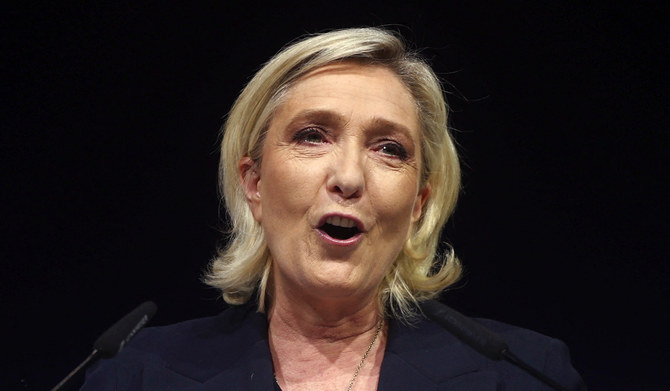


PARIS: France’s far right was on Sunday eyeing a historic chance to form a government and claim the post of prime minister after winning the first round of legislative elections with the centrist forces of President Emmanuel Macron coming in only third.
But it remained unclear if the far-right National Rally (RN) party of Marine Le Pen would win the absolute majority of seats in the new National Assembly in the July 7 second round. That is what it would need to be certain of taking power and for Le Pen’s protege Jordan Bardella, 28, to become prime minister.
Macron had stunned the nation and baffled even some allies by calling snap polls after the RN trounced his centrist forces in European Parliament elections this month.
But that gamble risks backfiring, with Macron’s alliance now expected to win a far smaller minority contingent in parliament. That would make the president a far less powerful figure for the remaining three years of his term.
Projections from prominent French polling firms gave the RN 33.2-33.5 percent of the vote, compared to 28.1-28.5 percent for the left-wing New Popular Front alliance, and 21.0-22.1 percent for Macron’s centrist camp.
The polling agencies projected this would give the RN a majority of seats in the 577-seat National Assembly after the second round. But it was far from clear the party would garner the 289 seats needed for an absolute majority.
The projections varied sharply, with Ipsos forecasting 230-280 seats, Ifop 240-270 and Elabe the only organization to put it in the range of an absolute majority on 260-310 seats.
In a statement, Macron called for a “broad” alliance against the far right in the second round, which will see run-off votes where there was no outright winner in the first round.
The leftwing alliance and the president’s camp will be hoping that tactical voting to prevent RN candidates winning seats will leave it short of the absolute majority.
French Prime Minister Gabriel Attal, who is likely to be forced to resign after the second round, warned the far right was now at the “gates of power.” The RN should not get a “single vote” in the second round, he said.
“We have seven days to spare France from catastrophe,” said Raphael Glucksmann, a key figure in the left-wing alliance.
With the French facing their most polarizing choices in recent history, turnout soared to 65 percent, way above the turnout in 2022 polls of just 47.5 percent.
Macron said the high turnout in the first round spoke of “the importance of this vote for all our compatriots and the desire to clarify the political situation.”
The arrival of anti-immigration and euroskeptic RN in government would be a turning point in French modern history and be the first time a far-right force has taken power in the country since World War II when it was occupied by Nazi Germany.
“Nothing is won and the second round is decisive,” Le Pen, who has long worked to distance the party from its extremist origins, told supporters.
“We need an absolute majority so that Jordan Bardella is in eight days named prime minister by Emmanuel Macron.”
Bardella said he wanted to be the “prime minister of all French.”
This would create a tense period of “cohabitation” with Macron, who has vowed to serve out his term until 2027.
Bardella has said he will only form a government if the RN wins an absolute majority in the elections.
The alternative is months of political paralysis and negotiations to find a solution for a sustainable government that can survive no-confidence votes.
Hard-left leader Jean-Luc Melenchon said Macron’s centrist alliance had suffered a “heavy and undisputable” defeat in the snap polls.
Risk analysis firm Eurasia Group said the RN now looked “likely” to fall short of an absolute majority. France was facing “at least 12 months with a rancorously blocked National Assembly and — at best — a technocratic government of ‘national unity’ with limited capacity to govern,” it added.
Macron’s decision to call the snap vote sparked uncertainty in Europe’s second-biggest economy. The Paris stock exchange suffered its biggest monthly decline in two years in June, dropping by 6.4 percent, according to figures released on Friday.
The turmoil also risks undermining Macron’s stature as an international leader taking a prime role in helping Ukraine fight the Russian invasion. In the immediate aftermath of the second round he is due to attend the NATO summit in Washington.
French daily Liberation urged voters to unite to halt the march of the far-right. “After the shock, form a block,” the newspaper said on its Monday front page.