Seven dead in torrential rains in southwest Pakistan amid warnings of more pre-monsoon showers

Onlookers gaze towards municipal workers using heavy machinery to level the ground after damage due to floodwaters following heavy rains on the outskirts of Quetta on April 15, 2024. (AFP/File)
Short Url
Updated 30 June 2024
Follow

Seven dead in torrential rains in southwest Pakistan amid warnings of more pre-monsoon showers

  • Provincial Disaster Management Authority calls Dera Bugti the most highly affected area due to the rainfall
  • Balochistan also bore a significant brunt of the devastation caused by heavy monsoon rains two years ago

QUETTA: Torrential rains killed seven people, including two children, and injured at least 25 in southwest Pakistan, a Provincial Disaster Management Authority (PDMA) official in Balochistan said on Sunday, adding that Dera Bugti district, about 360 kilometers from Quetta, was the most affected area.
Pakistan’s struggle with natural disasters intensified in 2022, as unprecedented monsoon rains wreaked havoc nationwide, claiming 1,700 lives and resulting in an estimated $35 billion in financial losses.
The country’s southern belt, including Balochistan, bore a significant brunt of the devastation.
Pakistan contributes less than one percent to global carbon emissions, though it ranks among the top ten nations most vulnerable to climate change.
“Relief operation is underway, and we have provided food items and tents to the affected,” Muhammad Younus, who supervises the PDMA emergency cell, told Arab News while confirming the number of fatalities. “Officials are doing the damage assessment survey.”
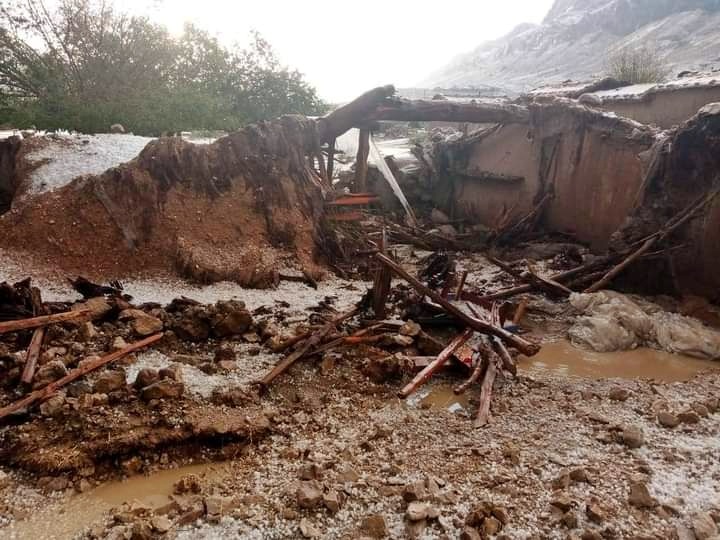


The photo taken on June 30, 2024, shows a house destroyed by torrential rains in the southwest Pakistan. (AN Photo)


Younus informed the province expected pre-monsoon rainfall early next month, starting from July 7.
“Relevant departments have been asked to clear the water channels before any disaster,” he added.
Speaking to Arab News, Riaz Ali, a resident of Sajjo Colony in Sui, a town in Dera Bugti district, said he lost his 17-year-old son a day earlier when the roof of a local restaurant collapsed due to heavy rain.
“It was 4 or 5 PM when the heavy rainstorm began and lasted for 30 minutes,” he recalled. “In the evening, I received a call from my neighbor, who works at a hospital, to tell me that my son had died. I went to the hospital to receive his body. He had been injured in his head.”
The current situation has reminded the residents of the province of the catastrophe two years ago when heavy rains led to flash floods that destroyed houses, agricultural fields and public infrastructure in the province.
Sannaullah Panezai, an associate professor of geography at the University of Balochistan, noted the rise in erratic weather patterns in Pakistan.
“Such rains mostly began by the end of July and lasted till September in the past,” he said, pointing out the region did not receive much rain in 2023. “Climate change has been affecting rainfall and causing flash floods.”
The recent rains in Balochistan have also caused concern for agricultural production in the area.
“Our garden of apples has been partially affected,” Fazal Deen, who has his own fields in Ziarat, told Arab News. “We have also planted vegetables on 10 acres of land that have been completely destroyed.”


At least 13 civilians killed in Pakistan strikes in Afghanistan, UN says

Updated 5 sec ago
Follow

At least 13 civilians killed in Pakistan strikes in Afghanistan, UN says

  • Pakistan said it launched the strikes after blaming recent suicide attacks on militants operating from Afghan territory
  • The reported toll adds to fears of a renewed cycle of retaliation between the neighbors, threatening a fragile ceasefire

ISLAMABAD/KABUL: At least 13 civilians ‌were killed and seven injured in Pakistani airstrikes in eastern Afghanistan, the United Nations said on Monday, as cross-border tensions escalated following a string ​of suicide bombings in Pakistan.

The reported toll adds to fears of a renewed cycle of retaliation between the neighbors, threatening a fragile ceasefire along their 2,600-km (1,600-mile) frontier and further straining ties as both sides trade blame over militant violence.

The United Nations Assistance Mission in Afghanistan (UNAMA) said it had received “credible reports” that overnight Pakistani airstrikes on February 21–22 killed at least 13 ‌civilians and injured ‌seven in the Behsud and Khogyani ​districts ‌of ⁠Nangarhar province.

Taliban ​spokesman Zabihullah ⁠Mujahid earlier reported dozens killed or wounded in the strikes, which also hit locations in Paktika province. Reuters could not independently verify the reported toll.

Pakistan said it launched the strikes after blaming recent suicide attacks, including during Ramadan, on militants operating from Afghan territory.

Pakistan’s information ministry in a post on X said ⁠the “intelligence-based” operation struck seven camps of the Pakistani Taliban ‌and Daesh (Islamic State) Khorasan Province ‌and that it had “conclusive evidence” the militant ​assaults on Pakistan were directed ‌by “Afghanistan-based leadership and handlers.”

Kabul has repeatedly denied allowing militants ‌to use Afghan territory to launch attacks in Pakistan.

The strikes took place days after Kabul released three Pakistani soldiers in a Saudi-mediated exchange aimed at easing months of tensions along the border.

Afghanistan’s defense ministry condemned ‌the strikes and called them a violation of sovereignty and international law, saying an “appropriate and measured ⁠response will ⁠be taken at a suitable time.” The Afghan foreign ministry said it had summoned Pakistan’s ambassador.

In a statement on the February 21-22 strikes, Afghanistan’s education ministry said eight school students; five boys and three girls, were killed in Behsud in Nangarhar province, and one madrasa student injured in Barmal in Paktika province, adding that dozens of other civilians were killed or wounded and educational centers destroyed. Reuters could not independently verify the information.

The latest strikes follow months of clashes and repeated border closures ​that have disrupted trade ​and movement along the rugged frontier.