Eleven dead in Indian capital after heavy rain, flight operations stutter

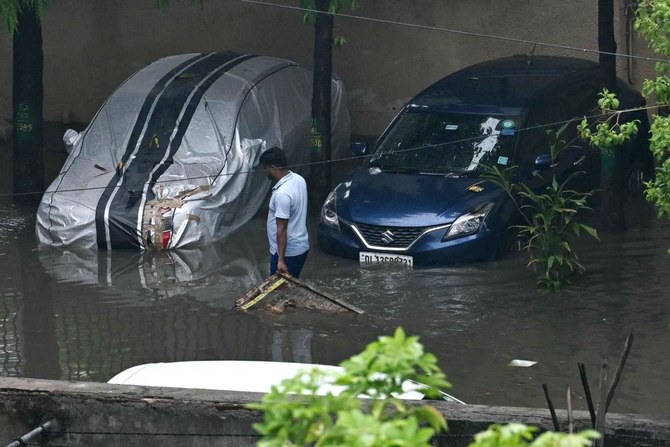
New Delhi faced the biggest downpour in decades on June 28, with rainfall in a single day surpassing the city’s average for the entire month. (AFP)
Short Url
Updated 30 June 2024
Follow

Eleven dead in Indian capital after heavy rain, flight operations stutter

  • New Delhi, which endured one of its worst heatwaves in history earlier this month, faced the biggest downpour in decades on June 28
  • Nearly 60 flights were canceled from New Delhi’s main airport in the last 24 hours, according to flight tracking platform Flightaware

NEW DELHI: The death toll from this week’s sudden heavy rain has climbed to 11 in New Delhi, including four citizens who drowned in submerged underpasses, the Times of India reported, while flight operations stuttered in the Indian capital.
New Delhi, which endured one of its worst heatwaves in history earlier this month, faced the biggest downpour in decades on June 28, with rainfall in a single day surpassing the city’s average for the entire month.
The torrential rain caused a fatal roof collapse at one of the three terminals of Delhi’s main airport, disrupted flights, flooded underpasses, and led to massive traffic jams, power and water outages in parts of the city.
Nearly 60 flights were canceled from New Delhi’s main airport in the last 24 hours, according to data from flight tracking platform Flightaware.
Operations were largely normal on Sunday, with most flights from the affected terminal diverted to the other two, an airport official said but did not rule out possible flight cancelations in the course of the day.
The Delhi airport is one of the country’s biggest and busiest.
Terminal 1, the now-closed terminal, is mostly used by low-cost carriers IndiGo, operated by Interglobe Aviation, and SpiceJet, and currently has a capacity to handle 40 million passengers annually.
An Indigo spokesperson did not comment on the flight cancelations and a SpiceJet spokesperson did not immediately respond to a phone call.


Philippines eyes closer cooperation on advanced defense tech with UAE

Updated 7 sec ago
Follow

Philippines eyes closer cooperation on advanced defense tech with UAE

  • Philippine-UAE defense agreement is Manila’s first with a Gulf country
  • Philippines says new deal will also help modernize the Philippine military

MANILA: The Philippines is seeking stronger cooperation with the UAE on advanced defense technologies under their new defense pact — its first such deal with a Gulf country — the Department of National Defense said on Friday.

The Memorandum of Understanding on Defense Cooperation was signed during President Ferdinand Marcos Jr.’s visit to Abu Dhabi earlier this week, which also saw the Philippines and the UAE signing a comprehensive economic partnership agreement, marking Manila’s first free trade pact with a Middle Eastern nation.

The Philippines-UAE defense agreement “seeks to deepen cooperation on advanced defense technologies and strengthen the security relations” between the two countries, DND spokesperson Assistant Secretary Arsenio Andolong said in a statement.

The MoU “will serve as a platform for collaboration on unmanned aerial systems, electronic warfare, and naval systems, in line with the ongoing capability development and modernization of the Armed Forces of the Philippines,” he added.

It is also expected to further military relations through education and training, intelligence and security sharing, and cooperation in the fields of anti-terrorism, maritime security, and peacekeeping operations.

The UAE’s Ministry of Foreign Affairs has described security and defense as “very promising fields” in Philippine-UAE ties, pointing to Abu Dhabi being the location of Manila’s first defense attache office in the Middle East.

The UAE is the latest in a growing list of countries with defense and security deals with the Philippines, which also signed a new defense pact with Japan this week.

“I would argue that this is more significant than it looks on first read, precisely because it’s the Philippines’ first formal defense cooperation agreement with a Gulf state. It signals diversification,” Rikard Jalkebro, associate professor at the Anwar Gargash Diplomatic Academy in Abu Dhabi, told Arab News.

“Manila is widening its security partnerships beyond its traditional circles at a time when strategic pressure is rising in the South China Sea, and the global security environment is (volatile) across regions.”

Though the MoU is not an alliance and does not create mutual defense obligations, it provides a “framework for the practical stuff that matters,” including access, training pathways, procurement discussions and structured channels” for security cooperation, he added.

“For the UAE, the timing also makes sense, seeing that Abu Dhabi is no longer only a defense buyer; it’s increasingly a producer and exporter, particularly in areas like UAS (unmanned aerial systems) and enabling technologies. That opens a new lane for Manila to explore capability-building, technology transfer, and industry-to-industry links,” Jalkebro said.

The defense deal also matters geopolitically, as events in the Middle East and the Indo-Pacific region have ripple effects on global stability and commerce.

“So, a Philippines–UAE defense framework can be read as a pragmatic hedge, strengthening resilience and options without formally taking sides,” Jalkebro said.