UNESCO-inscribed oral tradition of Alheda’a reflects enduring bond between Arabs and camels

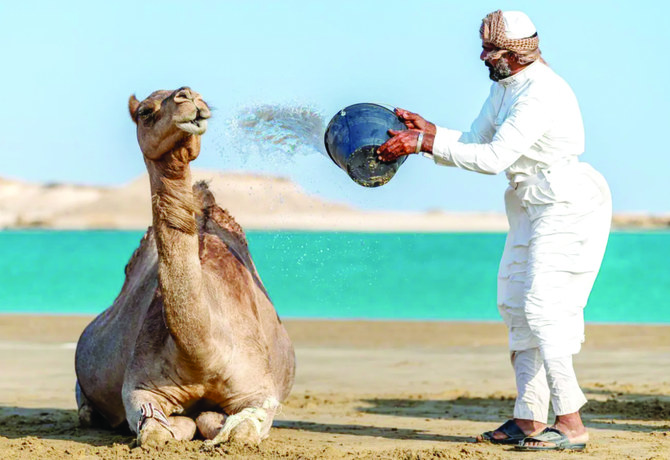
Camel herders use Alheda’a — a combination of sounds, gestures, and sometimes musical instruments — to communicate with their camels. (SPA)
Short Url
Updated 03 July 2024
Follow

UNESCO-inscribed oral tradition of Alheda’a reflects enduring bond between Arabs and camels

  • Historical accounts credit Mudar bin Nizar with having invented Alheda’a. After a fall from his camel, he kept crying “Waidah! Waidah!” (Oh, my hand!). The camels began moving, thus beginning the tradition of using vocal cues to guide camels

RIYADH: Alheda’a, a folk art passed down through generations across Arabian societies, embodies the deep connection between camels and locals.

Camel herders use Alheda’a — a combination of sounds, gestures, and sometimes musical instruments — to communicate with their camels. These rhythmic expressions, inspired by poetry, form a unique vocabulary that camels seem to understand and obey.

According to a report by the Saudi Press Agency published on June 29, herders use Alheda’a to guide their camels through the desert, find pastures for grazing, and prepare them for watering, milking, and riding. It also allows them to quickly gather the herd together in case of sandstorms.

Historical accounts credit Mudar bin Nizar with having invented Alheda’a. After a fall from his camel, he kept crying “Waidah! Waidah!” (Oh, my hand!). The camels began moving, thus beginning the tradition of using vocal cues to guide camels.

Early Alheda’a mimicked natural camel noises — herders would urge their animals along with sounds including “Heh,” “Doh,” and “Dah.” These vocalizations, along with rajaz (short, improvised poems), are still used today, but their use varies depending on the environment.

Over time, Alheda’a has evolved into a more poetic artform, with distinct styles and vocabulary. It has incorporated deeper meanings, sung verses, and balanced rhythms.

Saudi folk heritage researcher Ibrahim Al-Khaldi told the SPA that Alheda’a was “essential” for nomadic caravans. It typically involved two people reciting simple rhyming verses in unison, a practice that helped encourage the camels while extracting water from wells. For larger water-extraction tasks, where gathering distant camels was crucial, up to four people might recite Alheda’a. Their voices, carried in the quiet of the desert night or dawn, would travel a great distance.

The chairman of the Saudi Society for Camel Studies, Dr. Mohammed Al-Otaibi, told the SPA that Alheda’a existed in pre-Islamic times. The short, impactful chants helped gather camels, guide their movements, and direct them back to their resting places.

Inscribed in 2022 on the UNESCO Representative List of the Intangible Cultural Heritage of Humanity, Alheda’a has various specific chants — for departure, travel, watering, gathering, and drawing water from wells.

Camels hold a unique place in Arab society. Recognizing this rich cultural heritage, the Camel Club was established in Saudi Arabia under the directives of King Salman in 2017.

The Ministry of Culture even declared 2024 “Year of the Camel,” in honor of an animal seen as a cultural treasure, a pillar of national identity, and a valuable part of Arab heritage.


Decoder

What is Alheda’a?

Alheda’a is a combination of sounds, gestures, and sometimes musical instruments used by camel herders across Arabia to communicate with their camels. A folk art passed down through generations, these rhythmic expressions, inspired by poetry, form a unique vocabulary that camels seem to understand and obey.


Experimental farm in Al-Lith looks into future of Saudi Arabian agriculture

Updated 01 February 2026
Follow

Experimental farm in Al-Lith looks into future of Saudi Arabian agriculture

  • Research initiative reflects strategic transformation

JEDDAH: An experimental farm in Saudi Arabia’s Al-Lith Governorate is one of the research initiatives reflecting the strategic transformation taking place in the Kingdom’s agricultural sector.

The farm uses highly efficient, sustainable production models that combine scientific research with commercial application, contributing to strengthening the country’s food security system and the sustainability of water resources.

Located in the Ghumaiqa Center on an area of about 10 hectares, the cutting-edge farm is a testing platform for modern agricultural technologies that tackle the challenge of water scarcity.

The farm includes developed open fields and modern greenhouses, supported by smart irrigation encompassing drip and sprinkler irrigation alongside surface and subsurface technologies.

All the systems operate via smart controls that enable the monitoring of water consumption and ensure improved efficiency, thereby achieving a balance between agricultural production and water conservation.

The farm also uses treated and diluted low-salinity seawater.

It aims to diversify agricultural water sources, reduce reliance on freshwater, and open new horizons for agriculture in coastal and semi-arid environments.

The project represents a promising investment opportunity in the field of smart agriculture, enabling the development of commercially scalable production models, particularly for high-value vegetables and fruits, while reducing operational costs associated with water and energy, enhancing the economic feasibility of future agricultural projects.

In addition, the project contributes to transferring and localizing agricultural expertise, supporting local food supply chains, and creating an attractive environment for agricultural investment.

This aligns with Sustainable Development Goals and enhances the efficiency of the private sector in adopting innovative agricultural solutions.

Yahya bin Abdulrahman Al-Mahabi, the director of the Ministry of Environment, Water and Agriculture office in Al-Lith Governorate, told the Saudi Press Agency that the project represented the future of agriculture in the Kingdom.

He explained that the vision was based on investing in technology, enhancing the return on water per unit, and integrating scientific research with investment opportunities.

Al-Mahabi spoke of the experimental farm as a modern, scalable and replicable model applicable in several regions of the Kingdom, particularly in coastal environments.

Al-Mahabi highlighted the Ministry of Environment, Water and Agriculture’s commitment to supporting distinctive projects that contributed to achieving food security while developing rural areas and enhancing agricultural production efficiency, in line with the objectives of the Kingdom’s Vision 2030.