



RIYADH: The open studio at the second Intermix Residency offers entry into a realm of creative exploration in which artists from across the globe put the Kingdom’s natural landscapes and cultural elements at the center of their work.
Some 15 creators worked together over 10 weeks to develop their own artistic vision inspired by the fusion of visual arts and fashion, and centered around themes of transformation, innovation, and sustainability.
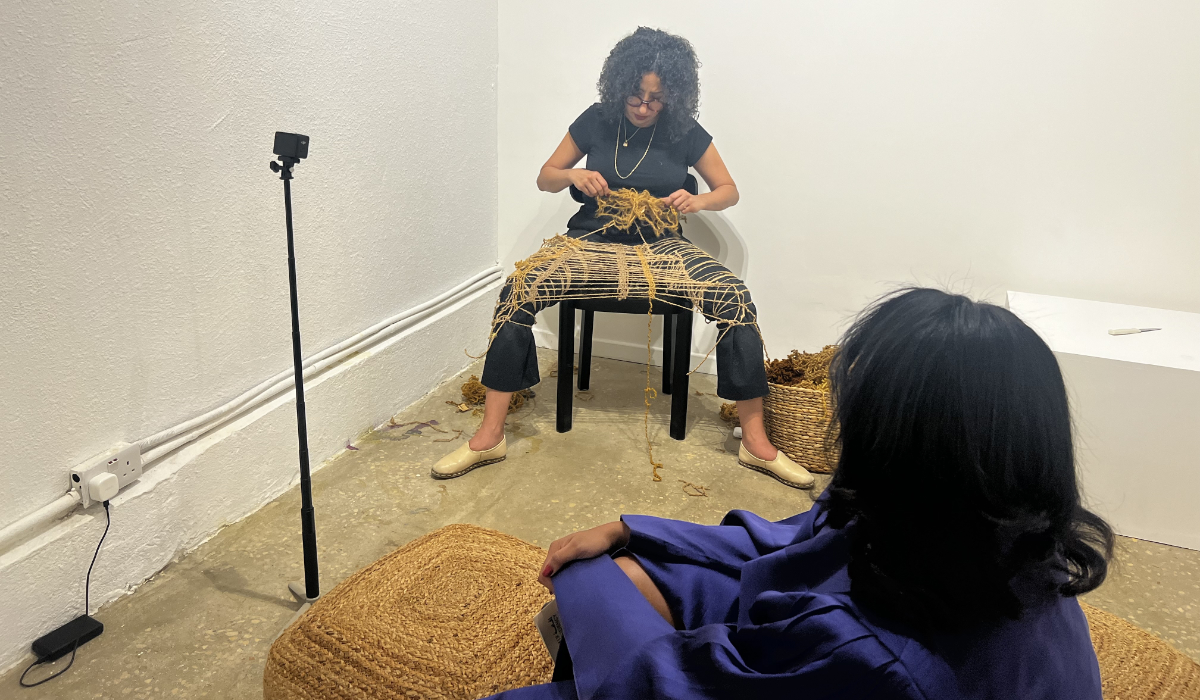
Kuwaiti artist Maha Alasaker focuses on the relationship between nature and culture, with a particular emphasis on the natural colors that can be extracted from the land, which led her to investigate herbal medicines and their historical use in pain management for women. (AN photo)
Italian visual artist Ivo Cotani told Arab News: “The residency (has) pushed me forward a lot. I’ve seen (it) not just in my productions, but (by) being myself in my art. I feel more mature and comfortable with what I’m doing.”
His artwork “I Am Nature” is a combination of various mediums and is inspired by local flora and fauna. His studio showcases small ceramic sculptures of oryxes, camels, eagles and other animals, abstract floral paintings, and animal-like flower masks made with the help of two artisans.
HIGHLIGHT
The Intermix Residency program is fully funded and initiated by Saudi Arabia’s Visual Arts Commission in collaboration with the Fashion Commission, and hosted in JAX District within Diriyah.
He added: “Whenever I work, I’m always relating to the land in some way. I have been looking at nature and the desert, and I also visited AlUla and saw the tombs and eagles there. From there I started creating and studying the animals of the desert. I was thinking of embodying nature in some way, and then I thought of masks.”
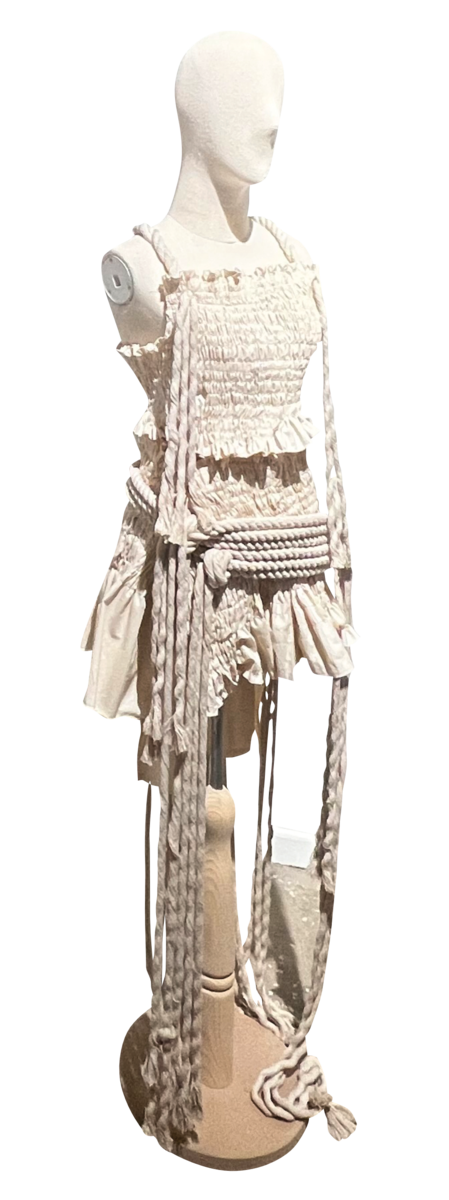
Alla Alsahli is a Syrian Palestinian designer born and raised in the United States whose work involves material manipulation and repetition to tell stories rooted in culture and space. (AN photo)
The open studio’s artworks delve into the intricacies of human experience, exploring how individuals embody memories, emotions, and interpretive codes that shape relationships between oneself, daily life, and the natural world, producing an archive of experiments, research, and possibilities.
Saudi visual artist Maram Alsuliman’s “Fragments of the Missing” reflects her background and interest in tradition. She investigates the why, how, and impact of forgotten, discontinued traditions, which are only temporarily preserved through oral transmission.
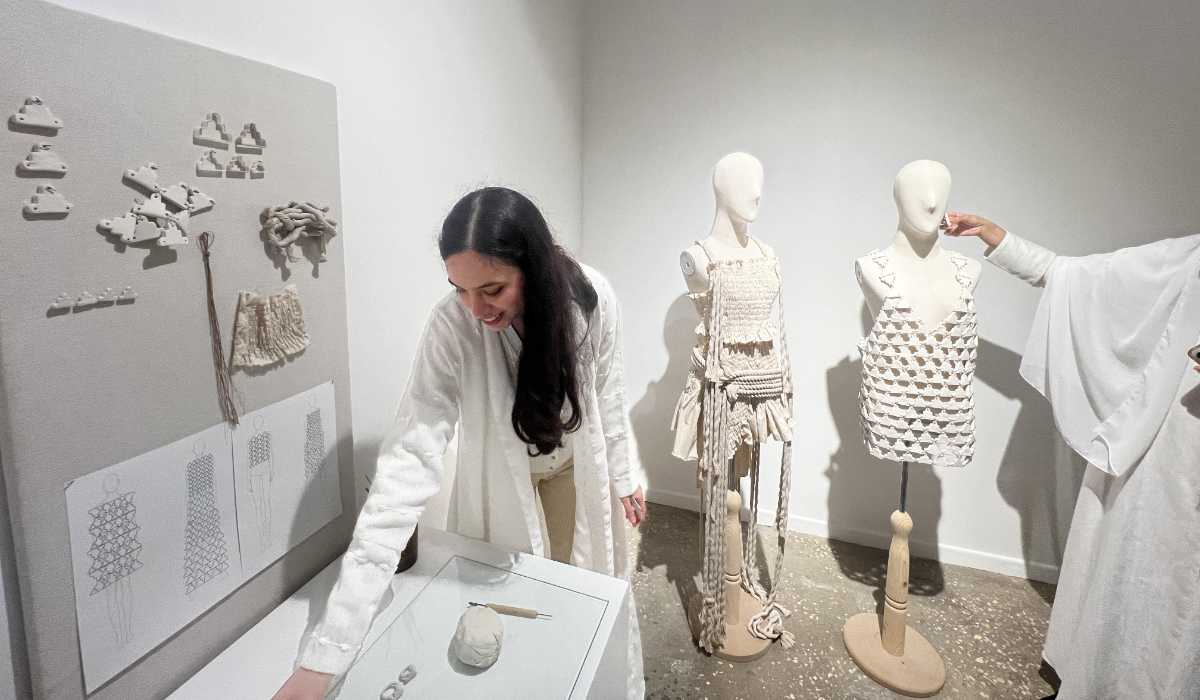
Alla Alsahli is a Syrian Palestinian designer born and raised in the United States whose work involves material manipulation and repetition to tell stories rooted in culture and space. (AN photo)
She told Arab News: “My family’s from Najran but I was born and raised in Jeddah, so I’ve always had this curiosity to know more about Najran. While it’s even difficult for me to learn about it, though my parents are from there, how will others learn? I’ve felt like it’s my responsibility to document and tell people about it through my art.”
Mirroring the residency’s sustainability theme, she uses objects that are discarded, like date seeds and broken coffee cups, to create abstract shapes that are then screen printed onto bags. The natural black dye is made from broken-down date seeds.
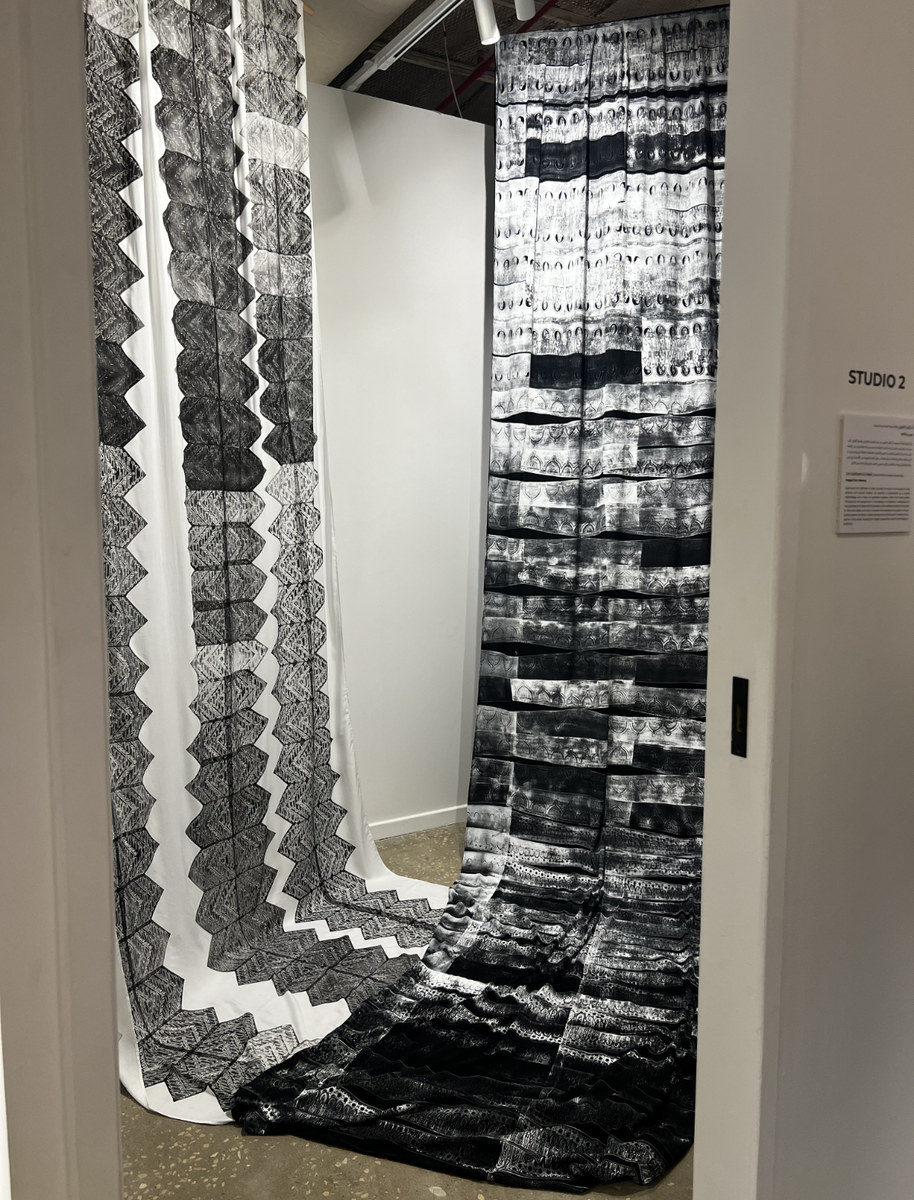
Saudi artist Um Kalthoom Al-Alawi’s draping “Images of Memory” investigates what lies hidden and what is revealed through printed patterns on fabric. (AN photo)
Alsuliman added: “My dad used to bring dates back from Najran in these plastic bags. For him he was carrying food, but I wanted to use them to carry my traditions.”
Alla Alsahli, a Syrian Palestinian designer born and raised in the US, incorporates material manipulation and repetition to tell stories that are rooted in culture and space.
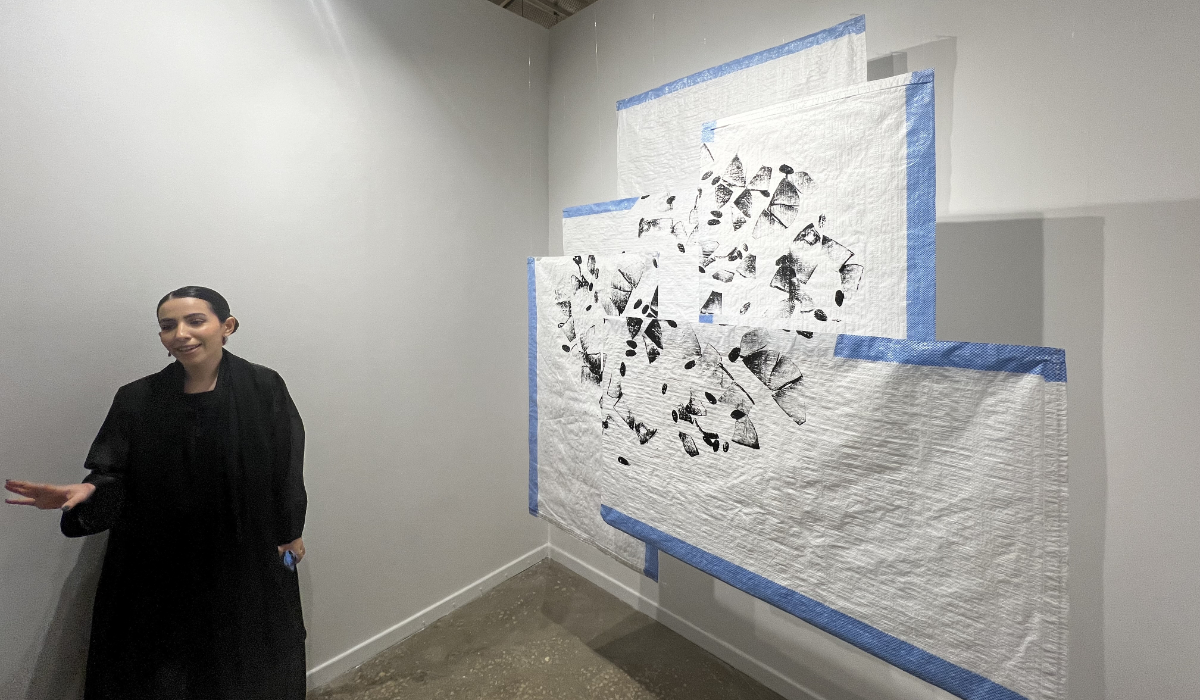
Saudi visual artist Maram Alsuliman’s “Fragments Of the Missing” reflects her cultural background and interest in tradition. She investigates the why, how, and impact of forgotten, discontinued traditions, which are only temporarily preserved through oral transmission. (AN photo)
Her Intermix project explores the idea of preservation through architecture in Riyadh and beyond. Inspired by the triangular geometrical patterns of Najdi traditional mud buildings, Alsahli creates fashion pieces out of clay, rope and fabric.
Her first ensemble joins each handmade ceramic piece with thread to hold it together. The other is constructed using the throw-away muslin fabric, which is used as a prototype by most designers, linked together by rope. The process of connecting each element to the other symbolizes a hope of preservation.
As architecture goes through phases, construction followed by deconstruction, so the art mirrors the process.
She told Arab News: “The reconstruction phase — which is when people are trying to revive and bring that space back to life — we see that a lot here in Riyadh with Diriyah and Al-Bujairi where a lot of people want to hold on to that culture and style because it's so significant to Najd. I wanted to translate that into fashion to showcase the idea of reconstruction.
“When I started the project, I was thinking about Saudi Arabia a lot, but I felt bad for not relating it to myself and my identity. When I started thinking about myself more, I thought about Syria and Palestine and that’s where the idea of ruins and preservation came from.”
The program's mission is to foster a shared visual language that celebrates the expressive potential of both visual arts and fashion design.
Kuwaiti artist Maha Alasaker focuses on the relationship between nature and culture, with a particular emphasis on the natural colors that can be extracted from the land. This led her to investigate herbal medicines and their historic use in pain management for women.
She presents a live ongoing performance using her own body as a loom for weaving as she contemplates the complex relationship between body and land.
While Egyptian fashion designer Somaia Abolezz’s abstract wearable installations demonstrate elements of the caravan journey from Egypt to Makkah, Saudi artist Um Kalthoom Al-Alawi’s “Images of Memory” investigates what lies hidden and what is revealed through printed patterns on fabric.
The Intermix Residency program is fully funded and initiated by Saudi Arabia’s Visual Arts Commission in collaboration with the Fashion Commission, and hosted in JAX District within Diriyah.
It aims to provide emerging and mid-career Saudi nationals, residents, and international visual artists, fashion designers, and curators with a platform to innovate, experiment, and collaborate in a supportive creative environment.


