ISLAMABAD: Opposition parties led by the Pakistan Tehreek-e-Insaf (PTI) backed Sunni Ittehad Council (SIC) on Saturday opposed a National Assembly resolution denouncing a US House of Representatives resolution that has called for a probe into alleged voting irregularities in the South Asian nation’s general election.
Earlier this week, a US congressional resolution called for “the full and independent investigation of claims of interference or irregularities” in Pakistan’s Feb. 8 national election, drawing a strong reaction from Islamabad. The resolution was seen as a boost for the PTI party of jailed former Prime Minister Imran Khan, which has insisted that its victory was converted into a defeat by the country’s election commission, which denies this. Other than widespread allegations of rigging, the vote was also marred by violence and communication blackouts throughout the country.
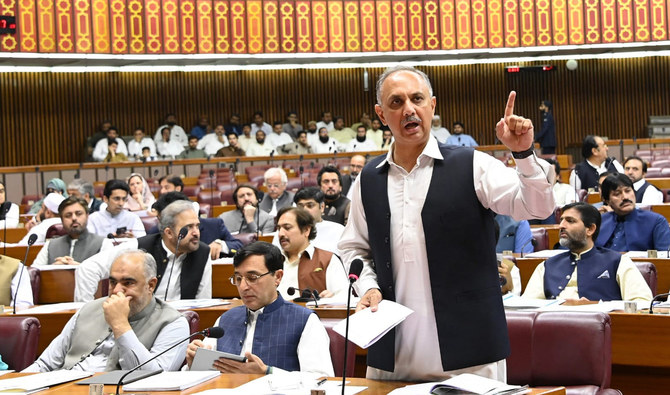
The government “did not show us the text of the resolution it passed in the National Assembly condemning the resolution passed by the US House of Representatives pointing out rigging in the 8th February 2024 elections,” Omar Ayub Khan, the leader of the opposition in the National Assembly, said on X on Saturday.
“The resolution passed by the US House of Representatives is based on the reports of multiple election observers and points out the facts. It points out the interference of intelligence agencies, lack of proper procedures followed, and a tainted electoral process.”
On Friday, when the resolution was tabled and passed, opposition lawmakers chanted “shame- shame” and tore up copies of the document.
In a televised speech, Pakistan Muslim League-Nawaz lawmaker Shaista Pervaiz Malik, who tabled the resolution, said the US resolution was “completely against the facts” and Pakistan would not tolerate any such interference in its internal affairs.
“The House further regrets that the US resolution does not acknowledge the free and enthusiastic exercise of the right to vote by millions of Pakistanis in the recently held General Election,” the resolution read. “An independent and sovereign country like Pakistan will not accept any interference in its internal affairs and the subject resolution is an attempt to undermine the state.”
Addressing a weekly news briefing earlier this week, Foreign Office Spokesperson Mumtaz Zahra Baloch separately said Pakistan “deeply regretted” the resolution, saying it stemmed from an “inadequate and erroneous understanding of the political and electoral processes of Pakistan.”
“It is also an unsolicited interference in Pakistan’s domestic affairs,” she said. “We believe that bilateral relations between countries should be based on mutual respect and sovereign equality … The unsolicited interference from the US Congress is therefore neither welcome nor accepted.”
Baloch said Pakistan wanted relations with the United States “on the basis of mutual trust and confidence and non-interference in each other’s domestic affairs.”
“We also hope that the US Congress would play a more constructive role in strengthening Pakistan-US bilateral relations by focusing on avenues of collaboration for mutual benefit of the relations,” the spokesperson concluded.
Khan’s party won the most seats in general elections but fell short of a simple majority to form a government, paving the way for Khan’s political rivals led by Prime Minister Shehbaz Sharif to form a coalition government.


![]()

Opposition rejects parliamentary resolution denouncing US congressional motion on probe into Pakistan polls
Short Url
https://arab.news/5guf5
Opposition rejects parliamentary resolution denouncing US congressional motion on probe into Pakistan polls
- National Assembly adopts resolution despite objections from Imran Khan party lawmakers
- February 8 vote was marred by violence, communication blackouts and allegations of rigging


Latest updates





Recommended


© 2026 SAUDI RESEARCH & PUBLISHING COMPANY, All Rights Reserved And subject to Terms of Use Agreement.