

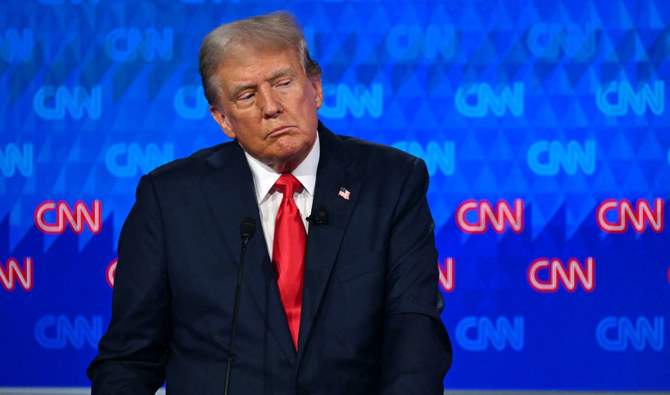
Trump says inflation is ‘killing our country’ under Biden

Former US President and Republican presidential candidate Donald Trump looks on as he participates in the first presidential debate of the 2024 elections with US President Joe Biden at CNN's studios in Atlanta, Georgia, on June 27, 2024. (AFP)
Short Url
Updated 28 June 2024
Follow

Trump says inflation is ‘killing our country’ under Biden

ATLANTA: Donald Trump accused Joe Biden on Thursday of doing a “poor job” on the US economy and of presiding over a disastrous rise in inflation — reflecting how rising prices and the cost of living have become key issues ahead of November’s presidential election.

“He has not done a good job. He’s done a poor job,” Trump said during CNN’s head-to-head debate with Biden in Atlanta, Georgia. “And inflation is killing our country. It is absolutely killing us.

“I gave him a country with essentially no inflation. It was perfect. It was so good, all he had to do is leave it alone.” he added. “He destroyed it“

In response to Trump’s attacks on his record, Biden said Trump had “absolutely decimated” the US economy when he was president.

“There was no inflation when I became president. You know why? The economy was flat on its back,” he said, adding that his administration had helped create “millions” of new jobs, including in minority communities.

Americans have named inflation or the cost of living as “the most important financial problem facing their family,” in each of the last three years, according to a recent poll from the Washington-based firm Gallup.

Perhaps more worryingly for Biden, 46 percent of adults in the United States said they have “a great deal” or “a fair amount” of confidence in Trump to do or recommend the right thing for the economy, while just 38 percent said the same thing about the current president, according to another Gallup poll.

While it is true that US consumer inflation jumped sharply after Biden took office, hitting a multi-decade high in 2022, the rise was largely fueled by a post-pandemic supply crunch and by Russia’s invasion of Ukraine.

In response, the US Federal Reserve hiked its key lending rate from almost zero to a two-decade high of between 5.25 and 5.50 percent — where it has remained for the past year.

Higher interest rates cool down the economy by raising borrowing costs for consumers and businesses, indirectly impacting everything from mortgage rates to auto loans.

Inflation has eased sharply since the Fed started hiking rates, but remains stuck stubbornly above its long-term target of two percent — keeping the US central bank on pause as it waits for more positive data.

Because inflation has remained high for a number of years, consumer prices have now risen by around 20 percent since January 2021, when Biden took office, according to the Labor Department’s consumer price index (CPI) inflation calculator.

In contrast, consumer prices rose by less than six percent during the same timeframe under Trump.

Although Congress has given the Fed the mandate to tackle inflation on its own, it is still a difficult topic for Biden, who has looked to talk up his economic record ahead of November’s election.

The Fed expects inflation will continue to ease this year and next, before hitting its long-term target of two percent in 2026.

But the path to two percent will likely depend on who becomes president in November — and which parties will control the House of Representatives and the Senate.

Trump has suggested that, if he wins the election, he will look to extend a series of tax cuts made under his leadership, severely restrict immigration, deport some foreign-born illegal immigrants and slap tariffs on all US imports.

These policies would all “likely be inflationary,” by putting up prices, placing upward pressure on wages and boosting adding to the nation’s debt, JP Morgan economists wrote in a recent note to clients.

As things stand, Republican control of the House, Senate and the White House is not the most likely scenario come November, Oxford Economics lead US economist Bernard Yaros wrote in a recent note to clients.

“If Biden is reelected but presides over a divided government, the upside risk potential to the economy from fiscal policy is limited,” he said.

“If Trump returns to the White House with a divided government, he will have a tougher time enacting his fiscal agenda,” he added.


Ukraine drops NATO goal as Trump envoy sees progress in peace talks

Updated 57 min 18 sec ago
Follow

Ukraine drops NATO goal as Trump envoy sees progress in peace talks

  • The move marks a major shift for Ukraine, which has fought to join NATO as a safeguard against Russian attacks and has such an aspiration included in its constitution

BERLIN/KYIV: President Volodymyr Zelensky offered to drop Ukraine’s aspirations to join the NATO military alliance as he held five hours of talks with US envoys in Berlin on Sunday to end the war with Russia, with negotiations set to continue on Monday.
Trump’s envoy Steve Witkoff said “a lot of progress was made” as he and Trump’s son-in-law Jared Kushner met Zelensky in the latest push to end Europe’s bloodiest conflict since World War Two, though full details were not divulged.
Zelensky’s adviser Dmytro Lytvyn said the president would comment on the talks on Monday once they were completed. Officials, Lytvyn said, were considering the draft documents.
“They went on for more than five hours and ended for today with an agreement to resume tomorrow morning,” Lytvyn told reporters in a WhatsApp chat.
Ahead of the talks, Zelensky offered to drop Ukraine’s goal to join NATO in exchange for Western security guarantees.
The move marks a major shift for Ukraine, which has fought to join NATO as a safeguard against Russian attacks and has such an aspiration included in its constitution. It also meets one of Russia’s war aims, although Kyiv has so far held firm against ceding territory to Moscow.
“Representatives held in-depth discussions regarding the 20-point plan for peace, economic agendas, and more. A lot of progress was made, and they will meet again tomorrow morning,” Witkoff said in a post on X.
The talks were hosted by German Chancellor Friedrich Merz, who a source said had made brief remarks before leaving the two sides to negotiate. Other European leaders are also due in Germany for talks on Monday.
“From the very beginning, Ukraine’s desire was to join NATO, these are real security guarantees. Some partners from the US and Europe did not support this direction,” Zelensky said in answer to questions from reporters in a WhatsApp chat.
“Thus, today, bilateral security guarantees between Ukraine and the US, Article 5-like guarantees for us from the US, and security guarantees from European colleagues, as well as other countries — Canada, Japan — are an opportunity to prevent another Russian invasion,” Zelensky said.
“And it is already a compromise on our part,” he said, adding the security guarantees should be legally binding.
Russian President Vladimir Putin has repeatedly demanded Ukraine officially renounce its NATO ambitions and withdraw troops from the about 10 percent of Donbas which Kyiv still controls. Moscow has also said Ukraine must be a neutral country and no NATO troops can be stationed in Ukraine.
Russian sources said earlier this year that Putin wants a “written” pledge by major Western powers not to enlarge the US-led NATO alliance eastwards — shorthand for formally ruling out membership to Ukraine, Georgia, Moldova and other former Soviet republics.
Sending Witkoff, who has led negotiations with Ukraine and Russia on a US peace proposal, appeared to be a signal that Washington saw a chance of progress nearly four years after Russia’s 2022 invasion.
Under pressure from Trump to sign a peace deal that initially backed Moscow’s demands, Zelensky accused Russia of dragging out the war through deadly bombings of cities and Ukraine’s power and water supplies.
A ceasefire along the current front lines would be a fair option, he added.

‘CRITICAL MOMENT’
Germany’s Defense Minister Boris Pistorius said it was a “good sign” Trump had sent his envoys while fielding questions in an interview with the ZDF broadcaster on the suitability of Witkoff and Kushner, two businessmen, as negotiators.
“It’s certainly anything but an ideal setup for such negotiations. That much is clear. But as they say, you can only dance with the people on the dance floor,” Pistorius said.
On the issue of Ukraine’s offer to give up its NATO aspirations in exchange for security guarantees, Pistorius said Ukraine had bitter prior experience of relying on security assurances. Kyiv had in 1994 agreed to give up its Soviet-era nuclear arsenal in exchange for territorial guarantees from the US, Russia and Britain.
“Therefore, it remains to be seen to what extent this statement Zelensky has now made will actually hold true, and what preconditions must be met,” Pistorius said.
“This concerns territorial issues, commitments from Russia and others,” he said, adding mere security guarantees, especially without significant US involvement, “wouldn’t be worth much.”
Britain, France and Germany have been working to refine the US proposals, which in a draft disclosed last month called for Kyiv to cede more territory, abandon its NATO ambitions and accept limits on its armed forces.
European allies have described this as a “critical moment” that could shape Ukraine’s future, and sought to shore up Kyiv’s finances by leveraging frozen Russian central bank assets to fund Kyiv’s military and civilian budget.