Sudan faces famine risk in 14 areas, global hunger monitor says

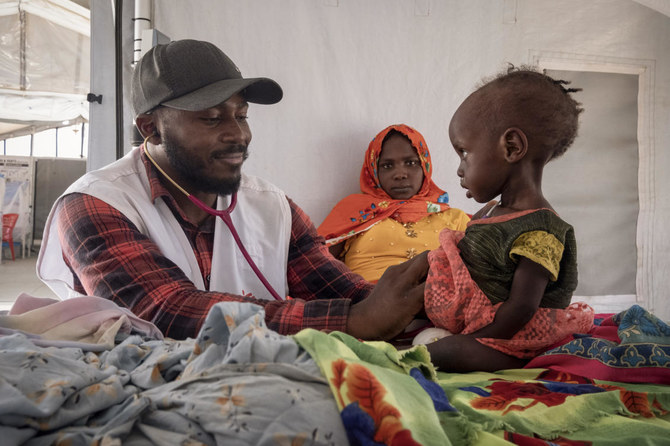
FILE — Sudanese Children suffering from malnutrition are treated at an MSF clinic in Metche Camp, Chad, near the Sudanese border, on April 6, 2024. (AP)
Short Url
Updated 27 June 2024
Follow

Sudan faces famine risk in 14 areas, global hunger monitor says

  • In total, 8.5 million people — or 18 percent of the population — face food shortages

CAIRO: There is a realistic chance of famine in 14 areas across Sudan if the conflict that began in April last year between military factions escalates further, a global hunger monitor said on Thursday.
The areas include parts of the capital Khartoum, the regions of Darfur and Kordofan and El Gezira state, according to an update from the Integrated Food Security Phase Classification (IPC).
As previously reported by Reuters, some 755,000 people in Sudan face “catastrophe,” the most severe level of extreme hunger. In total, 8.5 million people — or 18 percent of the population — face food shortages that could result in acute malnutrition and death or require emergency coping strategies, according to the update.
War between Sudan’s army and the Rapid Support Forces (RSF) erupted more than 14 months ago in the capital, and quickly spread to other parts of the country.
It has triggered waves of ethnically-driven violence in the western region of Darfur, caused the world’s biggest internal displacement crisis and split control of the country between the rival camps.
The IPC is a collaboration that includes UN agencies, national governments and aid groups, and produces internationally recognized assessments of food crises.
Its most extreme warning is Phase 5, which has two levels, catastrophe and then famine.
The IPC said its assessment released on Thursday meant that famine could occur with reasonable probability under a worst-case scenario in the 14 areas.
Famine can be declared if at least 20 percent of the population in an area are suffering extreme food shortages, with at least 30 percent of children acutely malnourished and two people out of every 10,000 dying daily from starvation or malnutrition and disease.
Since the IPC warning system was created 20 years ago, famines have only been declared twice — in parts of Somalia in 2011 and in parts of South Sudan in 2017.


Spain highlights importance of Gaza reconstruction

Palestinian prime minister, Mohammed Mustafa, and the Spanish foreign minister, Jose Manuel Albares. (AP)
Updated 02 January 2026
Follow

Spain highlights importance of Gaza reconstruction

  • Spain officially recognized Palestine as a state in May 2024, in a coordinated move alongside Ireland and Norway

RAMALLAH: The Palestinian prime minister, Mohammed Mustafa, and the Spanish foreign minister, Jose Manuel Albares, on Friday discussed the latest developments in the West Bank and Gaza Strip.
During their telephone conversation they emphasized the need to intensify international efforts to end the Israeli occupation and halt attacks and settler violence, and to secure the release of Palestinian funds held by Israeli authorities.
They affirmed the importance of ongoing efforts relating to plans for the reconstruction of Gaza, and Europe’s significant role in this process. Mustafa and Albares highlighted the need to unify Palestinian institutions in Gaza with those in the West Bank, with the aim of establishing a Palestinian state in line with international resolutions, including last year’s New York Declaration.
They also discussed coordination between their countries, and the strengthening of Spain’s political, diplomatic and financial support for Palestine, and Mustafa thanked Spain for its ongoing support.
Spain officially recognized Palestine as a state in May 2024, in a coordinated move alongside Ireland and Norway. Estephan Salameh, the Palestinian finance and planning minister, is set to visit Spain this month to discuss enhanced cooperation, particularly in the areas of development and reconstruction. Meanwhile, Israel continues operating in the occupied West Bank.
The Palestinian Prisoners media office said on Friday that Israel carried out numerous raids across the territory, including the major cities of Ramallah and Hebron, according to The Associated Press.
Nearly 50 people were detained, following the arrest of at least 50 other Palestinians on Thursday, most of those in the Ramallah area.
As 2026 begins, the shaky 12-week-old ceasefire between Israel and Hamas has largely ended large-scale Israeli bombardment of Gaza. 
But Palestinians are still being killed by Israeli fire, especially along the so-called Yellow Line that delineates areas under Israeli control, and the humanitarian crisis is compounded by frequent winter rains and colder temperatures.
On Friday, American actor and film producer Angelina Jolie visited the Rafah border crossing between Egypt and the Gaza Strip. 
The only crossing between the territory and a country other than Israel, it remains closed despite Palestinian requests to reopen it to people and aid.
Jolie met with members of the Red Crescent on the Egyptian side of the Rafah border crossing and then visited a hospital in the nearby city of Arish to speak with Palestinian patients on Friday, according to Egyptian officials.
Aid groups say not enough shelter materials are getting into Gaza during the truce.