

Pakistan Navy warship Babur returns after joint exercises with Saudi Arabia, Turkiye

This handout photograph, taken and released by Pakistan Navy, shows Pakistan Navy’s warship Babur sit in the dock at the Karachi Naval Dockyard in Karachi on June 26, 2024. (Photo courtesy: Pakistan Navy)
Short Url
Updated 27 June 2024
Follow

Pakistan Navy warship Babur returns after joint exercises with Saudi Arabia, Turkiye

  • PNS Babur warship conducted joint exercise with Saudi Arabia’s Al-Riyadh frigate in Jeddah last Wednesday
  • Pakistan and Turkiye launched warship last year, which is part of a four-vessel deal between the two countries

ISLAMABAD: Pakistan Navy’s warship PNS Babur returned to Karachi on Wednesday after holding separate joint exercises with Turkiye and Saudi Arabia this month, the navy said in a statement. 
Last Wednesday, the Pakistani ship visited the Jeddah port where it conducted a joint exercise with Saudi Arabia’s Al-Riyadh frigate to strengthen mutual cooperation between the two countries. 
On June 15, PNS Babur participated in bilateral exercise TURGUTREIS-IX at the Aksaz naval base in Turkiye. Their activities encompassed harbor and sea exercises, where the two navies rehearsed various maritime operations and enhanced interoperability.
The navy organized a ceremony at the dockyard in Karachi to welcome PNS Babur upon its arrival on Wednesday, the Pakistan Navy said in a statement. Commander Pakistan Fleet Vice Admiral Muhammad Faisal Abbasi was the chief guest. 
“While addressing the ceremony, Commander Pakistan Fleet highlighted that PN MILGEM class corvettes will significantly enhance Pakistan Navy’s capability of safeguarding maritime frontiers,” the navy said.
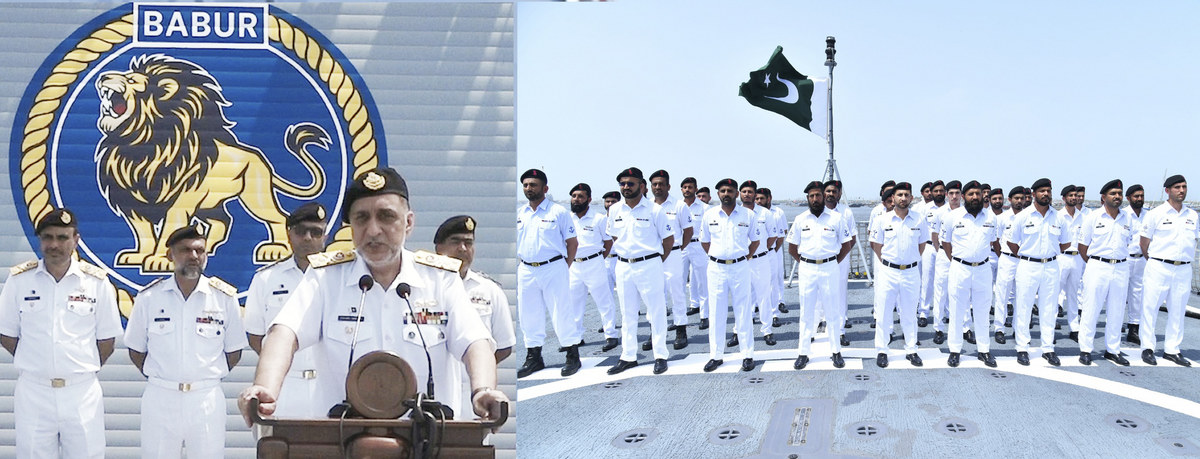


In this handout combination of photos, taken and released by Pakistan Navy, Commander Pakistan Fleet Vice Admiral Muhammad Faisal Abbasi (left) addresses the crew of Pakistan Naval Ship Babur at the Karachi Naval Dockyard in Karachi on June 26, 2024. (Photo courtesy: Pakistan Navy)

 “And reinforce the initiative of Pakistan Navy for independently conducting regional maritime security patrols of the Indian Ocean region.”
Abbasi emphasized that the MILGEM class project is a manifestation of Pakistan and Turkiye’s defense cooperation.
The two countries jointly launched PNS Babur last year, which is part of a four-vessel deal between Islamabad and Ankara.
Turkiye announced in 2017 the two countries had signed a memorandum of understanding for the sale of four Turkish-made corvette warships and 52 Pakistan-made training planes for Ankara’s armed forces. 
Ankara described it as Turkiye’s biggest single military export deal and “a very important day” for the defense industry. The contract was formally signed in 2018.
Under the deal, the Karachi Shipyard (KS&EW) would buy four corvettes made under Turkiye’s MILGEM warship program, aimed at designing and building locally a fleet of multipurpose corvettes and frigates that could replace older ships. 
As per the 2018 contract, two of the ships were to be manufactured in Istanbul and two in Karachi.


Pakistan remittances seen surpassing $40 billion in FY26 as Saudi Arabia leads November inflows

Updated 4 sec ago
Follow

Pakistan remittances seen surpassing $40 billion in FY26 as Saudi Arabia leads November inflows

  • The country’s November remittances rose 9.4 percent year-on-year to $3.2 billion, official data show
  • Economic experts say rupee stability and higher use of formal channels are driving the upward trend

ISLAMABAD: Pakistan’s workers’ remittances are expected to exceed the $40 billion mark in the current fiscal year, economic experts said Tuesday, after the country recorded an inflow of $3.2 billion in November, with Saudi Arabia once again emerging as the biggest contributor.

Remittances are a key pillar of Pakistan’s external finances, providing hard currency that supports household consumption, helps narrow the current-account gap and bolsters foreign-exchange reserves. The steady pipeline from Gulf economies, led by Saudi Arabia and the United Arab Emirates, has remained crucial for Pakistan’s balance of payments.

A government statement said monthly remittances in November stood at $3.2 billion, reflecting a 9.4 percent year-on-year increase.

“The growth in remittances means the full-year figure is expected to cross the $40 billion target in fiscal year 2026,” Sana Tawfik, head of research at Arif Habib Limited, told Arab News over the phone.

“There are a couple of factors behind the rise in remittances,” she said. “One of them is the stability of the rupee. In addition, the country is receiving more inflows through formal channels.”

Tawfik said the trend was positive for the current account and expected inflows to remain strong in the second half of the fiscal year, noting that both Muslim festivals of Eid fall in that period, when overseas Pakistanis traditionally send additional money home for family expenses and celebrations.

The official statement said cumulative remittances reached $16.1 billion during July–November, up 9.3 percent from $14.8 billion in the same period last year.

It added that November inflows were mainly sourced from Saudi Arabia ($753 million), the United Arab Emirates ($675 million), the United Kingdom ($481.1 million) and the United States ($277.1 million).

“UAE remittances have regained momentum in recent months, with their share at 21 percent in November 2025 from a low of 18 percent in FY24,” said Muhammad Waqas Ghani, head of research at JS Global Capital Limited. “Dubai in particular has seen a steady pick-up, reflecting improved inflows from Pakistani expatriates owing to some relaxation in emigration policies.”