

Rare bilingual inscription unearthed in Saudi Arabia’s Tabuk province

Recent archaelologican find demonstrates the historical coexistence of Thamudic in the Arabian Peninsula, says Saudi Heritage Commission
Short Url
Updated 27 June 2024
Follow

Rare bilingual inscription unearthed in Saudi Arabia’s Tabuk province

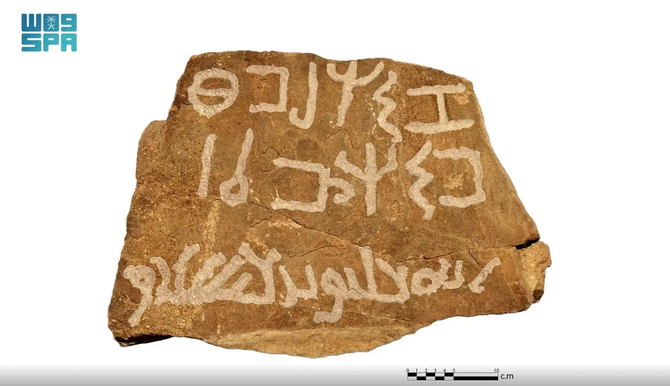
  • The piece, found during an archaeological dig in the village of Alqan, comprises two lines in Thamudic script and one in early Arabic

RIYADH: The Saudi Heritage Commission has announced the discovery of a bilingual inscription in Tabuk.

The piece, found during an archaeological dig in the village of Alqan, comprises two lines in Thamudic script and one in early Arabic, the Saudi Press Agency reported on Wednesday.

The style of the characters suggests the piece dates from the 5th century.


Recent archaelologican find demonstrates the historical coexistence of Thamudic in the Arabian Peninsula, says Saudi Heritage Commission

The commission said the find demonstrated the historical coexistence of Thamudic and early Arabic and illuminated the evolution of ancient writing systems in the Arabian Peninsula.

It represents a significant addition to the commission’s collection of ancient Arabic inscriptions and writings and aligns with its ongoing efforts to study, document, preserve and promote archaeological sites across the Kingdom.

Such work underscores Saudi Arabia’s commitment to protecting and showcasing its rich cultural heritage.


SDAIA president says Saudi Arabia is building an integrated AI ecosystem

Updated 20 February 2026
Follow

SDAIA president says Saudi Arabia is building an integrated AI ecosystem

RIYADH: Saudi Data and Artificial Intelligence Authority President Abdullah Al-Ghamdi says that Saudi Arabia is moving steadily to establish artificial intelligence as a trusted national capability, the Saudi Press Agency reported.

Guided by the objectives of Saudi Vision 2030, Al-Ghamdi said the goal is to use AI to help develop government services, enhance competitiveness, build human capacity and improve quality of life through a comprehensive strategy based on three main pillars that unlock the potential of this technology and achieve sustainable developmental impact.

“The first pillar focuses on building human capacity and enhancing readiness to engage with AI technologies,” he said.

The second pillar is building an integrated national AI ecosystem that drives expansion and innovation by developing advanced digital infrastructure that enables various sectors to adopt AI applications efficiently, consistently and with effective governance, Al-Ghamdi said.

The third pillar, he said, is governance that ensures responsible and measurable AI through a national framework aligned with international standards.

This came during Al-Ghamdi’s speech at a high-level ministerial session held on Thursday on the sidelines of the AI Impact Summit 2026 in New Delhi.

He is heading the Saudi delegation, and the session saw broad participation from heads of state, decision-makers and technology leaders from around the world.

Al-Ghamdi also had a meeting with Indian Prime Minister Narendra Modi on Thursday evening, discussed AI cooperation and expressed his gratitude for hosting the summit and for the hospitality extended to the participants.