

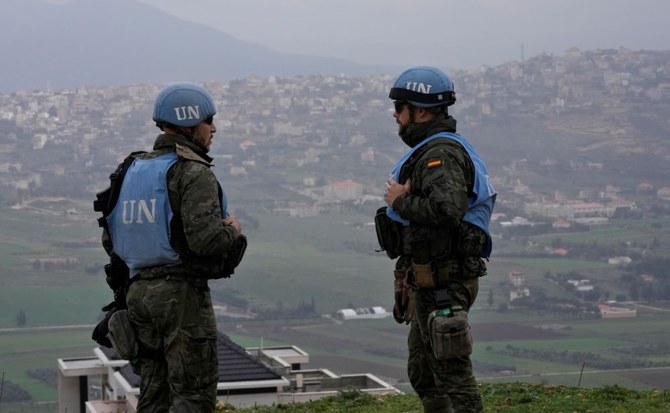

BEIRUT: The Lebanese Foreign Ministry has sent a letter to UN Secretary-General Antonio Guterres asking for the mandate of UNIFIL peacekeepers to be renewed for another year.
The request comes after eight months of hostilities between Hezbollah and the Israeli army.
Candice Ardell from the UNIFIL media office said: “Our sites and vehicles have been fired upon from both sides. Several peacekeepers have sustained non-critical injuries and measures are being taken by UNIFIL leadership to ensure the safety of the peacekeepers.”
Meanwhile, the southern front remains exposed to military operations, including an incident in which an Israeli drone targeted a power line serving Taybeh, just minutes after the power company had completed its maintenance, causing an electricity outage at the pumping station.
Turkish President Recep Tayyip Erdogan has reaffirmed his country’s support for Lebanon and called on “countries in the region to support Lebanon amid tensions with Israel, which has burned and destroyed Gaza and now seems to have its sights set on Lebanon, while we notice it receiving covert support from the West.”
“Israeli Prime Minister Benjamin Netanyahu’s plans to expand the war in the region would lead to a major disaster,” he said. “The Islamic world and Middle Eastern countries must first confront these bloody plans. Netanyahu is mentally ill and the silence of Western countries toward him will lead to a widespread war in the entire region.”
Russian Foreign Minister Sergei Lavrov called on “the international community to alert Israel to the devastating effects of extending the conflict to Lebanon.”
US State Department spokesperson Matthew Miller said: “Israeli Defense Minister Yoav Gallant told US Secretary of State Antony Blinken that Israel prefers a diplomatic solution to the conflict with Hezbollah and that a diplomatic solution is still possible.”
US Defense Secretary Lloyd Austin warned of “the risks of another war breaking out between Israel and Hezbollah that could easily escalate into a regional war.”
He emphasized “the importance of a diplomatic solution.”
German Foreign Minister Annalena Baerbock held talks in Beirut with Lebanon’s caretaker Prime Minister Najib Mikati and Foreign Minister Abdullah Bou Habib as part of diplomatic efforts to cool tensions on the southern front, following visits to Tel Aviv and the West Bank.
“The situation on the Blue Line is delicate and there are risks. Cooperation between all parties is necessary to reduce escalation and achieve a ceasefire in Gaza that leads to a ceasefire in southern Lebanon,” she said.
Baerbock also expressed Berlin’s “concern about the current tension in the region” and warned of “the danger of reaching a deadlock, especially if the parties refuse to cease fire.”
Vatican Secretary of State Cardinal Pietro Parolin has been in Beirut for two days to support Lebanon and call for the acceleration of the presidential election. He also met Mikati and parliament speaker Nabih Berri.
“Every war leaves the world worse off than it was and is a surrender to the forces of evil,” he said.
He also expressed Pope Francis’ concern regarding the failure to elect a new president “who represents the unity of Lebanon.”
The Middle East was “going through a tough period,” he said. “The Pope, who has strong relationships with Palestinians and Israelis, calls for peace, ending the conflict, releasing hostages in Gaza and delivering aid to the Palestinian territories without obstacles.”
Hossam Zaki, assistant secretary-general of the Arab League, on Wednesday held talks in Beirut with Berri and met the leaders of the Lebanese Phalange Party, Sami Gemayel, and Free Patriotic Movement, Gebran Bassil.
The talks centered on the “tense regional situation and the war waged by Hezbollah in the south, as well as the issue of the presidency.”


