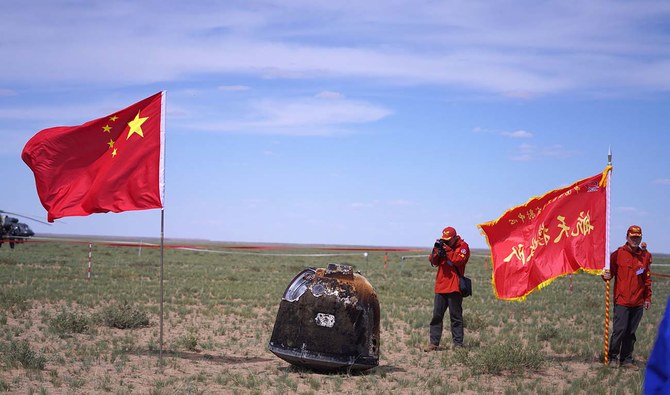
United Nations’ officials on Tuesday hailed the historic success of China’s Chang’e-6 lunar mission after the probe returned to Earth earlier that day carrying the first ever samples obtained from the far side of the moon, with the feat seen as a major triumph for the global science community.
The Chang’e-6 mission concluded its 53-day journey as it touched down in north China’s Inner Mongolia Autonomous Region on Tuesday, becoming the first spacecraft to successfully retrieve and return samples from the lunar far side and paving the way for scientists to uncover potentially groundbreaking secrets about the moon. Pakistan’s “historic” lunar satellite iCube-Q was also launched as part of the Chinese mission.
Stephane Dujarric, spokesman for United Nations Secretary-General Antonio Guterres, commended the mission as a “remarkable achievement” during a press briefing in New York City on Tuesday, and also pointed to the level of international cooperation involved in the project.
“It’s also a great demonstration of international collaboration in terms of outer space affairs. We understand there were also teams from Italy, from France, from Pakistan, and the European Space Agency, all involved. It’s also important, as we understand, that the valuable lunar samples will be shared with researchers around the world,” said Dujarric.
Launched on May 3, Chang’e-6 carried four international payloads, including Pakistan’s ICUBE-Q satellite, fostering lunar image capture and data sharing initiatives. The cube satellite separated from the main probe five days after launching to undertake its own mission alongside China’s lunar exploration efforts.
During a ceremony in Beijing shortly afterwards, China transferred the first batch of lunar data to Pakistan, sharing the first photographs captured by ICUBE-Q and strengthening bilateral cooperation in space exploration.
Munir Akram, Pakistan’s Permanent Representative to the UN, emphasized the potential scientific impact of the Chang’e-6 mission and said he hopes that it will enable scientists to “discover new things that will be a benefit to all of mankind.”
Akram also emphasized the significance of the partnership between China and Pakistan in terms of space exploration and believes there will be more joint endeavors between the two countries in the future.
“Our partnership is all-encompassing and comprehensive, and this is a new area of our cooperation. And we are very happy to join China in this quest out into space,” he said.
The momentous Chang’e-6 mission was considered one of the most complex and challenging undertakings in China’s space exploration efforts to date, and marked another milestone after the country become the first to achieve a soft landing on the moon’s far side back in 2019.


UN commends Chang’e-6 lunar mission with Pakistani satellite on board
https://arab.news/rshen
UN commends Chang’e-6 lunar mission with Pakistani satellite on board

- Chinese probe carrying samples from the far side of the Moon returned to Earth on Tuesday
- Pakistan’s “historic” lunar satellite iCube-Q was also launched as part of the Chinese mission

Russia strikes power plant, kills four in Ukraine barrage
KHARKIV: Russia battered Ukraine with more than two dozen missiles and hundreds of drones early Tuesday, killing four people and pummelling another power plant, piling more pressure on Ukraine’s brittle energy system.
An AFP journalist in the eastern Kharkiv region, where four people were killed, saw firefighters battling a fire at a postal hub and rescue workers helping survivors by lamp light in freezing temperatures.
Ukrainian President Volodymyr Zelensky said “several hundred thousand” households near Kyiv were without power after the strikes, and again called on allies to bolster his country’s air defense systems.
“The world can respond to this Russian terror with new assistance packages for Ukraine,” President Volodymyr Zelensky wrote on social media.
“Russia must come to learn that cold will not help it win the war,” he added.
Authorities in Kyiv and the surrounding region rolled out emergency power cuts in the hours after the attack, saying freezing temperatures were complicating their work.
DTEK, Ukraine’s largest energy provider, said Russian forces had struck one of its power plants, saying it was the eighth such attack since October.
The operator did not reveal which of its plants was struck, but said Russia had attacked its power plants over 220 times since Moscow invaded Ukraine in 2022.
Daily attacks
Moscow has pummelled Ukraine with daily drone and missile barrages in recent months, targeting energy infrastructure and cutting power and heating in the frigid height of winter.
The Ukrainian air force said that Tuesday’s bombardment included 25 missiles and 247 drones.
The Kharkiv governor gave the death toll and added that six people were wounded in the overnight hit outside the region’s main city, also called Kharkiv.
White helmeted emergency workers could be seen clambering through the still-smoking wreckage of a building occupied by postal company Nova Poshta, in a video posted by the regional prosecutor’s office.
Within Ukraine’s second city, Kharkiv Mayor Igor Terekhov said a Russian long-range drone struck a medical facility for children, causing a fire. No casualties were reported.
The overnight strikes hit other regions as well, including southern city Odesa.
Residential buildings, a hospital and a kindergarten were damaged, with at least five people wounded in two waves of attacks, regional governor Sergiy Lysak said.
Russia’s use last week of a nuclear-capable Oreshnik ballistic missile on Ukraine sparked condemnation from Kyiv’s allies, including Washington, which called it a “dangerous and inexplicable escalation of this war.”
Moscow on Monday said the missile hit an aviation repair factory in the Lviv region and that it was fired in response to Ukraine’s attempt to strike one of Russian President Vladimir Putin’s residences — a claim Kyiv denies and that Washington has said it does not believe happened.


