Afghan women protest exclusion from upcoming UN meeting in Doha

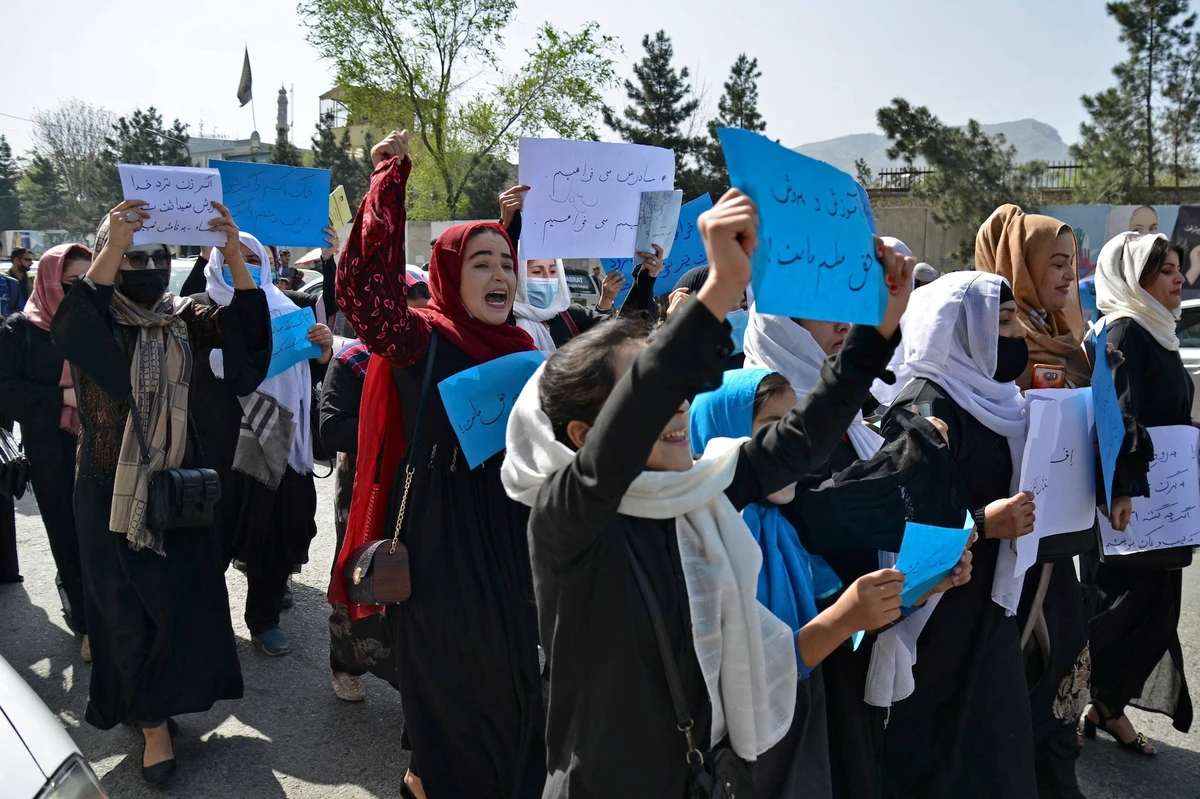
Afghan women and girls take part in a protest in front of the Ministry of Education in Kabul on March 26, 2022, demanding that high schools be reopened for girls. (AFP/File)
Short Url
Updated 26 June 2024
Follow

Afghan women protest exclusion from upcoming UN meeting in Doha

  • Women have been facing increasing restrictions since Taliban took over Afghanistan in 2021
  • On Tuesday, Taliban foreign ministry said chief government spokesman will attend Doha talks

KABUL: Afghan women spoke up on Wednesday against their exclusion from an upcoming UN conference in Doha, saying their absence will not improve the deteriorating situation for females in Afghanistan.

Since the Taliban regained control of Afghanistan in August 2021, Afghan women have faced increasing restrictions including on movement, personal attire, as well as access to work and education.

The UN has reportedly agreed to the Taliban’s demands of preventing Afghan women from participating at the Doha meeting on Afghanistan that will start on June 30, and to remove a discussion on gender equality from the agenda.

“When a society cannot be complete without women, how can we expect that such important meetings will have fruitful results without them?” Mahboba Akbar, a former teacher and education activist in Kandahar, told Arab News on Wednesday.

“I think the life, work, education and the future of Afghan women and girls don’t really matter for the people attending the meeting in Doha. Therefore, the meeting is not intended to seek solutions for the problems of all Afghans, but is focusing more on reaching some political agreements.”

The latest development appears to be a part of the UN’s attempts to get the Taliban to attend the third Doha conference, which was set up to discuss the international community’s approach to Afghanistan.

The Taliban were not invited to the first gathering, and UN Secretary-General Antonio Guterres said they set unacceptable conditions to participate at the second meeting held in February. This included excluding Afghan civil society members from the talks, and for them to be treated as Afghanistan’s legitimate rulers.

No country has recognized the Taliban as Afghanistan’s government, with the UN saying that recognition is almost impossible while bans on female education and employment remain in place.

On Tuesday, the Foreign Ministry in Kabul confirmed their attendance at the Doha meeting, saying that chief Taliban government spokesman, Zabihullah Mujahid, will lead the delegation.

When such political agreements are made, it is usually Afghan women who bear the burden, said Zainab Muwahid, an Islamic scholar who participated in the US-Taliban peace talks in Qatar in 2019.

“Afghan women bear the biggest sacrifices in these political deals,” she told Arab News.

The absence of women will have a negative impact on the outcome of the meeting, Muwahid said.

“Women have exclusive views and experiences that are crucial for sustainable and fair talks. Without their presence, there’s always the risk of increased inequalities and injustices.”

The numerous restrictions introduced by the Taliban have been regarded as some of the world’s most serious violations of human rights. Human Rights Watch highlighted on Tuesday how the abuses “deepen daily.”

“Many Afghan women look to the UN to make things right — to hold the Taliban accountable for their crimes, for making Afghanistan a suffocating prison for women and girls — but have been disappointed by ineffective UN responses,” the rights group said in a statement.

The HRW said a growing number of Afghan women activists in the country and abroad have called on states to boycott the upcoming Doha meeting.

“If Doha 3 moves ahead as planned, the UN will be setting a deeply harmful precedent, betraying Afghan women’s struggle for their rights,” it added.

Samira Rahimi, a schoolteacher in Kabul, said women’s voices are often ignored in major meetings.

“When it comes to big and important meetings, only men participate. We don’t have any representation, our issues are largely ignored,” she said.

“We had hope for the international community to continue supporting Afghan women and their rights. The international community has also failed us a great deal. They don’t care about us anymore.”
US Justice Department official eyes cases against Cuba leaders as Trump floats ‘friendly takeover’

Updated 07 March 2026
Follow

US Justice Department official eyes cases against Cuba leaders as Trump floats ‘friendly takeover’

  • “Working group” formed to build cases against people connected to the Cuban government
  • Trump’s has increasingly displayed aggressive stance against Cuba’s communist leadership

MIAMI: The top Justice Department prosecutor in Miami is considering criminal investigations of Cuban government officials, according to people familiar with the matter. The inquiry comes as President Donald Trump has raised the possibility of a “friendly takeover” of the communist-run island.
Jason Reding Quiñones, the US attorney for the Southern District of Florida, has created a “working group” that includes federal prosecutors and officials from the Drug Enforcement Administration and other agencies to try to build cases against people connected to the Cuban government and its Communist Party, according to one of the people. They spoke on the condition of anonymity because they were not authorized to publicly discuss the effort.
It was not immediately clear which Cuban officials the office is targeting or what criminal charges prosecutors may be looking to bring.
The Justice Department said in a statement Friday that “federal prosecutors from across the country work every day to pursue justice, which includes efforts to combat transnational crime.”
The effort is taking place against the backdrop of Trump’s increasingly aggressive stance against Cuba’s communist leadership.
Emboldened by the US capture of Cuba’s close ally, Venezuelan President Nicolás Maduro, Trump last month said his administration was in high-level talks with officials in Havana to pursue “a friendly takeover” of the country. He repeated those claims this week, saying his attention would turn back to Cuba once the war with Iran winds down.
“They want to make a deal so bad,” Trump said of Cuba’s leadership.
While Cuba has faded from Washington’s radar as a major national security threat in recent decades, it remains a priority in the US Attorney’s office in Miami, whose political, economic and cultural life is dominated by Cuban-American exiles.
The FBI field office has a dedicated Cuba group that in 2024 was instrumental in the arrest of former US Ambassador Victor Manuel Rocha on charges of serving as a secret agent of Cuba stretching back to the 1970s.
In recent weeks, several Miami Republicans, in addition to Florida Sen. Rick Scott, have called on the Trump administration to reopen its criminal investigation into the 1996 shootdown of four planes operated by anti-communist exiles.
In a letter to Trump on Feb. 13, lawmakers including Reps. Maria Elvira Salazar and Carlos Gimenez highlighted decades-old news reports indicating that former President Raúl Castro — the head of Cuba’s military at the time — gave the order to shoot down the unarmed Cessna aircraft.
“We believe unequivocally that Raúl Castro is responsible for this heinous crime,” lawmakers wrote. “It is time for him to be brought to justice.”
While no indictment against Castro has been announced, Florida’s attorney general said this week that he would open a state-level investigation into the crime.
The Trump administration has also accused Cuba of not cooperating with American counterterrorism efforts, adding it alongside North Korea and Iran to a select few nations the US considers state sponsors of terrorism.
The designation stems from Cuba’s harboring of US fugitives and its refusal to extradite several Colombian rebel leaders while they were engaged in peace talks with the South American nation.