

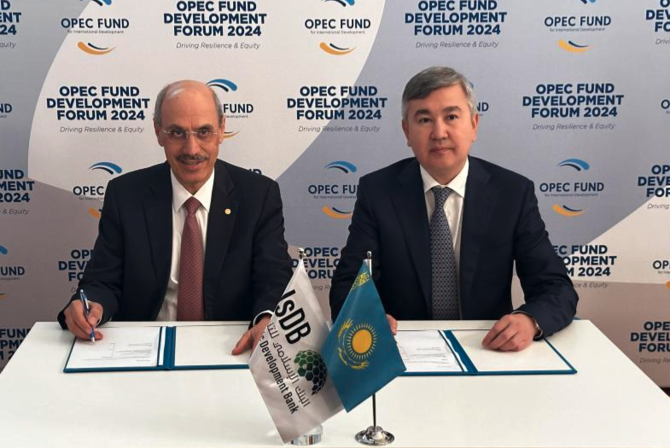

RIYADH: Infrastructure projects in Kazakhstan will receive support from the Islamic Development Bank after a deal was signed in Vienna.
IsDB President Mohammed Sulaiman Al-Jasser inked the agreement with the Central Asian country’s Deputy Prime Minister and Minister of National Economy Nurlan Baibazarov on the sidelines of the 19th Meeting of Heads of Institutions of the Arab Coordination Group.
According to a statement, the framework deal seeks to enhance Kazakhstan’s competitive ability by supporting its growth strategy.
Since Kazakhstan became a member of the IsDB in 1995, the group has approved a total of $1.64 billion in financing for various projects in the country, 14 of which are still active.
During their meeting, Al-Jasser and Baibazarov discussed possible financing of new mega projects in water resources management and irrigation, transport infrastructure, and further involvement in private sector development.
Furthermore, Al-Jasser also met with UN World Food Program Executive Director Cindy McCain on the sidelines of the development forum.
The two officials reviewed the two institutions’ partnership to strengthen and develop strong collaborations. They also explored ways to foster closer cooperation to address food insecurity in member countries and globally.
The two sides cooperate through the Afghanistan Humanitarian Trust Fund, managed by the IsDB, along with other initiatives focused on human capital development as part of their ongoing alliance.
In addition, they facilitate collaborative opportunities to execute programs and undertakings within the humanitarian aid sector, with a specific focus on areas such as food security, nutrition, agriculture, and rural development.
In a separate meeting, the IsDB president and Global Partnership for Education CEO Laura Frigenti shed light on their close partnership and potential ways to enhance schooling in lower-income countries.
The IsDB, in collaboration with the GPE and its partners, manages a portfolio exceeding $500 million to advance the Arab Coordination Group Smart Education Financing Initiative, aimed at elevating education in Cameroon, Nigeria, Uzbekistan, and Kyrgyzstan.
The GPE represents a collective dedication to eradicating the worldwide learning crisis by mobilizing resources and fostering partnerships to assist approximately 90 low-income countries in strengthening their education systems.
Its ultimate aim is to ensure that each young individual obtains the high-quality schooling necessary to unleash their full potential and actively contribute to the construction of a brighter future.
On the sidelines of the forum, the Saudi Export-Import Bank and the Organization of the Petroleum Exporting Countries Fund for International Development concluded a memorandum of understanding aimed at enhancing aspects of cooperation to activate development initiatives and expand the spread of Saudi non-oil exports in markets of common interest.
“The MoU with the OPEC Fund for International Development comes within the framework of the bank’s commitment to strengthening international partnerships and contributing to sustainable development initiatives in cooperation with the international community, in addition to focusing fully on developing Saudi non-oil exports in global markets, and paving the way for local investors,” CEO of the Saudi EXIM Bank Saad Al-Khalb said.
“This is in order to empower the non-oil national economy and create a diversified and comprehensive economy in accordance with the goals of the Kingdom’s Vision 2030,” Al-Khalb added.


