

Pakistan eyes $50 billion Chinese exports in 10 years, greenlights joint venture for industry relocation

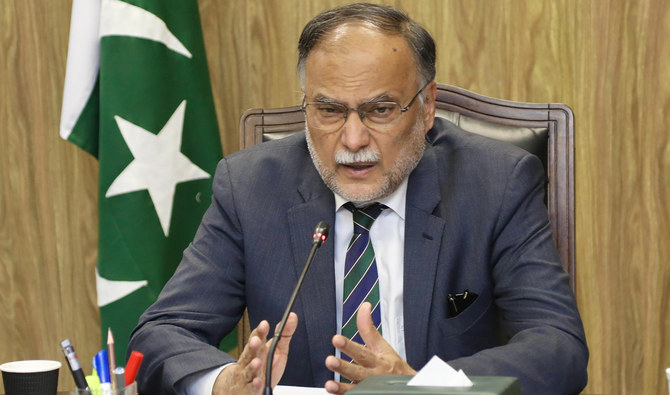
Pakistan Planning Minister Ahsan Iqbal is chairing a meeting in Islamabad on June 22, 2024, to develop a roadmap ahead of the visit of Chinese experts at the end of June. (@PlanComPakistan/X)
Short Url
Updated 26 June 2024
Follow

Pakistan eyes $50 billion Chinese exports in 10 years, greenlights joint venture for industry relocation

  • Chinese experts scheduled to visit Pakistan this month “to foster innovation, technology transfer, capacity building”
  • Earlier this month, Prime Minister Shehbaz Sharif was on a five-day visit to China in which dozens of MoUs were signed 

ISLAMABAD: The Pakistan planning ministry said this week it planned to increase exports to China to $50 billion in the next ten years, as the Prime Minister on Wednesday greenlit a joint venture project to relocate Chinese industries to Pakistan.

Earlier this month, Prime Minister Shehbaz Sharif went on a five-day visit to China that included meetings with top political and business leaders with the aim of upgrading the China-Pakistan Economic Corridor (CPEC), a flagship of the Belt and Road Initiative (BRI), through which Beijing has pledged over $60 billion to Pakistan. Dozens of MoUs were also signed during the visit. 

“The Planning Minister highlighted the goal of exporting fifty billion dollars to the Chinese market. The aim is to increase Pakistan’s exports from 30 billion dollars to 150 billion dollars in the next 10 years,” the ministry said in a statement, emphasizing the importance of learning from China’s experience and know-how.

“A delegation of Chinese experts from various fields is scheduled to visit Pakistan at the end of this month, aiming to foster innovation, technology transfer, and capacity building,” the statement added. 

“The focus will be on capacity building of Pakistani experts through training and knowledge sharing, learning from China’s experience in innovation and technological advancements, adapting innovative solutions to Pakistan’s specific needs, and skill development in key sectors.”

While chairing a meeting to prepare for the Chinese delegation’s visit, Planning Minister Ahsan Iqbal directed line ministries to be “selective and strategic” and focus on areas where China had experience that could be shared with Pakistani professionals. 

“He noted that China has 2.7 trillion dollars in imports, and Pakistan must focus on areas through which it could enhance exports and secure a share in Chinese imports,” Iqbal said, emphasizing the need for Pakistan to learn from China’s strategic advancements in knowledge and technology. 

“The visit aims to transfer Chinese expertise to promote innovation and technology across various sectors in Pakistan, with a focus on mutual cooperation and knowledge sharing.”

Separately on Wednesday, Sharif chaired a meeting of the Board of Investment (BoI) to discuss promoting both local and foreign investment in Pakistan.

“There was significant potential for relocating China’s textile, leather, footwear, and other industries to Pakistan,” state-run APP said in a report, quoting the PM, who okayed a joint venture project to relocate Chinese industries to Pakistan.


Pakistan to promote mineral sector at Saudi forum this month with 13 companies

Updated 02 January 2026
Follow

Pakistan to promote mineral sector at Saudi forum this month with 13 companies

  • Delegation will take part in the Future Minerals Forum in Riyadh from Jan. 13-15
  • Petroleum minister will lead Pakistan, participate in a 90-minute country session

ISLAMABAD: Around 13 Pakistani state-owned and private companies will attend the Future Minerals Forum (FMF) in Saudi Arabia from Jan. 13 to 15, an official statement said on Friday, as the country seeks to ramp up global engagement to develop its mineral resources.

The FMF is an international conference and investment platform for the mining sector, hosted by mineral-rich countries to attract global investors, companies and governments.

Petroleum Minister Ali Pervaiz Malik confirmed Pakistan’s participation in a meeting with the Saudi envoy, Nawaf bin Said Al-Malki.

Pakistan hosts one of the world’s largest copper-gold zones. The Reko Diq mine in southwestern Balochistan, with an estimated 5.9 billion tons of ore, is partly owned by Barrick Gold, which calls it one of the world’s largest underdeveloped copper-gold deposits. Its development is expected to boost Pakistan’s struggling economy.

“Upon an invitation of the Government of the Kingdom of Saudi Arabia, the Federal Minister informed the Ambassador that Pakistan will fully participate in the upcoming Future Minerals Forum (FMF), scheduled to be held in Riyadh later this month,” Pakistan’s Press Information Department (PID) said in an official statement.

The Pakistani minister will lead his country’s delegation at the FMF and take part in a 90-minute country showcase session titled “Unleashing Potential: Accelerating Pakistan’s Mineral Revolution” along with local and foreign investors.

Pakistan will also establish a dedicated pavilion to highlight the vast potential of its rich geological landscape to the global mineral community.

The Saudi envoy welcomed Pakistan’s decision to participate in the forum and discussed enhancing bilateral cooperation in the minerals and energy sectors during the meeting.

According to the statement, he highlighted the potential for cooperation between Saudi Arabia and Pakistan in the minerals and energy sectors, expressing confidence that the FMF would provide a platform to expand collaboration.
Pakistan’s mineral sector, despite its rich reserves of salt, copper, gold and coal, contributes only 3.2 percent to the country’s GDP and just 0.1 percent to global mineral exports.

However, many countries, including the United States, have shown interest in Pakistan’s underdeveloped mineral sector, particularly in copper, gold and other critical resources.

In October, Pakistan dispatched its first-ever shipment of rare earth and critical minerals to the United States, according to a Chicago-based US public relations firm’s report.