
KARACHI: Pakistan’s gold jewelry exporters are planning to relocate their business operations to the United Arab Emirates (UAE), said the top official of their trade association on Tuesday, citing “unfavorable business conditions” that include heavy taxation by the government.
The Federal Board of Revenue (FBR), Pakistan’s tax collection body, has levied an 18 percent tax on local jewelers for the sale of advanced gold to foreign buyers, which can later be refunded after the export.
However, those involved in the business point out that this condition is challenging even for some of the biggest companies, as it requires them to deposit tax worth millions of rupees, often exceeding the value addition and profit.
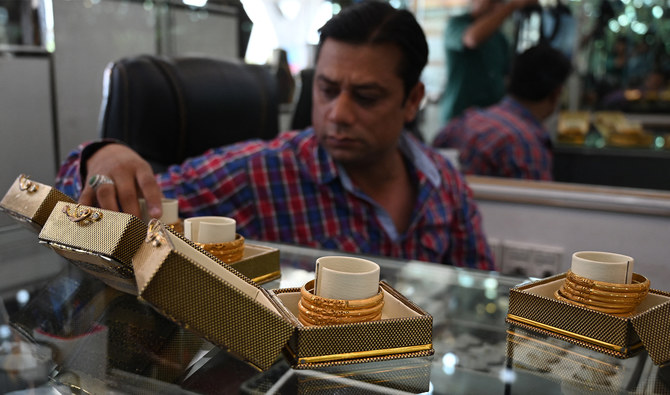
Pakistani jewelers receive raw gold from foreign buyers who require them to convert the precious metal into finished products before export.
“Exports are suspended and the 18 percent sales tax requirement on advanced gold purchase by foreign buyers under the Entrustment Scheme by the FBR has dashed the exporters’ hopes,” Habib-ur-Rahman, Chairman of the Pakistan Gem and Jewelry Traders and Exporters Association (PGJTEA), told Arab News on the sidelines of a news conference in Karachi.
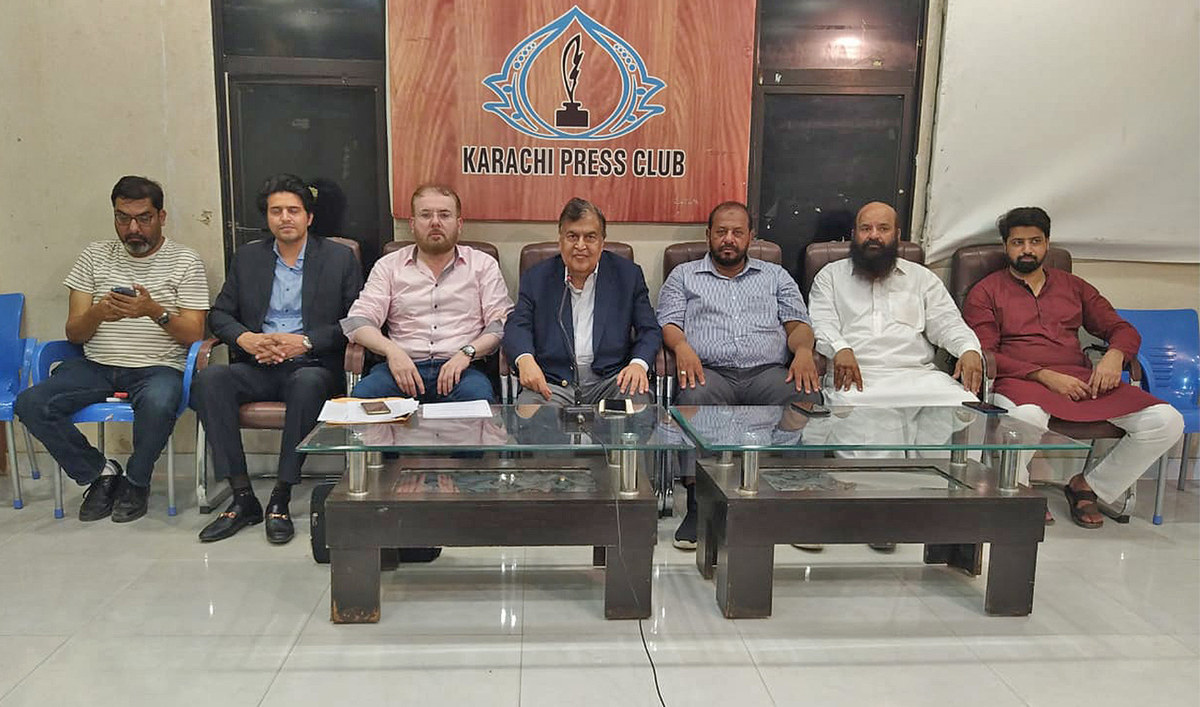
Chairman pf Pakistan Gem and Jewelry Traders and Exporters Association (PGJTEA), Habib-ur-Rahman (center), is addressing a press conference at Karachi Press Club in Karachi, Pakistan, on June 25, 2024. (AN photo)
Rahman noted that due to the “unfavorable business conditions,” many jewelers had decided to shift their businesses to the Middle East.
“There are nearly 100 businesses involved in Pakistan’s gold jewelry export, out of which 25 top exporters have decided to shift their business from Pakistan to the Middle East and the UAE, and many have already gone to Dubai,” he said, adding this would significantly reduce jewelry exports from the country.
The official said the UAE’s business conditions were far better than Pakistan’s since there was no issue of law and order, electricity was available at lower rates and one could export the goods instantly.
He warned if the sales tax exemption was not restored on the export of gold ornaments, the current export of $100 million would be reduced to $1-2 million.
This, he added, would financially impact the families of 10,000 gold jewelry artisans and reduce some valuable foreign exchange from the sector.
Addressing the news conference, Rahman said not even a gram of raw gold had been imported into the country since the end of the sales tax exemption earlier this year in February, adding Pakistani exporters had turned away buyers who were offering them business of $12 million.
“The orders which were canceled from Pakistan were transferred to India,” he added.
He noted the export of gold jewelry from Pakistan had declined by 95 percent at a time when other countries, like Turkiye, had increased theirs from $4 billion to $13 billion.
Indian exports had also surged from $32 billion to $42 billion, he continued.
Adnan Qadri, convener of the Federation of Pakistan Chambers of Commerce & Industry’s Central Standing Committee on Gems & Jewelry, said the sector had historically enjoyed exemptions from all duties and taxes related to gold exports.
A recent change in the customs processing system, however, had led to the sudden withdrawal of these exemptions, he informed, particularly affecting the sales tax exemption under the Sales Tax Act.
“This has resulted in the imposition of an 18 percent sales tax on gold imports, which is unjustified given the temporary nature of these imports under the Entrustment Scheme,” Qadri told Arab News.
He said that despite the assurances from the relevant authorities, the proposed amendment to the Act was omitted from the recent federal budget, causing severe economic repercussions within the sector.