

Pakistani gold jewelry exporters plan relocation to UAE amid taxation challenges, says trade association

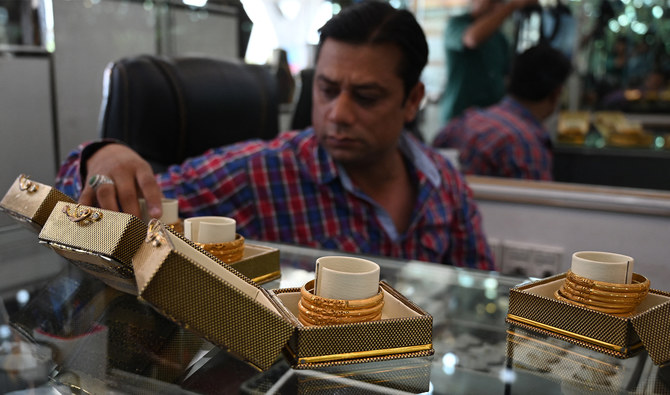
In this pictures taken on April 22, 2019, a Pakistani jeweller checks gold bangles at his shop in Rawalpindi. (AFP/File)
Short Url
Updated 26 June 2024
Follow

Pakistani gold jewelry exporters plan relocation to UAE amid taxation challenges, says trade association

  • The association says gold jewelry export from Pakistan has decreased by 95 percent since imposition of 18 percent sales tax
  • It warns export of gold ornaments can decline from $100 million to $1-2 million, affecting the families of 10,000 gold artisans

KARACHI: Pakistan’s gold jewelry exporters are planning to relocate their business operations to the United Arab Emirates (UAE), said the top official of their trade association on Tuesday, citing “unfavorable business conditions” that include heavy taxation by the government.

The Federal Board of Revenue (FBR), Pakistan’s tax collection body, has levied an 18 percent tax on local jewelers for the sale of advanced gold to foreign buyers, which can later be refunded after the export.

However, those involved in the business point out that this condition is challenging even for some of the biggest companies, as it requires them to deposit tax worth millions of rupees, often exceeding the value addition and profit.

Pakistani jewelers receive raw gold from foreign buyers who require them to convert the precious metal into finished products before export.

“Exports are suspended and the 18 percent sales tax requirement on advanced gold purchase by foreign buyers under the Entrustment Scheme by the FBR has dashed the exporters’ hopes,” Habib-ur-Rahman, Chairman of the Pakistan Gem and Jewelry Traders and Exporters Association (PGJTEA), told Arab News on the sidelines of a news conference in Karachi.
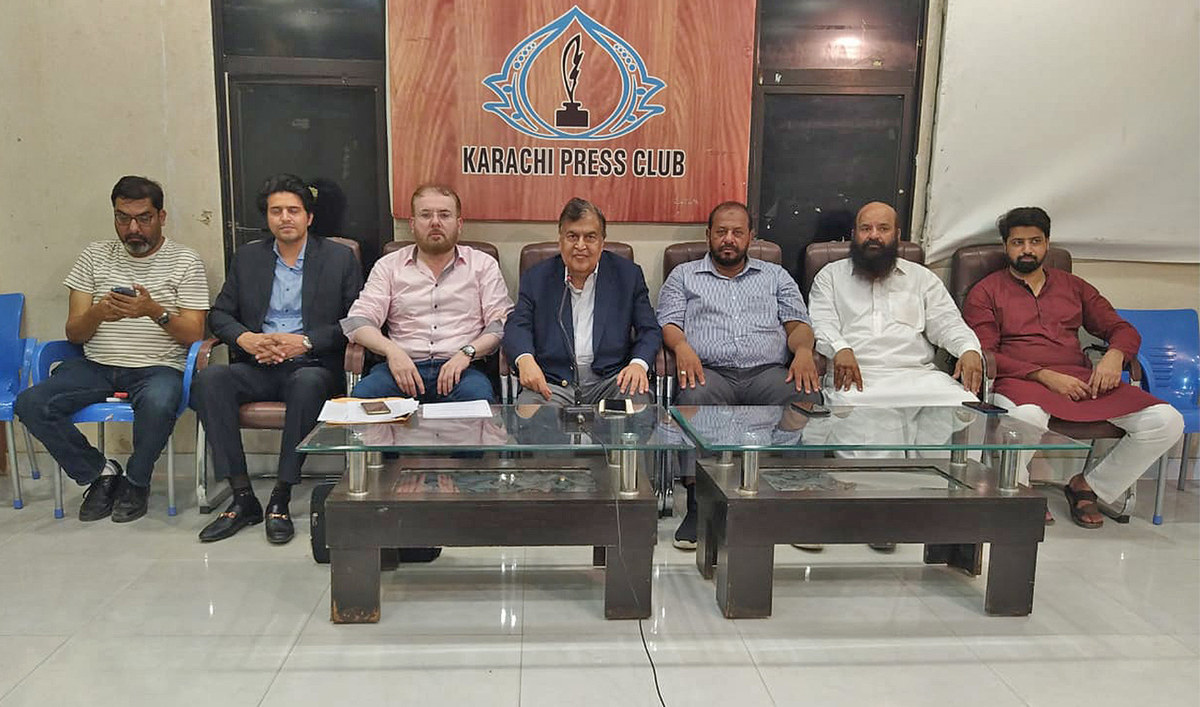


Chairman pf Pakistan Gem and Jewelry Traders and Exporters Association (PGJTEA), Habib-ur-Rahman (center), is addressing a press conference at Karachi Press Club in Karachi, Pakistan, on June 25, 2024. (AN photo)

Rahman noted that due to the “unfavorable business conditions,” many jewelers had decided to shift their businesses to the Middle East.

“There are nearly 100 businesses involved in Pakistan’s gold jewelry export, out of which 25 top exporters have decided to shift their business from Pakistan to the Middle East and the UAE, and many have already gone to Dubai,” he said, adding this would significantly reduce jewelry exports from the country.

The official said the UAE’s business conditions were far better than Pakistan’s since there was no issue of law and order, electricity was available at lower rates and one could export the goods instantly.

He warned if the sales tax exemption was not restored on the export of gold ornaments, the current export of $100 million would be reduced to $1-2 million.

This, he added, would financially impact the families of 10,000 gold jewelry artisans and reduce some valuable foreign exchange from the sector.

Addressing the news conference, Rahman said not even a gram of raw gold had been imported into the country since the end of the sales tax exemption earlier this year in February, adding Pakistani exporters had turned away buyers who were offering them business of $12 million.

“The orders which were canceled from Pakistan were transferred to India,” he added.

He noted the export of gold jewelry from Pakistan had declined by 95 percent at a time when other countries, like Turkiye, had increased theirs from $4 billion to $13 billion.

Indian exports had also surged from $32 billion to $42 billion, he continued.

Adnan Qadri, convener of the Federation of Pakistan Chambers of Commerce & Industry’s Central Standing Committee on Gems & Jewelry, said the sector had historically enjoyed exemptions from all duties and taxes related to gold exports.

A recent change in the customs processing system, however, had led to the sudden withdrawal of these exemptions, he informed, particularly affecting the sales tax exemption under the Sales Tax Act.

“This has resulted in the imposition of an 18 percent sales tax on gold imports, which is unjustified given the temporary nature of these imports under the Entrustment Scheme,” Qadri told Arab News.

He said that despite the assurances from the relevant authorities, the proposed amendment to the Act was omitted from the recent federal budget, causing severe economic repercussions within the sector.


IMF warns against policy slippage amid weak recovery as it clears $1.2 billion for Pakistan

Updated 11 December 2025
Follow

IMF warns against policy slippage amid weak recovery as it clears $1.2 billion for Pakistan

  • Pakistan rebuilt reserves, cut its deficit and slowed inflation sharply over the past one year
  • Fund says climate shocks, energy debt, stalled reforms threaten stability despite recent gains

ISLAMABAD: Pakistan’s economic recovery remains fragile despite a year of painful stabilization measures that helped pull the country back from the brink of default, the International Monetary Fund (IMF) warned on Thursday, after it approved a fresh $1.2 billion disbursement under its ongoing loan program.

The approval covers the second review of Pakistan’s Extended Fund Facility (EFF) and the first review of its climate-focused Resilience and Sustainability Facility (RSF), bringing total disbursements since last year to about $3.3 billion.

Pakistan entered the IMF program in September 2024 after years of weak revenues, soaring fiscal deficits, import controls, currency depletion and repeated climate shocks left the economy close to external default. A smaller stopgap arrangement earlier that year helped avert immediate default, but the current 37-month program was designed to restore macroeconomic stability through strict monetary tightening, currency adjustments, subsidy rationalization and aggressive revenue measures.

The IMF’s new review shows that Pakistan has delivered significant gains since then. Growth recovered to 3 percent last year after shrinking the year before. Inflation fell from over 23 percent to low single digits before rising again after this year’s floods. The current account posted its first surplus in 14 years, helped by stronger remittances and a sharp reduction in imports. And the government delivered a primary budget surplus of 1.3 percent of GDP, a key program requirement. Foreign exchange reserves, which had dropped dangerously low in 2023, rose from US$9.4 billion to US$14.5 billion by June.

“Pakistan’s reform implementation under the EFF arrangement has helped preserve macroeconomic stability in the face of several recent shocks,” IMF Deputy Managing Director Nigel Clarke said in a statement after the Board meeting.

But he warned that Islamabad must “maintain prudent policies” and accelerate reforms needed for private-sector-led and sustainable growth.

The Fund noted that the 2025 monsoon floods, affecting nearly seven million people, damaging housing, livestock and key crops, and displacing more than four million, have set back the recovery. The IMF now expects GDP growth in FY26 to be slightly lower and forecasts inflation to rise to 8–10 percent in the coming months as food prices adjust.

The review warns Pakistan against relaxing monetary or fiscal discipline prematurely. It urges the State Bank to keep policy “appropriately tight,” allow exchange-rate flexibility and improve communication. Islamabad must also continue raising revenues, broadening the tax base and protecting social spending, the Fund said.

Despite the progress, Pakistan’s structural weaknesses remain severe.

Power-sector circular debt stands at about $5.7 billion, and gas-sector arrears have climbed to $11.3 billion despite tariff adjustments. Reform of state-owned enterprises has slowed, including delays in privatizing loss-making electricity distributors and Pakistan International Airlines. Key governance and anti-corruption reforms have also been pushed back.

The IMF welcomed Pakistan’s expansion of its flagship Benazir Income Support Program, which raises cash transfers for low-income families and expands coverage, saying social protection is essential as climate shocks intensify. But it warned that high public debt, about 72 percent of GDP, thin external buffers and climate exposure leave the country vulnerable if reform momentum weakens.

The Fund said Pakistan’s challenge now is to convert short-term stabilization into sustained recovery after years of economic volatility, with its ability to maintain discipline, rather than the size of external financing alone, determining the durability of its gains.