DUBAI: Seemingly every afternoon in Iran’s capital, police vans rush to major Tehran squares and intersections to search for women with loose headscarves and those who dare not to wear them at all.
The renewed crackdown comes not quite two years since mass protests over the death Mahsa Amini after she was detained for not wearing a scarf to the authorities’ liking. A United Nations panel has found that the 22-year-old died as a result of “physical violence” wrought upon her by the state.
Amini’s death set off months of unrest that ended in a bloody crackdown, and for a time morality police disappeared from the streets. But now videos are emerging of women being physically forced into vans by police as lawmakers continue to push for harsher penalties. Meanwhile, authorities have seized thousands of cars over women having their hair uncovered while also targeting businesses that serve them.
The renewed hijab push, which police are calling the Noor — or “Light” — Plan, began before President Ebrahim Raisi died in a helicopter crash, and whoever wins a vote to replace the hard-line cleric on Friday will have an influence over just how intense it becomes — and how Iran responds to any further unrest.
“An intervention ... under the Noor Plan will take us into darkness,” reformist presidential candidate Masoud Pezeshkian recently told a group of female supporters
Enforcement began ramping up in April, with videos spreading online showing women having violent encounters with female enforcers dressed in the all-encompassing black chador alongside uniformed police officers.
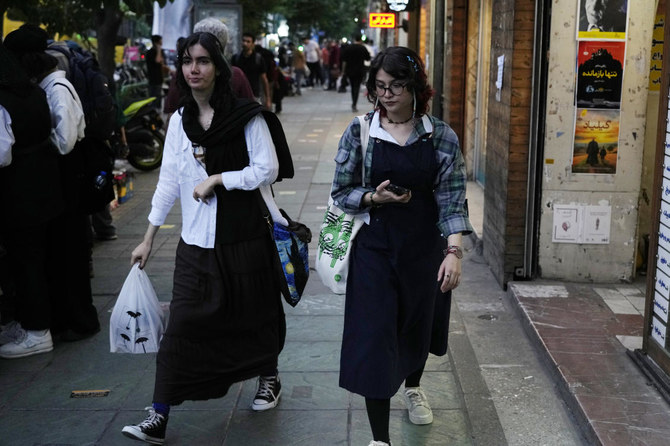
While police haven’t published arrest numbers about the crackdown and media haven’t given it major attention, it’s widely discussed in Iran. But still, many women continue to wear their hijabs loosely or leave them draped around their shoulders while walking in Tehran.
On a recent afternoon in northern Tehran, women sat in cafes and other public places, as a police officer in his 50s told those passing by: “Please cover yourselves, ladies,” and then muttered audibly: “My God, I am fed up repeating this without getting any attention.”
“We know the police are not eager to fight women, but they are under pressure to,” said Fatemeh, a 34-year-old math teacher who gave only her first name for fear of reprisal. “Sooner or later, the authorities will realize that it would serve their interests better to pull back.”
Iran and neighboring Taliban-controlled Afghanistan are the only countries where the hijab remains mandatory. While women attend school, work and can manage their own lives in Iran, hard-liners insist that the hijab must be enforced.
The garment has long has been entwined with politics in Iran. Former ruler Reza Shah Pahlavi banned it in 1936, part of his efforts to mirror the West. The ban lasted only five years, but many middle and upper-class Iranian women chose not to wear it.
After the 1979 Islamic Revolution, some of the women who helped overthrow the shah embraced the even more conservative chador. But others protested a decision by Grand Ayatollah Ruhollah Khomeini to order women to wear hijabs in public. In 1983, it became law, enforced with penalties including fines and up to two months in prison.
Amini’s death in September 2022 sparked months of protests and a security crackdown that killed more than 500 people and saw over 22,000 detained. But less than two years later, hard-liners within Iran’s theocracy have pressed forward with a crackdown.
The government’s insistence on enforcing the hijab also reflects its conspiratorial view of the world. Iran’s national police chief, Gen. Ahmad Reza Radan, has alleged without providing evidence that the country’s enemies plan to transform the nation’s culture by encouraging women to avoid the veil.
Already, “tens of thousands of women have had their cars arbitrarily confiscated as punishment for defying Iran’s veiling laws,” Amnesty International said in March. “Others have been prosecuted and sentenced to flogging or prison terms or faced other penalties such as fines or being forced to attend ‘morality’ classes.”
On Saturday, police said they would release some 8,000 vehicles held over women not wearing the hijab in them for the Eid Al-Ghadir holiday marked by Shiites.
There’s also been a push to close down businesses that serve women who aren’t wearing hijabs.
“The Islamic Republic is using the distraction of its presidential ‘election’ to go after its women activists and cow them into silence through imprisonment and abuse,” said Hadi Ghaemi, the executive director of the New York-based Center for Human Rights in Iran. The center said at least 12 women activists have been sentenced to prison since Raisi’s deaths for their work.
But there are signs that Iran’s government, and 85-year-old Supreme Leader Ayatollah Ali Khamenei, know there are risks to escalating enforcement. A bill passed by Iran’s parliament that could impose 10-year prison sentences for hijab violations has yet to be approved by the country’s Guardian Council, a panel of clerics and jurists ultimately overseen by Khamenei.
So far among the presidential candidates, only Pezeshkian has criticized the hijab law. Others, including current parliament speaker Mohammad Bagher Qalibaf, asked for the law to be implemented in a softer way. Candidate Mostafa Pourmohammadi, a Shiite cleric, criticized the use of violence against women, saying police should use “the language of trust and gratitude” rather than the baton.
Meanwhile, the imprisoned Nobel Peace Prize laureate Narges Mohammadi, a prominent women’s rights activist, has issued a call from prison urging a boycott of the presidential vote, saying it only supports “a regime that believes in repression, terror and violence.”
At a recent Friday prayers in Tehran, women uniformly wore the chador while attending, as they always do.
“Every women should cover herself in veil, this is an order by Allah,” said Masoumeh Ahmadi, a 49-year-old housewife.
But even among the pious, there can be differences of opinion.
“Yes, it is an order by God, but it is not a must for all women as far as I have learned,” said Ahmadi’s 37-year-old friend, Zahra Kashani.

As Iran’s presidential vote looms, tensions boil over renewed headscarf crackdown
https://arab.news/b6b42
As Iran’s presidential vote looms, tensions boil over renewed headscarf crackdown
- Videos are emerging of women being physically forced into vans by police as lawmakers continue to push for harsher penalties
- Authorities have seized thousands of cars over women having their hair uncovered
Great expectations: Yemenis look forward to outcomes of Riyadh dialogue
- Southern factions look to Saudi-hosted talks to defuse tensions after December’s violent escalation
- Analysts say Riyadh dialogue could help reset the southern cause — but only if militias are excluded
RIYADH: Last December marked a troubled end to the year in Yemen, particularly in its southern and eastern governorates. While much of the world marked the season with hopes for peace and stability, developments on the ground took a sharply different turn.
The Southern Transitional Council (STC), led by Aidarous Al-Zubaidi, moved to seize control of state institutions and military camps, defying expectations in Hadramout and Al-Mahra and mounting a direct challenge to the internationally recognized government.
These actions, carried out through armed force and supported by external actors, led to casualties and an escalation of tensions in both governorates.
In response, Yemen’s political leadership appealed to the Saudi-led coalition to contain the situation, called for the withdrawal of Emirati forces, and initiated operations to reassert control over military headquarters in Hadramout and Al-Mahra.
Subsequently, Rashad Mohammed Al-Alimi, chairman of the Presidential Leadership Council, asked Saudi Arabia to host a conference in Riyadh, bringing together all southern factions to discuss solutions — a request accepted by the Saudi leadership.
The initiative comes amid the Kingdom’s affirmation of the legitimacy of the southern cause, coupled with its clear rejection of any solution imposed by force.
Arab News surveyed the views of several Yemeni politicians and analysts on their expectations for the conference, convened at a critical and highly sensitive juncture, and on the key issues anticipated to dominate the dialogue.
Among them was Salah Batis, a member of the Yemeni Shura Council, a member of the Preparatory Committee for the Unified Council of the Eastern Governorates, and a prominent figure in Hadramout.
“We extend our sincere gratitude to our brothers in the Kingdom of Saudi Arabia — both leadership and people — for their steadfast support, assistance, and courageous stand alongside the people of Hadramout and the eastern governorates in particular, and Yemen as a whole,” Batis told Arab News.
“Without this support, and without the role of the Saudi Air Force, this victory would not have been achieved, security would not have been restored, and this militia would not have been removed from these sensitive areas, especially Hadramout and the eastern governorates.
“We also express our appreciation to the political leadership, represented by the chairman of the Presidential Leadership Council, Dr. Rashad Al-Alimi, and to the governor of Hadramout and commander of the Homeland Shield Forces, Salem Al-Khanbashi.
“Our gratitude further extends to the heroes of the Homeland Shield Forces, the armed forces, and the security forces who participated in the operation to take control of the camps. It was a swift and decisive operation, carried out at minimal cost, praise be to God.”
However, Batis said he opposes the inclusion of the STC in the upcoming Riyadh conference, citing its involvement in the killing and terrorizing of civilians in Hadramout and Al-Mahra.
He described the call for dialogue as “a positive step toward preserving the southern cause, which the STC had sought to hijack and undermine, nearly causing severe damage had it not been for swift and decisive intervention.”
Batis said the southern cause must represent all southerners without exception, and that no single party should monopolize it or claim exclusive representation. He said the STC had already harmed the cause by using armed violence to advance its agenda, resulting in killings.
For this reason, he said, the people of Hadramout — where many of these violations occurred — have demanded, and continue to demand, accountability for those responsible and their exclusion from the dialogue.
He accused the STC of mobilizing armed forces, invading governorates, killing tribesmen, attacking villages and civilians, storming and looting state camps, and destroying public institutions, including airports, ports, oil facilities, and government offices in Seiyun, Mukalla, and other locations.
Batis said the STC and its leadership bear full responsibility, arguing they had led and directed the armed groups toward Hadramout under the banner of southern forces.
He questioned how the people of Hadramout and the eastern governorates could accept belonging to such a region after what had occurred, noting that these forces operated under a declared leadership and a self-proclaimed supreme commander.
Batis said local communities viewed them as invading forces that killed civilians, shed blood, attacked state institutions, and seized military camps.
He added that, were it not for the decisive intervention of allied forces and local authorities — leading to the return of the camps, the repair of the damage, and the withdrawal of these militias to their original positions — the consequences would have been far more severe.
“I believe this dialogue and conference must have a clear and firm framework: no group that possesses weapons, militias, or armed forces should take part,” Batis said.
“Arms must be exclusively in the hands of the state, under the authority of the ministries of defense and interior, and sovereignty must rest solely with the state — not with parties, factions, or individuals.”
Batis warned against repeating what he described as the mistake of 2013, when the Houthi group was allowed to participate in the National Dialogue Conference while still armed and expanding its territorial control.
He recalled that by January 2014 the Houthis had seized Amran Governorate and laid siege to Sanaa, halting the drafting of the federal constitution and forcing meetings to be held at the Presidential Palace.
Batis noted that he was serving at the time as vice president of the National Authority tasked with monitoring the implementation of the dialogue’s outcomes, before the Houthis later stormed the capital and plunged the country into a crisis that continues to this day.
For his part, political analyst and activist Youssef Ismail Abdo said that any fair and equitable outcomes from the conference would help stabilize the south — particularly Hadramawt and the eastern governorates — fostering security, development, and stability, with positive implications for all of Yemen and the wider region.
Also speaking to Arab News, Dr. Nasser bin Habtour, secretary-general of the Shabwa National Council, said that “the south is home to multiple political projects, including secession and a federal state.
“The events of December demonstrated that not all southerners support secession, leaving the STC isolated in its unilateral move. In my opinion, all political options should be placed on the dialogue table so that southerners can discuss them and reach a unified vision.”
He argued that “secession is neither feasible nor appropriate at the present stage, given Yemen’s dire circumstances, with the Houthi militia controlling Sanaa and state institutions and posing a serious threat to Yemen and the wider region.”
He stressed that “restoring the Yemeni state must come first, after which all political projects can be presented to the people, who should then decide the future form of the state.”
He added: “The meeting, to be held in Riyadh, came at the request of southern political and social figures and groups who convened after recognizing both their responsibility and the danger into which the STC had placed the southern cause.
“They contacted the chairman of the Presidential Leadership Council, urging him to ask the Kingdom to host a southern dialogue conference.” He noted that “this initiative was consistent with Saudi Arabia’s longstanding role in supporting Yemen.”
“The conference must focus on repairing the damage inflicted on the southern cause by the STC’s unilateral decisions and attempts to monopolize it, as well as restoring the issue to its proper course through a consensual vision shared by the people of the south.”
Regarding the expected outcomes of the comprehensive southern national dialogue, Habtour said: “The first priority is reaching consensus on a unified southern vision that reflects the aspirations of the people of the south.”
He added: “The southern issue must be situated within the broader national struggle to restore the state from the Houthi militia, as well as integrated into the negotiation process aimed at restoring security and stability in Yemen.”
He further stressed “the importance of defining the role of southerners in the upcoming phase, particularly within the framework of a future federal state and their contribution to nation-building and development.”


