NATO to formally appoint Rutte next boss Wednesday: diplomats

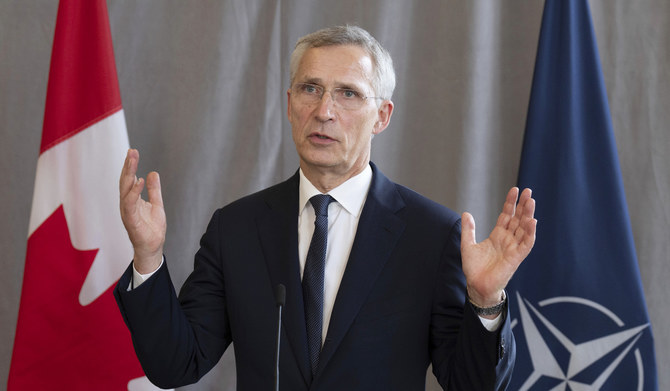
NATO will officially name outgoing Dutch PM Mark Rutte as the alliance’s next head on Wednesday, after ambassadors from all 32 member countries greenlit his appointment, diplomats said Tuesday. (AP/File)
Short Url
Updated 25 June 2024
Follow

NATO to formally appoint Rutte next boss Wednesday: diplomats

  • Diplomats from several NATO states said Rutte will take over from current secretary general Jens Stoltenberg
  • The seasoned Dutch leader will take the reins at a pivotal time

BRUSSELS: NATO will officially name outgoing Dutch Prime Minister Mark Rutte as the alliance’s next head on Wednesday, after ambassadors from all 32 member countries greenlit his appointment, diplomats said Tuesday.
Diplomats from several NATO states said Rutte, who was strongly backed by leading power the United States, will take over from current secretary general Jens Stoltenberg when his term ends on October 1.
Rutte, 57, last week sealed the race to lead the Western military alliance after lone challenger Romanian President Klaus Iohannis dropped out.
The seasoned Dutch leader, who is set to leave office in the Netherlands soon after almost 14 years in charge, will take the reins at a pivotal time.
The next NATO chief will have to grapple with the ongoing fallout from Russia’s war on Ukraine and the potential return to the US presidency of Donald Trump after elections in November.


Philippines probes Bondi Beach suspects’ visit, downplays militant training reports

Updated 12 sec ago
Follow

Philippines probes Bondi Beach suspects’ visit, downplays militant training reports

  • Suspects spent 4 weeks in the Philippines last month
  • Govt says no evidence visit linked to militant activity

MANILA: The Philippine National Police launched on Wednesday a probe into the recent visit to the country of a father and son whom Australian authorities have identified as suspects in last week’s mass shooting in Sydney.

Two gunmen killed 15 people and wounded dozens of others during Hanukkah celebrations at Sydney’s Bondi Beach on Sunday.

The suspected shooters, identified by Australian authorities as Sajid Akram and his son Naveed Akram, traveled to the Philippines last month.

The news has prompted various media outlets to speculate that there are links between their visit and the Sydney attack — an allegation Manila has since denied.

The investigation launched by the Philippine police seeks to establish the purpose of the suspects’ travel and their movement while in the country.

“This matter is being investigated as we seek to determine the reason behind their visit to the Philippines. We are finding out which places they went to, who they talked to, and where they stayed while they were in the country,” Philippine National Police acting chief Lt. Gen. Jose Melencio Nartatez Jr. said in a statement.

Bureau of Immigration data shows that 50-year-old Akram and his 24-year-old son arrived in the Philippines from Sydney on Nov. 1. They left the country on Nov. 28 via a connecting flight from Davao in the southern Philippines to Manila, with Sydney as their final destination.

According to a police statement, Philippine authorities, including the government and military, said there was no evidence the trip was related to any militant activity in the country and was “not considered as a serious security concern.”

Australian media reports linking the suspects to Daesh and alleging the group used the Philippines as its training ground were denied by the Philippine government.

“Information from operating units on the ground indicates no ongoing training and recruitment,” Department of National Defense spokesperson Arsenio Andolong told Arab News.

“There is no indication of imminent domestic terrorist threats.”

Presidential Communications Office Undersecretary and Palace Press Officer Claire Castro also dismissed the claims as “misleading” and “portraying the Philippines as a training hotspot for violent extremist groups.”

She told reporters that the National Security Council “maintained there is no confirmation to allegations that the father-and-son suspects in the recent mass shooting in Bondi Beach, Sydney, Australia, received training in the Philippines.”

Castro added that Philippine security forces “have significantly weakened” Daesh-affiliated groups since the 2017 Marawi siege.

The southern Philippine city in Mindanao island was in 2017 taken over by groups affiliated with Daesh. After five months of fighting and hundreds of deaths, the Philippine army reclaimed the area.

“Both UN and the US government assessments indicate that these groups now operate in a fragmented and diminished capacity,” Castro said.

“Violence in Mindanao is largely driven by historical conflicts and local clan disputes rather than the operational capacity of ISIS-affiliated organizations.”