

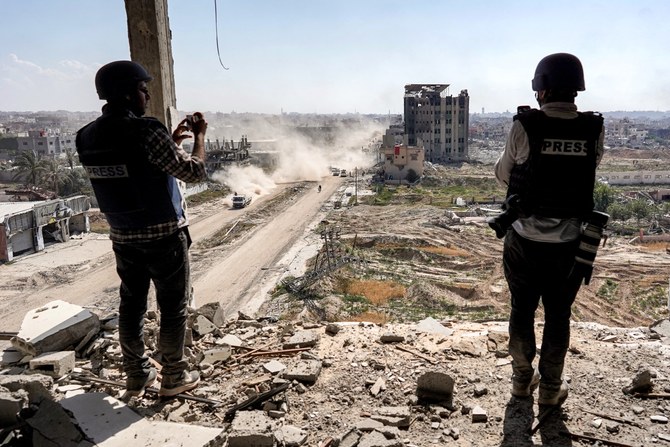

LONDON: A new investigation has suggested that the Israeli military views some Gaza-based journalists as “legitimate targets.”
The Guardian, in collaboration with the Paris-based non-profit Forbidden Stories, revealed that some members of the armed forces consider journalists working for Hamas-controlled or affiliated outlets as legitimate targets not covered by the same international protections as civilians.
Media watchdogs Committee to Protect Journalists and Arab Reporters for Investigative Journalism reported that around 30 percent of the 108 media workers killed since Oct. 7 in Gaza were employed by outlets affiliated with or closely tied to Hamas.
This includes the largest Hamas-run outlet in Gaza, Al-Aqsa media network, which employs hundreds of people across its TV station, radio, and newspaper arms.
The report, authored by Harry Davies, Manisha Ganguly, David Pegg, Hoda Osman, Bethan McKernan, and award-winning Israeli journalist and film director Yuval Abraham, noted that while “Al-Aqsa’s programming is unmistakably pro-Hamas, anti-Israel and, at times, antisemitic … simply working (for the media outlet) does not make someone a legitimate target to be killed.”
Janina Dill, a professor at the University of Oxford and expert in the laws of war, said: “Reporting the news is not direct participation in hostilities.
“Even if they reported the news in a biased way, even if they did propaganda for Hamas, even if Israel fundamentally disagrees with how they report the news. That is not enough.”
Since 2019, Israel has designated Al-Aqsa network as a terrorist organization, calling it “a propaganda arm of Hamas and a central platform for the distribution of inciting messages by the terror organization.”
The media group has also been sanctioned by the US since 2010.
Its offices, evacuated after Hamas attacks on Oct. 7 to avoid Israeli retaliation, have been previously bombed by Israel over accusations of being used for military purposes.
The report detailed how Israeli soldiers were given a “permissive approach” to targeting, with Hamas-affiliated media being told they existed in a “grey zone” and that some in the Israeli military hold the view that “anyone getting paid by Hamas” could be considered a legitimate target.
“Hamas invests a lot of resources in its propaganda teams. They often won’t do an activity if they don’t have a photographer. They must document everything,” an unnamed military intelligence officer said. “So some will tell you: ‘Look, a Hamasnik is Hamasnik.’”
An Israeli military spokesperson denied the report’s accusations, stating that while it “does not target civilian objects,” the outlet “employs terrorists and affords them the facade of journalists.”
The spokesperson claimed that the Israeli military killed six Al-Aqsa workers who were alleged members of Hamas’s armed wing but did not provide evidence to support the claim.
Experts warned that this approach puts Israel in a “troubling position” as it is often difficult to distinguish between combatants and civilians.
Many press freedom organizations expressed concerns about the military’s efforts to silence critical reporting.
Irene Khan, the UN’s special rapporteur on the promotion and protection of the right to freedom of opinion and expression, stated that Israel had “spread disinformation about journalists being linked to militants” and failed to meet the “burden of proof” to make such claims.


