

Chinese lunar probe returns to Earth with world’s first samples from far side of moon

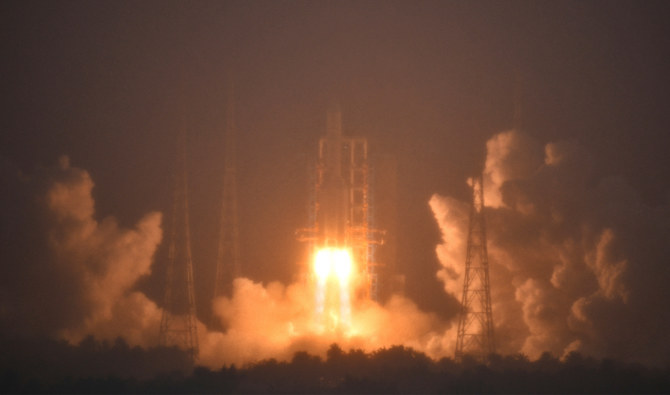
In this photo provided by China's Xinhua News Agency, a Long March-5 rocket, carrying the Chang'e-6 spacecraft, blasts off from its launchpad at the Wenchang Space Launch Site in Wenchang, south China's Hainan Province, on May 3, 2024. (Guo Cheng/Xinhua via AP/File)
Short Url
Updated 25 June 2024
Follow

Chinese lunar probe returns to Earth with world’s first samples from far side of moon

  • Chinese scientists anticipate returned samples will include 2.5-million-year-old volcanic rock, other material
  • Moon program is part of growing rivalry with US, still leader in space exploration, and others including Japan, India

BEIJING: China’s Chang’e 6 probe returned on Earth on Tuesday with rock and soil samples from the little-explored far side of the moon in a global first.

The probe landed in northern China on Tuesday afternoon in the Inner Mongolian region.

“I now declare that the Chang’e 6 Lunar Exploration Mission achieved complete success,” Zhang Kejian, Director of the China National Space Administration said shortly in a televised news conference after the landing.

Chinese scientists anticipate the returned samples will include 2.5 million-year-old volcanic rock and other material that scientists hope will answer questions about geographic differences on the moon’s two sides.

The near side is what is seen from Earth, and the far side faces outer space. The far side is also known to have mountains and impact craters, contrasting with the relatively flat expanses visible on the near side.

While past US and Soviet missions have collected samples from the moon’s near side, the Chinese mission was the first that has collected samples from the far side.

The moon program is part of a growing rivalry with the US — still the leader in space exploration — and others, including Japan and India. China has put its own space station in orbit and regularly sends crews there.

China’s leader Xi Jinping sent a message of congratulations to the Chang’e team, saying that it was a “landmark achievement in our country’s efforts at becoming a space and technological power.”

The probe left earth on May 3, and its journey lasted 53 days. The probe has drilled into the core and scooped rocks from the surface.

The samples “are expected to answer one of the most fundamental scientific questions in lunar science research: what geologic activity is responsible for the differences between the two sides?” said Zongyu Yue, a geologist at the Chinese Academy of Sciences, in a statement issued in the Innovation Monday, a journal published in partnership with the Chinese Academy of Sciences.

China in recent years has launched multiple successful missions to the moon, collecting samples from the moon’s near side with the Chang’e 5 probe previously.

They are also hoping that the probe will return with material that bear traces of meteorite strikes from the moon’s past. With the successful reentry of the probe, scientists will begin studying the samples.


UN report says Ugandan troops helped South Sudan with deadly airstrikes

Updated 5 sec ago
Follow

UN report says Ugandan troops helped South Sudan with deadly airstrikes

  • Ugandan troops are deployed in South Sudan to help the government of President Salva Kiir against forces loyal to opposition figure Riek Machar
  • The attacks cited in the UN report involved widespread use of “improvised incendiary devices,” it said

NAIROBI: Uganda helped South Sudan carry out airstrikes that killed and badly burned civilians a year ago, according to a UN inquiry.
Joint aerial bombardments by South Sudan and Uganda “targeted civilian-populated areas predominantly affecting Nuer communities in opposition-affiliated areas,” said the report by the UN Commission on Human Rights in South Sudan, referring to South Sudan’s second-largest ethnic group.
Ugandan troops are deployed in South Sudan to help the government of President Salva Kiir against forces loyal to opposition figure Riek Machar, who was suspended as vice president in September after he faced criminal charges. Ugandan military authorities say troops are in South Sudan at the invitation of the South Sudan government and in accordance with a bilateral security agreement.
While Machar is currently on trial for offenses including treason, fighting has intensified in areas seen as his strongholds, where government troops are trying to disperse the rebels.
The attacks cited in the UN report involved widespread use of “improvised incendiary devices,” it said.
Ugandan forces entered South Sudan in March 2025 with military hardware, including tanks and armored vehicles. That happened shortly after a militia overran a military garrison near the Ethiopian border.
Weeks later, Machar was placed under house arrest for his alleged role in orchestrating the attack, charges that he denies. The government has since relied on aerial attacks to gain the upper hand in a widening conflict with Machar’s forces and other armed groups.
Ugandan President Yoweri Museveni sent his army to intervene in South Sudan’s 2013-2018 civil war on multiple occasions on behalf of Kiir’s forces, helping to turn the tide in his favor. Ongoing fighting threatens a 2018 peace deal.
During one attack in March 2025 in Wunaliet, 15 kilometers (9 miles) from the capital of Juba, homes were engulfed after planes dropped “barrels of liquid that ignited,” witnesses told the UN commission. Survivors said they saw “civilians set alight, including a boy burnt beyond recognition.” A barracks, housing opposition soldiers, was also struck.
A day after the attack, Gen. Muhoozi Kainerugaba, Museveni’s son who also serves as the top military commander, posted on X that Uganda had bombed opposition forces.
“Our air offensive will not stop until Riek Machar makes peace with my uncle Afande Salva,” he wrote. While Kiir is not actually Kainerugaba’s uncle, the term shows the closeness of the two governments.
The post, which was later deleted, accompanied a video appearing to show fiery explosions captured from an in-flight aircraft.
Flight tracking data shows that a turboprop plane that circled the area during the bombing had arrived earlier that day from Uganda and was operated by the Ugandan army, the UN report said.
The report does not state conclusively how many operations Uganda was involved in or the exact nature of their involvement, only that there appeared to be “high degrees of planning, operational integration and command-level authorization.”
In November, Uganda denied participating in any combat operations in South Sudan. It has also denied using “chemical weapons and barrel bombs” and said it does not attack civilians.
Last year, Amnesty International said that Uganda had violated a 2018 UN arms embargo that prohibits member states from providing most forms of military assistance to South Sudan, including weapons and personnel. An UN panel of experts echoed that assessment in November.