

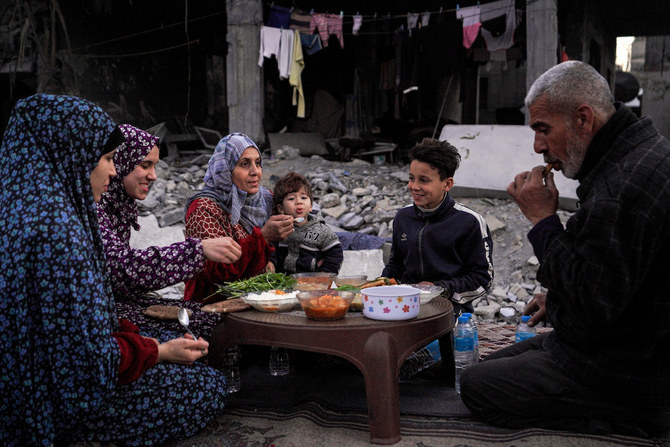

LONDON: More than 495,000 people in Gaza, representing one in five of the enclave’s population, are now facing catastrophic levels of acute food insecurity, characterized by extreme lack of food, starvation, and exhaustion, according to a forthcoming UN report.
The latest “Special Snapshot” of Gaza from the Integrated Food Security Phase Classification will be published on Tuesday, The Guardian reported.
The UN report will also reveal that more than half of Gaza’s households have had to sell or exchange clothes to buy food, as the risk of famine remains high across the territory following recent violence.
Israeli authorities have tight control over entry into Gaza, and movements require military permission. Rubble has damaged the roads, fuel is in short supply, and power and communication networks are barely functional.
At the start of the war Israel imposed a complete siege on Gaza, which has only been gradually eased under US pressure. The war has significantly reduced Gaza’s ability to produce its own food.
The IPC noted that food deliveries and nutritional services to northern Gaza increased significantly in March and April, preventing a famine and improving conditions in the territory’s south. However, the situation has deteriorated again as a result of renewed hostilities, and the risk of famine remains in the Gaza Strip as long as the conflict continues and humanitarian access is limited, according to a draft report obtained by The Guardian.
More than half of households reported frequently running out of food at home, and more than 20 percent go entire days and nights without eating, The Guardian reported. The most recent trajectory is negative and highly unstable. If this trend continues, the improvements seen in April may be quickly reversed.
UN agencies and aid organizations report difficulties in reaching Kerem Shalom border crossing due to ongoing fighting, Israeli restrictions, coordination issues with the army, and the breakdown of law and order.
Although the IPC has not officially declared a famine — which requires a stringent set of conditions — the situation in Gaza is dire. Stage 5 hunger, which affects 22 percent of Gaza’s population, is comparable to famine conditions.
A formal famine declaration requires 20 percent of households to have an extreme lack of food, 30 percent of children to suffer from acute malnutrition, and at least two adults or four children per 10,000 people to die each day.
Volker Turk, the UN high commissioner for human rights, has said that Israel’s restrictions on humanitarian aid into Gaza may constitute the war crime of deliberate starvation. The World Food Programme and the Food and Agriculture Organization have warned that by the middle of July, more than 1 million people could be dead or starving.
A joint statement from Josep Borrell, the EU’s foreign policy chief, and the European Commissioner for Crisis Management Janez Lenarcic said: “The crisis in Gaza has reached another breaking point … The delivery of any meaningful humanitarian assistance inside Gaza has become almost impossible and the very fabric of civil society is unraveling.”
Ahead of the release of the IPC’s report on Gaza, Kate Phillips-Barrasso, vice president of global policy and advocacy at Mercy Corps, said: “People are enduring subhuman conditions, resorting to desperate measures like boiling weeds, eating animal feed, and exchanging clothes for money to stave off hunger and keep their children alive.
“The humanitarian situation is deteriorating rapidly, and the specter of famine continues to hang over Gaza … Humanitarian aid is limited … The international community must apply relentless pressure to achieve a ceasefire and ensure sustained humanitarian access now. The population cannot endure these hardships any longer.”


