

Pakistani grain exporters seek government permission to export 3.9 million tons surplus wheat

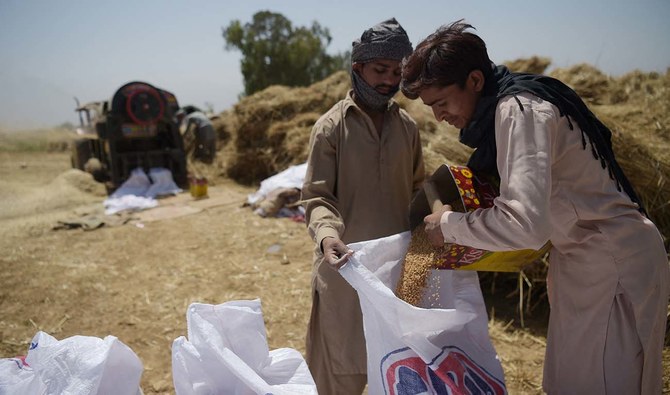
Pakistani farmers fill a sack with refined wheat after use a threshing machine during harvesting in a field on the outskirts of Islamabad on April 27, 2018. (AFP/File)
Short Url
Updated 24 June 2024
Follow

Pakistani grain exporters seek government permission to export 3.9 million tons surplus wheat

  • Pakistan’s wheat production during 2023-24 stood at 31.4 million tons compared to 28.2 million tons last year
  • National Food Security and Research Ministry official says no decision had yet been taken to allow wheat export

KARACHI: Exporters have sought permission from the government this week to export surplus wheat to neighboring and Gulf countries to stabilize local markets following a bumper crop in Pakistan.

Pakistan’s wheat production during 2023-24 stood at 31.4 million tons compared to 28.2 million tons last year, posting a growth of 11.6 percent. According to official data, the country has over 36 million tons of wheat stock including carry-forward stock. The local consumption of wheat is estimated to be around 32.2 million tons this year. 

“We have sought permission to export a million tons in the first phase including half a million tons un-milled and half a million tons in the form of by-products,” Muzammil Chappal, Chairman of the Cereal Association of Pakistan (CAP), told Arab News on Monday.

“Our members are ready to commence exports of wheat products through land and sea routes immediately and ensure no shortage locally.”

The CAP chairman, who also wrote a letter to Prime Minister Shehbaz Sharif in this regard earlier this month, said due to surplus production, Pakistan had the capacity to export 250,000 tons of flour and fine flour each and 500,000 tons of wheat.

“Currently, there are 3.92 million tons of surplus wheat in the country and that is why the farmers are not getting good prices,” Chappal said, adding that the move would help stabilize the local wheat market and also alleviate the suffering of farmers due to a high yield and low prices. 

Chappal said exporters were engaged in talks with the government, highlighting that exporting surplus wheat would give a chance to farmers to sell at good prices and also earn foreign exchange for the country. He listed all Middle Eastern countries including the United Arab Emirates as potential markets for Pakistani wheat.
 
An official of the National Food Security and Research Ministry said no decision had yet been taken to allow wheat exports as a committee formed by the government was still assessing wheat stock levels in the country.
 
“No decision has been taken to allow the export of wheat from Pakistan,” he said. “A committee has been formed to assess the stock situation of the country.” 
 
The South Asian nation has not allowed exports of wheat from Pakistan since the financial year 2019-2020 due to domestic supply concerns to ensure stable supply as wheat is crucial for national food security.
 
Earlier in May, peasant unions in Pakistan had strongly protested against the wheat crisis, which they say has been deliberately created by the former caretaker prime minister Anwaarul Haq Kakr and some bureaucrats.

Pakistani farmers had announced a nationwide protest over the wheat import crisis, demanding the government stop wheat imports that had flooded the market at a time when they expected bumper crops.

They had said the import of wheat in the second half of 2023 and the first three months of this year had resulted in excess amounts of the commodity in the country, leading to reduced prices. 

Later, PM Sharif also took notice of the matter and formed a committee under the Ministry of National Food Security and Research to address farmer grievances.
 
Official data shows that Pakistan spent over $1 billion to import 3.5 million tons of wheat during the July-May period of the current fiscal year.
 
Wheat has a 9 percent share in agriculture and 2.2 percent of the GDP is harvested in Pakistan from April to June, with peak vegetation development occurring between late March and early February. 


Pakistan Supreme Court halts trial of prominent lawyer over alleged anti-military tweets

Updated 7 sec ago
Follow

Pakistan Supreme Court halts trial of prominent lawyer over alleged anti-military tweets

  • Top court orders lower court to pause proceedings after lawyers allege due-process breaches
  • Mazari-Hazir, husband face charges under cybercrime law that carry up to 14 years in prison

ISLAMABAD: Pakistan’s Supreme Court on Thursday halted the cybercrime trial of prominent human rights lawyer Imaan Mazari-Hazir and her husband, Hadi Ali Chattha, after their lawyers argued that a lower court had recorded witness testimony in their absence, violating due-process rules.

Mazari-Hazir, one of Pakistan’s most outspoken civil liberties lawyers, and Chattha are being prosecuted under the Prevention of Electronic Crimes Act (PECA) over posts on X that authorities say incited ethnic divisions and portrayed the military as involved in “terrorism.” Both reject the allegations. If convicted under the relevant PECA provision, they face a prison term of up to 14 years.

The case has drawn broad attention in Pakistan’s legal community because Mazari-Hazir, who has been repeatedly detained over her criticism of the security establishment, argues that the trial court ignored basic procedural guarantees despite her medical leave request. The case also comes as Pakistan faces sustained scrutiny over the use of PECA against activists, journalists and political dissenters, with lawyers arguing that lower courts often move ahead without meeting minimum fair-trial standards.

The couple’s lawyer, Riasat Ali Azad, said his clients filed a petition in the Supreme Court because the lower court had moved ahead improperly.

“Today, the Supreme Court of Pakistan has stayed the lower court proceedings, the trial court proceedings and has said that the [Islamabad] High Court should decide our pending revision petition for which a date has already been fixed,” he told reporters.

Azad said the violation was clear under Pakistan’s Code of Criminal Procedure, which requires evidence to be recorded in the presence of the accused.

“Yet, on that very day, evidence of four witnesses was recorded in their absence, and a state counsel was appointed to conduct cross-examination on their behalf,” he said. “All these things are against the right to a fair trial under Articles 10 and 10-A.”

A three-judge bench led by Justice Muhammad Hashim Khan Kakar ordered the trial court to pause proceedings and instructed the Islamabad High Court to hear the couple’s pending criminal revision petition first.

The trial had been scheduled to resume on Dec.15, but the Supreme Court’s stay now freezes proceedings before both the additional sessions judge and the special PECA court. 

The Islamabad High Court is expected to hear the criminal revision petition next week.

Chattha, who is also a lawyer, said the SC ruling underscored the need for procedural safeguards.

“It is a victory for the constitution and the law,” he said, arguing that the trial court had ignored their request to re-record witness statements in their presence.