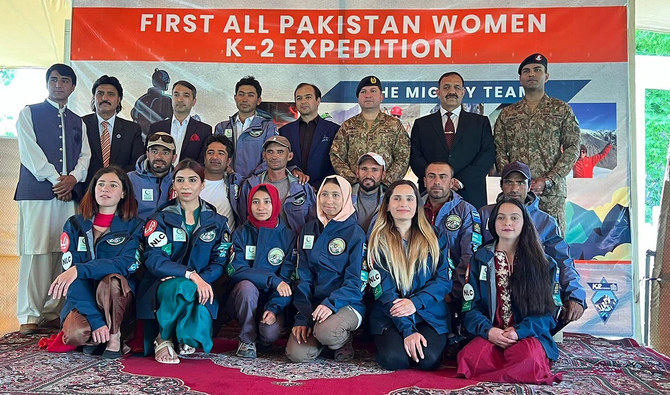

KHAPLU, GB: In a first, a six-member team of Pakistani women climbers on Monday kicked off its mission to scale the second-highest peak in the world, K2, hoping to conquer the summit and break gender stereotypes associated with women in the country.
The team features professional women climbers Anum Uzair from Lahore, sisters Amina Hanif and Siddiqa Hanif from Hushe Valley in Gilgit-Baltistan’s district Ghanche, Bibi Afzoon and Sultana Nasab from Hunza in northern Pakistan and Shama Baqir.
The 45-day expedition is being organized by Imagine Climb, a mountain trekking and climbing company operated by Pakistani climber Sirbaz Khan, and is sponsored by the Pakistan Army. Khan, who is the first and only Pakistani to have climbed 11 of the world’s 14 highest peaks, will lead the all-women team in their 45-day expedition.
Speaking to Arab News over the phone, Khan confirmed all arrangements regarding the expedition have been completed.
“Being part of an all-women team is incredibly empowering, it feels like we’re breaking barriers and challenging societal norms,” Uzair, the co-leader of the expedition, told Arab News over the phone before embarking on the expedition. “I do believe that we are paving the way for other women in Pakistan, showing them that they too can achieve great heights in any field they choose.”
Known as “Savage Mountain” among climbers, K2 in Pakistan’s northern Gilgit-Baltistan region has often been deemed a more challenging ascent than Mount Everest, the world’s highest peak. Many climbers from around the world have died in their quest to summit the mountain.
Uzair and her husband, Ahmed Uzair, became the first Pakistani husband-wife duo in September 2023 to summit Nepal’s towering Mount Manaslu. She said the challenge of climbing a mountain as dangerous as K2 had always “fascinated” her.
“The inspiration came from a deep desire to push my limits, the allure of the mountain itself and the opportunity to represent and inspire women in Pakistan,” she explained. “The idea of standing on the summit of K2, knowing the obstacles I’ve overcome, is incredibly motivating.”
The challenging expedition meant the climbers had to prepare for the journey. The team completed a one-week climbing training at Sadpara Mountaineering School earlier this month. Uzair said the biggest challenges one encounters whilst climbing towering mountains are extreme weather conditions and high-altitude sickness.
“To overcome these, I have trained extensively in similar conditions, and of course being part of the team assembled by the Pakistan Army gives me a lot of comfort,” Uzair shared. “We will also have a robust support system in place for emergencies.”
Amina Hanif, granddaughter of the late legendary Pakistani climber Little Karim, said she did not encounter difficulties in mountaineering as both her father and grandfather had worked in the same profession.
“You can say we are genetically in this field so there are no difficulties for me,” she said. “Secondly, I have summited seven mountains in Pakistan, Spain and Iran.”
The confident Hanif, however, was wary of the challenge the “Bottleneck” presented on her quest to summit K2.
The Bottleneck is a challenging and hazardous section on the K2’s climbing route. It is usually described as one of the most notorious and treacherous parts of the ascent by the mountaineering community.
“For K2 the most dangerous part is the Bottleneck,” Hanif said. “If we manage to cross it, we will be able to summit K2, God willing.”
Hanif requested Pakistani men to support the women in their lives and help them accomplish their goals and objectives.
“Please support them, they [girls] can do anything like men,” Hanif said.
Uzair, meanwhile, said that by summitting K2, she hoped to send the message that “nothing is impossible” for Pakistani women.
“With determination, hard work, and support, you can overcome any obstacle,” she said. “I hope to inspire young girls and women to dream big, pursue their passions, and believe in their potential.”