

Pakistan top court hears reserved seats petitions filed by ex-PM Khan-backed party

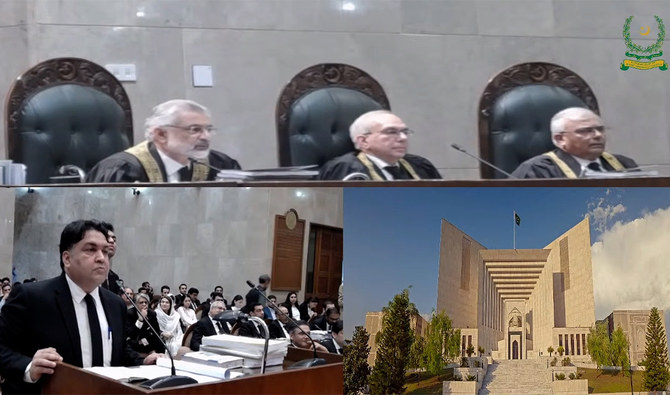
Pakistan’s top court is hearing a significant political case involving petitions that challenge the denial of reserved seats in parliament to the Sunni Ittehad Council (SIC), a party backed by the country’s jailed former prime minister Imran Khan in Islamabad, Pakistan on June 24, 2024. (Supreme Court of Pakistan)
Short Url
Updated 24 June 2024
Follow

Pakistan top court hears reserved seats petitions filed by ex-PM Khan-backed party

  • Pakistan’s election regulator denied these seats for women and minorities to Sunni Ittehad Council after Feb. polls
  • Outcome of the case may impact National Assembly’s composition, influencing how the government functions

ISLAMABAD:  Pakistan’s top court resumed hearing a significant political case today, Monday, involving petitions that challenge the denial of reserved seats in parliament to the Sunni Ittehad Council (SIC), a party backed by the country’s jailed former prime minister Imran Khan.

These seats for women and minorities in Pakistan’s national and provincial legislatures, constitutionally reserved for greater political inclusion, are allocated to various political factions on a proportional basis after considering the number of general seats won by them during elections.

Leaders from Khan’s Pakistan Tehreek-e-Insaf (PTI) were compelled to contest the national polls in February as independent candidates after being deprived of their party symbol, the cricket bat, by the Supreme Court of Pakistan due to internal elections deemed flawed.

The PTI-backed independent candidates won the maximum number of seats, emerging as the single largest bloc in the National Assembly, but chose to join the SIC in the absence of their original party identity. However, the Election Commission of Pakistan (ECP) decided not to allocate the reserved seats to them on technical grounds, instead distributing the SIC’s share among other parties.

SIC counsel Faisal Siddiqui presented his arguments before a 13-member bench of the apex court headed by Chief Justice Qazi Faez Isa on Monday. Justice Isa remarked during the hearing that despite the ECP’s decision to strip it off its iconic bat symbol, the PTI continued to remain a registered party even then. 

“PTI continued to exist [as a political party] after the decision, continues to exist today,” Justice Isa said, wondering why independent candidates did not join the PTI, and then put forth the demand for reserved seats. 

“Didn’t you (PTI) commit suicide yourself,” Justice Isa asked Siddiqui, referring to the PTI. “You could have simply said we want to join PTI. End of story.”

When Siddiqui promptly said no, Justice Isa informed him that he had a “great conflict of interest” in the case and he should make clear to the court whether he was representing the SIC or the PTI, which were two separate entities.

The outcome of the case can be politically significant since it may impact the National Assembly’s composition, influencing how legislations are passed and the government functions.
Khan’s party says it is hopeful of winning 78 reserved seats in parliament given to the rival parties after the elections.

Khan, has been in jail since August 2023 after being convicted by a local court on corruption charges, accused the ECP of stripping the PTI of the bat symbol in its bid to keep the party from winning the polls. The Pakistani election regulator has denied the party’s allegations. 


Curfew extended in Gilgit-Baltistan, probe ordered after deadly Khamenei protests

Updated 03 March 2026
Follow

Curfew extended in Gilgit-Baltistan, probe ordered after deadly Khamenei protests

  • At least 15 people were killed in clashes with law enforcement agencies over the weekend in Gilgit-Baltistan
  • Government also announces a de-weaponization campaign, crackdown on hate speech and cybercrime in region

ISLAMABAD: The government in Pakistan’s Gilgit-Baltistan (GB) region on Tuesday extended a curfew in Gilgit district and ordered a judicial probe into violent protests over the killing of Iranian Supreme Leader Ali Khamenei in US-Israeli strikes last week, an official said.

At least 15 people were killed in clashes with law enforcement agencies over the weekend in GB, where protesters torched and vandalized several buildings, including United Nations regional offices, an army-run school, software technology park and a local charity building.

The violence prompted regional authorities to impose curfew in Gilgit and Skardu districts on March 2-4 as officials urged people to stay indoors and cooperate with law enforcers, amid widespread anger in Pakistan, particularly among members of the Shiite minority, over Khamenei’s killing.

On Tuesday, the GB government convened to review the situation and announced the extension of curfew in Gilgit among a number of security measures as well as ordered the establishment of a judicial commission to investigate the weekend violence in the region.

“The government has made it clear that the law will strictly take its course against elements involved in vandalism at government institutions, private properties and incidents of vandalism in Gilgit and Skardu and no kind of mischief will be tolerated,” Shabbir Mir, a GB government spokesperson, said in a statement.

“In view of the security situation, curfew will remain in force in Gilgit, while the decision to extend the curfew in Skardu will be taken keeping the ground realities and the changing situation in view.”

The statement did not specify how long the curfew will remain in place in Gilgit.

Besides the formation of the judicial commission to investigate the violent clashes, the government also decided to launch a large-scale de-weaponization campaign in the entire Gilgit district, for which relevant institutions have been directed to immediately complete all necessary arrangements, according to Mir.

In addition, a crackdown has been ordered on hate speech, spread of fake news and cybercrime.

“The aim of these decisions is to ensure the rule of law, protect the lives and property of citizens and crack down on miscreants,” he said. “Approval has also been given to immediately survey the affected infrastructure and start their restoration work on priority basis.”

Demonstrators in Pakistan’s southern port city of Karachi also stormed the US Consulate on Sunday, smashing windows and attempting to burn the building. Police responded with batons, tear gas, and gunfire, leaving 10 people dead and more than 50 injured.

Pakistani authorities have since beefed up security at US diplomatic missions across the country, including around the US consulate building in Peshawar, to avoid any further violence.