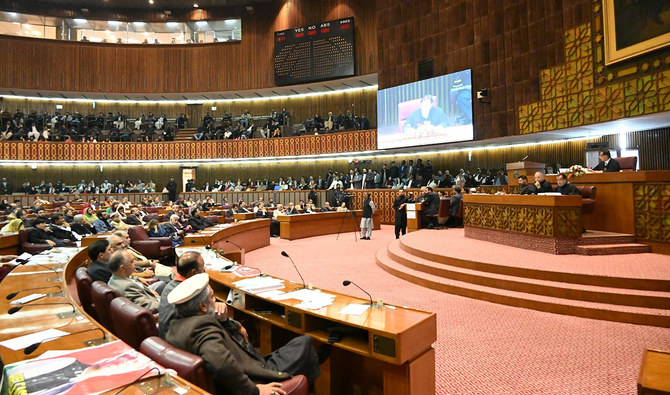
ISLAMABAD: The National Assembly of Pakistan passed a resolution on Sunday condemning recent mob lynching incidents in Punjab and Khyber Pakhtunkhwa (KP) provinces, while urging relevant authorities to ensure the safety of all citizens, including religious minorities, and bring perpetrators of such violence to justice.
The development follows the recent torture and killing of a local tourist in the picturesque Swat valley of KP, accused of desecrating the Holy Qur’an, whose body was then set alight by a furious mob.
During Saturday’s parliamentary debate, Federal Minister for Planning and Development Ahsan Iqbal emphasized this was not an isolated incident, but part of a troubling series of violent acts committed in the name of religion.
Earlier today, Pakistan’s Defense Minister Khawaja Muhammad Asif echoed the concern, urging the National Assembly to adopt a clear stance on the issue.
“The House believes that right to life is the most cherished right as enshrined in the Constitution of Pakistan,” the resolution presented by Law Minister Azam Nazeer Tarar said. “Every person is to be dealt with in accordance with the law and not otherwise.”
“This House takes serious notice of the recent mob lynchings of our citizens accused of offenses in Swat and Sargodha,” it continued. “It is noted with grave concern that such incidents have recently increased in different parts of the country. The House strongly condemns these horrific and tragic incidents which cannot be tolerated in any civilized society.”
The resolution urged the federal and provincial governments to ensure “the safety and security of all our citizens, including religious minorities and other vulnerable segments of society.”
Referring to another incident where a Christian man was targeted by his enraged neighbors in Punjab’s Sargodha district over blasphemy allegation, the resolution asked Punjab and KP administrations to “take all necessary measures to ensure that persons involved in these incidents are identified, investigated and prosecuted under the relevant laws.”
“The House also expects that the courts shall ensure immediate and speedy justice in these cases,” it added.
The KP police have formed a joint investigation team to investigate the Swat incident and arrest all involved individuals using CCTV footage.
Mob lynchings are not uncommon in Pakistan where even a mere accusation of blasphemy can lead to violence.
In case of Swat, mob members killed the tourist after storming the police station where he was detained, pulling him out and taking him away.


![]()

National Assembly passes resolution against mob lynchings in Pakistan, demands citizen safety
Short Url
https://arab.news/2ddpe
National Assembly passes resolution against mob lynchings in Pakistan, demands citizen safety
- The development follows the killing of a local tourist in Swat on the accusation of desecrating the Holy Qur’an
- Pakistani lawmakers say violent acts committed in the name of religion have become a norm in the country
Latest updates



© 2026 SAUDI RESEARCH & PUBLISHING COMPANY, All Rights Reserved And subject to Terms of Use Agreement.