

Gunmen kill 15 police officers, priest and multiple civilians in Russia’s southern Dagestan region

1 / 4
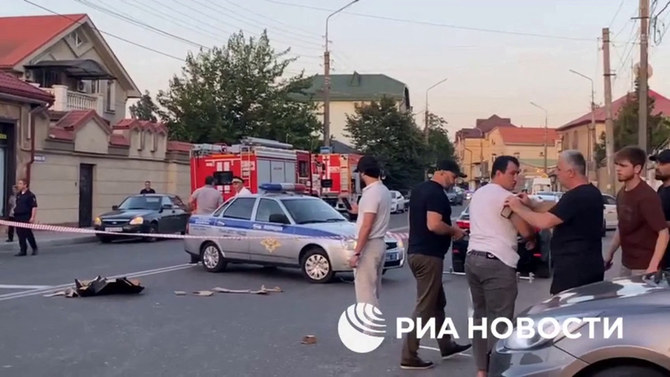
This screengrab picture taken from video released on June 23, 2024 by Russian state news agency RIA Novosti shows an area sealed off by police following deadly attacks on churches and a synagogue in Russia's North Caucasus region of Dagestan. (RIA Novosti via AFP)
2 / 4
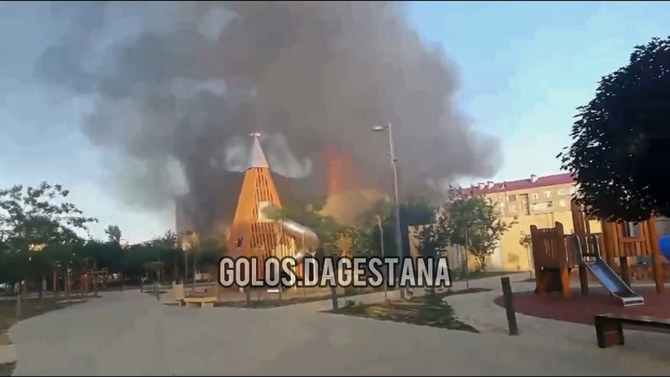
This photo taken from video released by Golos Dagestana shows smoke rises following an attack in Makhachkala, republic of Dagestan, Russia, on June 23, 2024. (Golos Dagestana via AP)
3 / 4
This screengrab picture taken from video released on June 23, 2024 by Russian state news agency RIA Novosti shows an area sealed off by police following deadly attacks on churches and a synagogue in Russia's North Caucasus region of Dagestan. (RIA Novosti via AFP)
4 / 4
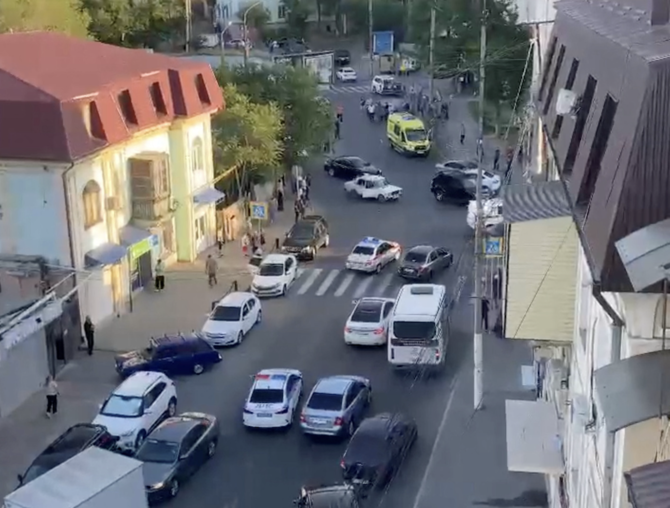
A view shows emergency service vehicles on the street of Makhachkala in southern Russia, June 23, 2024, in this still image obtained from a video. (Reuters) 
Short Url
Updated 24 June 2024
Follow

Gunmen kill 15 police officers, priest and multiple civilians in Russia’s southern Dagestan region

  • Gunmen targetted two Orthodox churches, a synagogue and a police post in two cities
  • Six of the gunmen were shot and killed as the incidents unfolded, says governor

MOSCOW: Gunmen opened fire at a synagogue, an Orthodox church and a police post in attacks across two cities in Russia’s North Caucasus region of Dagestan on Sunday, killing an Orthodox priest and multiple police officers, the region’s head said.
“This is a day of tragedy for Dagestan and the whole country,” Sergei Melikov, governor of the Dagestan region, said in a video published early on Monday on the Telegram messaging app.
Melikov said that more than 15 police officers “fell victim” to what he said was a “terrorist attack,“” but he did not specify how many of the police were killed and how many were injured. Russia’s Interfax agency reported that at least 15 police officers were killed.
The simultaneous attacks across the cities of Makhachkala and Derbent came three months after 145 people were killed in an attack claimed by the Daesh (Islamic State) on a concert hall near Moscow, Russia’s worst terrorist attack in years.
There was no immediate claim of responsibility for the attacks in the volatile North Caucasus region.
“We understand who is behind the organization of the terrorist attacks and what goal they pursued,” Melikov said, without disclosing further details.

Six of the gunmen were shot and killed as the incidents unfolded, Melikov said. Russian state news agencies cited the National Anti-Terrorist Committee as saying that five of the gunmen had been killed.

Russia’s state media cited law enforcement as saying that among the attackers had been two sons of the head of central Dagestan’s Sergokala district, who had been detained by investigators.
Melikov said that among the dead, in addition to the police officers, were several civilians, including an Orthodox priest who worked in Derbent for more than 40 years. A spokesman for the Russian Orthodox Church said on Telegram that the priest, Nikolai Kotelnikov, was “brutally murdered.”
Dagestan’s RGVK broadcaster said Kotelnikov had served more than 40 years in Derbent.
“The synagogue in Derbent is on fire,” the chairman of the public council of Russia’s Federation of Jewish Communities, Boruch Gorin wrote on Telegram.
“It has not been possible to extinguish the fire. Two are killed: a policeman and a security guard.”
He added: “The synagogue in Makhachkala has also been set on fire and burnt down.”

Days of mourning
June 24-26 have been declared days of mourning in Dagestan, Melikov said, with flags lowered to half-staff and all entertainment events canceled.
The restive region was in the 2000s hit by an Islamist insurgency spilling over from neighboring Chechnya, with Russian security forces moving aggressively to combat extremists in the region.
In recent years, attacks had become rarer, with Russia’s Federal Security Service (FSB) saying in 2017 that it had defeated the insurgency in the region.
The agencies reported exchanges of gunfire in the center of Makhachkala. They cited the interior ministry as saying that exits from the Caspian Sea port of around 600,000 had been closed, and that conspirators who were still at large may yet attempt to flee the city.
About 125 km (75 miles) south of Makhachkala, gunmen attacked a synagogue and a church in Derbent, home to an ancient Jewish community and a UNESCO World Heritage site. Authorities were quoted as saying that both the synagogue and church were ablaze, and that two attackers had been killed.
Russian media cited the head of the country’s federation of Jewish communities as calling for people to avoid reacting to “provocations.”
In Israel, the Foreign Ministry said the synagogue in Derbent had been burned to the ground and shots had been fired at a second synagogue in Makhachkala. The statement said it was believed there were no worshippers in the synagogue at the time.
Russian authorities have pointed to militant Muslim elements in previous incidents in the region.
In October, after the war in Gaza broke out, rioters waving Palestinian flags broke down glass doors and rampaged through Makhachkala airport to look for Jewish passengers on a flight arriving from Tel Aviv.
Russian President Vladimir Putin accused the West and Ukraine of stirring up unrest inside Russia in connection with the incident.

Russia’s FSB security service in April said it had arrested four people in Dagestan on suspicion of plotting a deadly attack on Moscow’s Crocus City Hall concert venue in March, which was claimed by Daesh.
Militants from Dagestan are known to have traveled to join the Daesh group in Syria.
In 2015, the group declared it had established a “franchise” in the North Caucasus.
Dagestan lies east of Chechnya where Russian authorities battled separatists in two brutal wars, first in 1994-1996 and then in 1999-2000.
After the defeat of Chechen insurgents, Russian authorities have been locked in a simmering conflict with militants from across the North Caucasus that has killed scores of civilians and police.


Russia and Ukraine trade attacks as US and European officials prepare for peace talks

Updated 14 December 2025
Follow

Russia and Ukraine trade attacks as US and European officials prepare for peace talks

Moscow pounded Ukrainian power infrastructure with drone and missile strikes on Saturday and Kyiv launched a deadly strike of its own on southwestern Russia, a day before talks involving senior European and US officials aimed at ending the war were set to resume.
Ukrainian President Volodymyr Zelensky said Ukrainian, US and European officials will hold a series of meetings in Berlin in the coming days, adding that he will personally meet with US President Donald Trump’s envoys.
“Most importantly, I will be meeting with envoys of President Trump, and there will also be meetings with our European partners, with many leaders, concerning the foundation of peace — a political agreement to end the war,” Zelensky said in an address to the nation late Saturday.
Trump’s special envoy Steve Witkoff and his son-in-law Jared Kushner are traveling to Berlin for the talks, according to a White House official, who spoke on condition of anonymity.
American officials have tried for months to navigate the demands of each side as Trump presses for a swift end to Russia’s war and grows increasingly exasperated by delays. The search for possible compromises has run into major obstacles, including which combatant will get control of Ukraine’s eastern Donbas region, which is mostly occupied by Russian forces.
“The chance is considerable at this moment, and it matters for our every city, for our every Ukrainian community,” Zelensky said. “We are working to ensure that peace for Ukraine is dignified, and to secure a guarantee — a guarantee, above all — that Russia will not return to Ukraine for a third invasion.”
As diplomats push for peace, the war grinds on.
Russia attacked five Ukrainian regions overnight, targeting the country’s energy and port infrastructure. Zelensky said the attacks involved more than 450 drones and 30 missiles. And with temperatures hovering around freezing, Ukraine’s interior minister, Ihor Klymenko, said more than a million people were without electricity.
An attack on Odesa caused grain silos to catch fire at the coastal city’s port, Ukrainian deputy prime minister and reconstruction minister Oleksiy Kuleba said. Two people were wounded in attacks on the wider Odesa region, according to regional head Oleh Kiper.
Kyiv and its allies say Russia is trying to cripple the Ukrainian power grid and deny civilians access to heat, light and running water for a fourth consecutive winter, in what Ukrainian officials call “weaponizing” the cold.
The drone attack in Russia’s Saratov region damaged a residential building and killed two people, said the regional governor, Roman Busargin, who didn’t offer further details. Busragin said the attack also shattered windows at a kindergarten and clinic. Russia’s Defense Ministry said it shot down 41 Ukrainian drones over Russian territory overnight.
On the front lines, Ukrainian forces said Saturday that the northern part of Pokrovsk was under Ukrainian control, despite Russia’s claims this month that it had taken full control of the critical city. The Associated Press was not able to independently verify the claims.
The latest attacks came after Kremlin foreign affairs adviser Yuri Ushakov reaffirmed Friday that Moscow will give its blessing to a ceasefire only after Ukraine’s forces have withdrawn from parts of the Donetsk region that they still control.
Ukraine has consistently refused to cede the remaining part of the region to Russia.
Ushakov told the business daily Kommersant that Russian police and national guard troops would stay in parts of eastern Ukraine’s Donbas even if they become a demilitarized zone under a prospective peace plan — a demand likely to be rejected by Ukraine as US-led negotiations drag on.
Ushakov warned that a search for compromise could take a long time, noting that the US proposals that took into account Russian demands had been “worsened” by alterations proposed by Ukraine and its European allies.
“We don’t know what changes they are making, but clearly they aren’t for the better,” Ushakov said, adding: “We will strongly insist on our considerations.”
In other developments, about 480 people were evacuated Saturday from a train traveling between the Polish city of Przemysl and Kyiv after police received a call concerning a threat on the train, Karolina Kowalik, a spokesperson for the Przemysl police, told The Associated Press. Nobody was hurt and she didn’t elaborate on the threat.
Polish authorities are on high alert since multiple attempts to disrupt trains on the line linking Warsaw to the Ukrainian border, including the use of explosives in November, with Polish authorities saying they have evidence Russia was behind it.