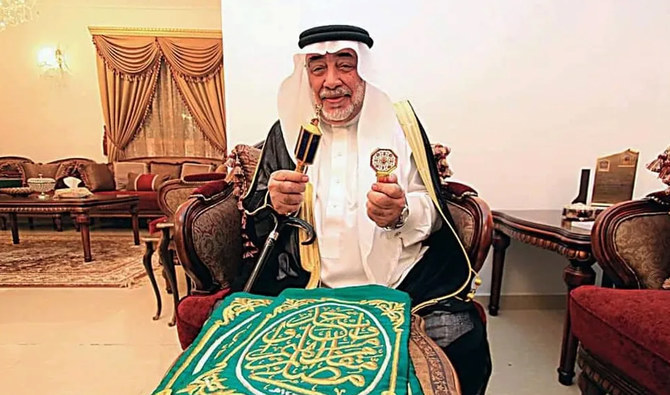
MAKKAH: Dr. Saleh bin Zain Al-Abidin Al-Shaibi, the senior caretaker of the Kaaba, died in Makkah on Friday evening. Funeral prayers were held after Fajr on Saturday at the Grand Mosque.
Al-Shaibi, who held a doctorate in Islamic studies, was a university professor and an author of several works on creed and history. He was the 77th key holder of the Kaaba since the conquest of Makkah.
His responsibilities included opening and closing the Kaaba, cleaning, washing, repairing its Kiswa (covering), and welcoming visitors. He took over the guardianship after the death of his uncle, Abdulqader Taha Al-Shaibi, in 2013.
His son, Abdulrahman Saleh Al-Shaibi, told Arab News that saying farewell to his father was one of the hardest and saddest moments of his life. He added that the family accepted Allah’s will for a man who was always close to everyone and dedicated his life to serving the family.
He went on to say that his father had been suffering from illness recently but had remained patient and steadfast. The entire community shared in the family’s grief and expressed their sorrow and pain for the loss of the Al-Shaibi family’s pillar.
Al-Shaibi chaired the Department of Creed at Umm Al-Qura University for over two decades. Known for his scholarly approach and love for knowledge, he explored religious and doctrinal issues deeply. An academic at heart, he left a significant and lasting impact.
King Fahd bin Abdulaziz appointed him to the Saudi Shoura Council, and Al-Shaibi served as the deputy to his uncle in the guardianship of the Kaaba until becoming senior caretaker.
His son Abdulrahman added that he had served as his father’s deputy in the guardianship of the Kaaba for five years, after which his cousin Abdulmalik Al-Shaibi had taken over.
He said that his father had wished him to hold the guardianship and the key to the Kaaba after him. However, if this wish is not honored, the guardianship and the key will be handed over to his uncle Abdulwahab Al-Shaibi.
Nizar Al-Shaibi, the cousin of the deceased, told Arab News that it was a sad day for the family. However, the outpouring of love, solidarity, and support from all segments of society, who had rushed to offer their condolences, had helped to ease the burden of their grief.
They had expressed their gratitude for the life of the deceased, who had dedicated his life to the guardianship of the Kaaba and enhancing its reverence.
The General Presidency for the Affairs of the Grand Mosque and the Prophet’s Mosque mourned the death of Sheikh Dr. Saleh bin Zain Al-Abidin Al-Shaibi.
It said in a statement: “With hearts content with God’s decree, the General Presidency for the Affairs of the Grand Mosque and the Prophet’s Mosque and all its employees extend their deepest condolences to the family of the deceased, Sheikh Dr. Saleh bin Zain Al-Abidin Al-Shaibi, the senior caretaker of the Holy Kaaba.”
Khaled Al-Husseini, a writer and expert on Makkah’s affairs, expressed his deep sorrow over the death.
Al-Husseini described Al-Shaibi as a man of knowledge and learning, who, alongside his honored role in the guardianship of the Kaaba, was a scholar, academic, and lecturer at Umm Al-Qura University. He had generously shared his knowledge with successive generations which had benefited from his expertise over 20 years.


![]()

Saleh Al-Shaibi, senior caretaker of the Kaaba, dies
Short Url
https://arab.news/6bvbu
Saleh Al-Shaibi, senior caretaker of the Kaaba, dies
- Funeral prayers held after Fajr on Saturday at the Grand Mosque
- His responsibilities included opening and closing the Kaaba, cleaning, washing, repairing its Kiswa (covering), and welcoming visitors


Latest updates


Recommended


© 2026 SAUDI RESEARCH & PUBLISHING COMPANY, All Rights Reserved And subject to Terms of Use Agreement.