

Kaaba kiswa raised ahead of Hajj

1 / 5
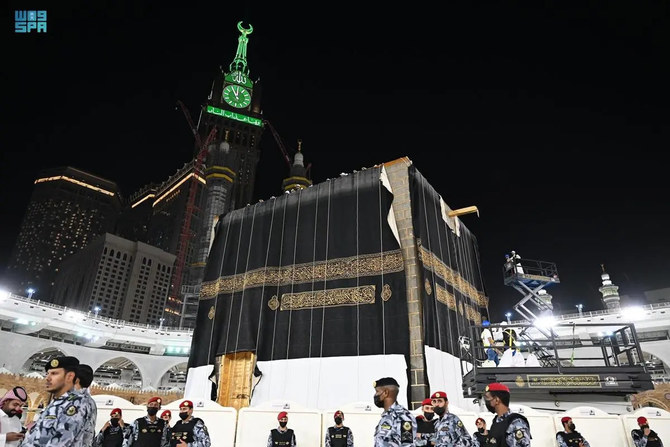
Security personnel secure the Kaaba on Wednesday as a special technical team prepare to raise the kiswa cover. (SPA)
2 / 5
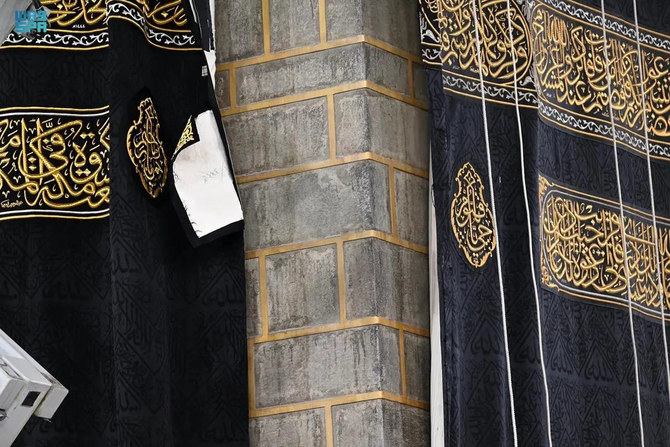
Specialized technicians are seen at work at the Kaaba on Wednesday, raising the special cover to keep it from being soiled and damaged. (SPA)
3 / 5
Technicians are seen at work at the Kaaba on Wednesday, raising the special cover to keep it from being soiled and damaged. (SPA)
4 / 5
Technicians are seen at work at the Kaaba on Wednesday, raising the special cover to keep it from being soiled and damaged. (SPA)
5 / 5
Technicians are seen at work at the Kaaba on Wednesday, raising the special cover to keep it from being soiled and damaged. (SPA)
Short Url
Updated 23 May 2024
Follow

Kaaba kiswa raised ahead of Hajj

  • The procedure is meant to keep the cover, known as kiswa, free from getting soiled and tampered with as pilgrims performing Hajj circumabulate the Kaaba

RIYADH: In keeping with the annual tradition, officials raised the lower part of the kiswa — the elaborately designed black cloth covering the Kaaba — in Makkah on Wednesday ahead of this year's Hajj pilgrimage.

As approved by the General Authority for the Care of the Affairs of the Two Holy Mosques, the exposed part was covered with a white cotton fabric, two-and-a-half meters wide and 54 meters long on all four sides, according to the Saudi Press Agency.

Carrying out the procedure were 36 specialized technical personnel with the aid of 10 cranes.

As described in the SPA report, the kiswa is lifted in several stages: It starts with unscrewing the bottom of the cover from all sides, separating the corners, then untying the bottom rope and removing it from the fixing rings, after which the cloth is rolled upward. The lanterns are then dismantled and the white cloth are put in place, after which the lanterns are reinstalled over the white cloth until the final stage.

The procedure is repeated every year to protect the kiswa from getting soiled and damaged as pilgrims circumambulate the Kaaba.

The annual Hajj in Saudi Arabia is considered the world's largest human gathering, with year 2012 marking the biggest number of participants at 3.16 million.

At the height of the COVID-19 pandemic, Saudi authorities allowed only a symbolic observance of Hajj with just a thousand pilgrims. The numbers were gradually raised as the health crisis was placed under control worldwide. Last year, almost 1.84 million pilgrims performed the "once in a lifetime" journey and the figure is expected to go higher this year.

Every year, on the ninth day of the Islamic month of Dul Hijjah, the black silk cloth is removed and a new kiswa is draped in its place.


Saudi hospitality boom sparks innovation beyond the plate

Chefs at Julien prepare meals to pair with Diageo drinks. (AN photo by Basmah Albasrawi)
Updated 11 January 2026
Follow

Saudi hospitality boom sparks innovation beyond the plate

  • At the Four Seasons Riyadh, Diageo hosted a private tasting at Tonic Bar followed by a 10-course dinner at Julien
  • Dinner at Julien paired dishes with drinks made using Tanqueray 0.0, Captain Morgan 0.0, and Guinness 0.0

RIYADH: As restaurants and hotels in Saudi Arabia refine their culinary identities, beverages are increasingly being treated as crafted experiences in their own right, shaped by technique and intention.

At the Four Seasons Riyadh, Diageo hosted a private tasting at Tonic Bar followed by a 10-course dinner at Julien, offering a snapshot of how this evolution is beginning to take shape, as international players and local venues test new approaches to pairing and presentation. 

Speaking to Arab News, Nick Rees, marketing director of Diageo MENA, pointed to the rapid growth of the nonalcoholic segment globally and in the region: “There’s a far faster growing percentage of it (the industry) is non-alcohol … There (are) trends globally … A lot of it will be pointed to wellness, mindful drinking.”

Rees said that Saudi Arabia’s fast-developing culinary and hospitality scene calls for beverages that match the level of excellence seen in kitchens across the Kingdom.

“It’s kind of the lack of choices and that’s where we want to be able to provide people the option, and people here absolutely have the same kind of talent and desire as their counterparts behind the kitchen,” he said.

“That’s where our role is to give people the kind of core ingredients for them to be able to work with … we have many more brands that we would love to introduce to the Kingdom.”

The dinner at Julien paired dishes with drinks made using Tanqueray 0.0, Captain Morgan 0.0, and Guinness 0.0, offering a glimpse into the range of styles Diageo is bringing to the market.

Flavor profiles ranged from light and refreshing combinations with cucumber and capers brine to richer, malt-forward blends, each designed to complement the accompanying dishes, from ravioli to black cod. 

Rees emphasized that pairing food with thoughtfully crafted beverages is becoming an essential part of the hospitality experience. 

“In the Kingdom, we’re looking at giving people the experience that currently is not available to them because I know for sure that the kind of quality and expertise and craftsmanship that can go into creating some of these drinks is absolutely as exciting as the work that the chefs would do with their food,” he said.

Anthony Abou Haider, head of Gulf at Diageo, said the company sees long-term potential in Saudi Arabia’s hospitality sector. 

“It’s such an opportunity to be a part of this transformation journey,” he told Arab News. “We’re not looking for a short-term gain, we’re looking at a very long-term gain here because whatever we do now is building for the future.”