KYIV: Russian guided bombs struck an apartment building in Ukraine’s second largest city of Kharkiv, on Saturday, killing three people, injuring 29 and prompting President Volodymyr Zelensky to call for more help from Kyiv’s allies.
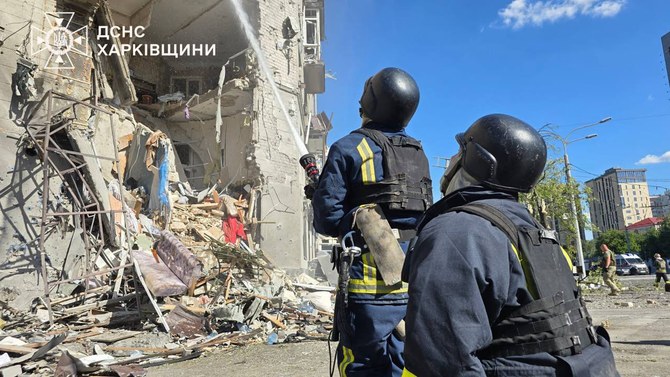
Pictures posted online showed parts of an apartment building in ruins, with windows smashed, balconies shattered and rubble strewn about a crater on the ground.
Interior Minister Ihor Klymenko put the casualty toll at three dead and 29 injured in the mid-afternoon attack. Regional governor Oleh Syniehubov said two children were among the injured and four of those hurt were in serious condition.
“This Russian terror through guided bombs must be stopped and can be stopped,” Zelensky wrote on Telegram.
“We need strong decisions from our partners to enable us to stop the Russian terrorists and Russian military aviation right where they are.”
Syniehubov said rescue work was proceeding. Other civilian targets had also been hit and public transport halted.
Mayor Ihor Terekhov said there had been four strikes.
Kharkiv lies about 30 km (20 miles) from the border with Russia. The city of about 1.3 million people has frequently been targeted in Russian attacks during nearly 28 months of war.
Russia has relied increasingly on the use of the bombs, relatively inexpensive, dropped from a distance and involving fewer risks for its forces.

Russian bomb attack kills three, injures 29 in Ukraine’s Kharkiv
https://arab.news/vepnd
Russian bomb attack kills three, injures 29 in Ukraine’s Kharkiv
- Interior Minister Ihor Klymenko put the casualty toll at three dead and 29 injured
- “This Russian terror through guided bombs must be stopped and can be stopped,” Zelensky wrote on Telegram
Prabowo, Trump expected to sign Indonesia-US tariff deal in January 2026
- Deal will mean US tariffs on Indonesian products are cut from a threatened 32 percent to 19 percent
- Jakarta committed to scrap tariffs on more than 99 percent of US goods
JAKARTA: Indonesia expects to sign a tariff deal with the US in early 2026 after reaching an agreement on “all substantive issues,” Jakarta's chief negotiator said on Tuesday.
Indonesia’s Coordinating Minister for Economic Affairs Airlangga Hartarto met with US trade representative Jamieson Greer in Washington this week to finalize an Indonesia-US trade deal, following a series of discussions that took place after the two countries agreed on a framework for negotiations in July.
“All substantive issues laid out in the Agreement on Reciprocal Trade have been agreed upon by the two sides, including both the main and technical issues,” Hartarto said in an online briefing.
Officials from both countries are now working to set up a meeting between Indonesian President Prabowo Subianto and US President Donald Trump.
It will take place after Indonesian and US technical teams meet in the second week of January for a legal scrubbing, or a final clean-up of an agreement text.
“We are expecting that the upcoming technical process will wrap up in time as scheduled, so that at the end of January 2026 President Prabowo and President Trump can sign the Agreement on Reciprocal Trade,” Hartarto said.
Indonesian trade negotiators have been in “intensive” talks with their Washington counterparts since Trump threatened to levy a 32 percent duty on Indonesian exports.
Under the July framework, US tariffs on Indonesian imports were lowered to 19 percent, with Jakarta committing to measures to balance trade with Washington, including removing tariffs on more than 99 percent of American imports and scrapping all non-tariff barriers facing American companies.
Jakarta also pledged to import $15 billion worth of energy products and $4.5 billion worth of agricultural products such as soybeans, wheat and cotton, from the US.
“Indonesia will also get tariff exemptions on top Indonesian goods, such as palm oil, coffee, cocoa,” Hartarto said.
“This is certainly good news, especially for Indonesian industries directly impacted by the tariff policy, especially labor-intensive sectors that employ around 5 million workers.”
In the past decade, Indonesia has consistently posted trade surpluses with the US, its second-largest export market after China.
From January to October, data from the Indonesian trade ministry showed two-way trade valued at nearly $36.2 billion, with Jakarta posting a $14.9 billion surplus.